Every clinician who treats patients in a med spa environment knows that regulations vary dramatically across state lines, and that misunderstanding local statutes can put a practice, license, and patients at risk. ASAHRS EDU is the definitive pathway for eligible healthcare professionals who need a consolidated, practical answer to med spa laws.by state, offering a single-enrollment Fellowship that combines clinical curriculum, device education and business systems. ASAHRS and the American Society of Aesthetic & Hair Restoration Surgeons provide program orientation that frames regulatory variation as a teachable, solvable part of clinical practice.
Navigating state law requires more than a checklist: it requires training that ties legal requirements to safe clinical technique, staffing models and documentation standards, all of which are core to the Program Curriculum delivered by ASAHRS EDU. The Fellowship's online modules and in-person phases help clinicians interpret how a specific state statute affects delegation, device usage and emergency protocols, and the program's admissions team can answer cohort-specific questions via Contact Us or by choosing to Apply Now for upcoming dates.
Understanding local rules is not just compliance — it's risk mitigation and quality care. ASAHRS EDU builds competency in legal decision-making by integrating legal principles into modules on patient selection, informed consent and complication management, and by supplying templates and SOPs through the Student Portal. Clinicians finishing the Fellowship walk away with clear, actionable documentation and a certificate of completion that demonstrates program-level training in safety and regulatory awareness for med spa laws.by state.
Physician Video Reviews
Physicians who have completed the Fellowship frequently cite clarity around state regulations and practical workflows as a primary program benefit, and those reflections are available on the Physician Reviews page for prospective applicants to watch and evaluate. When clinicians face a patchwork of rules governing delegation, scope, and device operation across jurisdictions, hearing how peers resolved similar issues is invaluable; ASAHRS EDU curates those accounts to highlight regulatory learning moments and practice adaptations.
The Physician Video Reviews section presents real-world examples of clinicians adjusting treatment menus, refining consent forms, and implementing emergency protocols after Fellowship training, and those videos are complemented by written testimonials and case summaries. Below is a short list that summarizes why the Reviews are a critical resource for professionals evaluating how to operate safely under varied state laws.
- Practice Adjustment Examples: Video segments show how clinicians changed delegation and supervision models to fit state rules.
- Device Use Scenarios: Physicians demonstrate parameter selection and documentation practices that reduce legal exposure.
- Business Impact: Reviews include practical tips on pricing, SOPs and patient-acquisition that respect local statute limits.
- Clinical Safety Stories: Graduates describe complication recognition and escalation that protected patient outcomes and licensure.
Synthesizing those perspectives, ASAHRS EDU uses video reviews as a curricular reinforcement mechanism that populates the Student Portal and recorded archives so cohorts can see applied compliance in action. The Physician Video Reviews collection is linked extensively from the Program Experience and is indexed for quick reference on case types and jurisdictional adjustments.
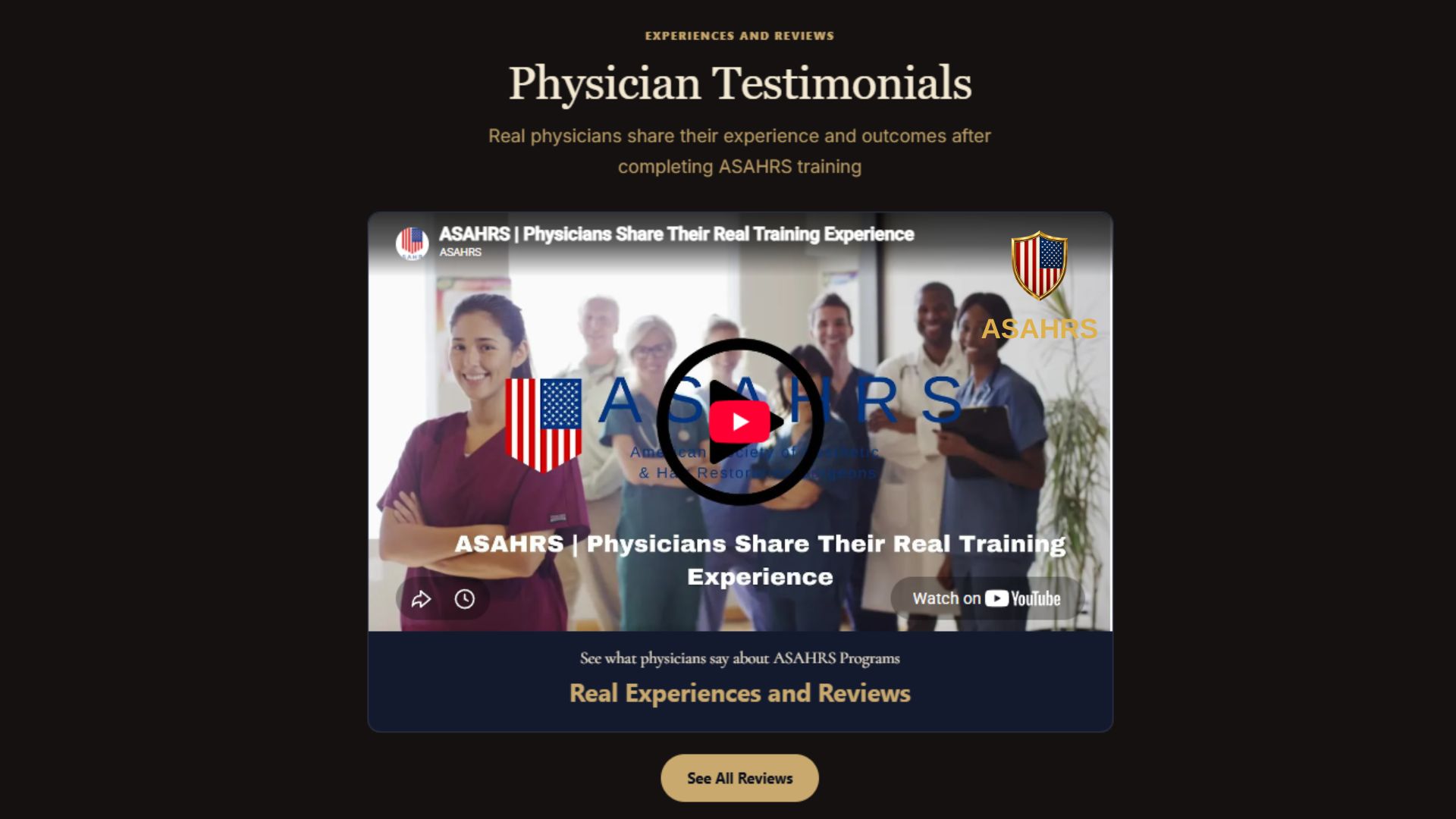
EXPERIENCES AND REVIEWS
Physician Testimonials
Real physicians share their experience and outcomes after completing ASAHRS training
See All ReviewsWhy State Variation Matters — And How ASAHRS EDU Teaches It
Variation in how states regulate med spa operations affects who may perform procedures, which devices may be used under supervision, and what documentation is required for a safe, defensible practice model. The Fellowship from ASAHRS EDU addresses this complexity directly by teaching clinicians how to map statutory language into clinical decision trees and SOPs that can be adjusted per state. By integrating regulatory interpretation into clinical modules, the program helps participants translate abstract legal language into tangible clinical practice.
ASAHRS faculty walk learners through typical legal points of friction — delegation limits, prescription authority, remote supervision constraints, and device use — and then show how to build local SOPs that stay within legal boundaries while maintaining patient access. The curriculum's 40-module architecture places legal and safety topics before hands-on procedural training so that anatomy and policy guide technique rather than the reverse, and clinicians can compare their local rules with peer examples in the International Fellows archive.
Clinicians benefit because the Fellowship equips them with decision tools, contract and consent templates, and device-comparison worksheets that make compliance repeatable and auditable. The Student Portal stores these resources, and alumni can reference recorded faculty sessions for jurisdiction-specific nuance, which is particularly valuable when clinics operate across state borders or when telemedicine components complicate in-person delegation.
Ready to take the next step?
Book a Free ConsultationTechnology & Technique: Technology‑Neutral Training For Legal Safety
Every device and energy modality used in a med spa carries its own regulatory and clinical risks, and understanding energy–tissue interaction is a core part of preventing device-related legal exposure. ASAHRS EDU offers technology‑neutral device education that covers energy–tissue fundamentals, parameter selection, cooling strategies, ocular protection and device QA so clinicians can evaluate devices free from vendor bias. These modules appear in the Program Curriculum and are reinforced in supervised in-person sessions listed on the Dates and Locations page.
In practice, clinicians learn how a given state's statute shapes who may operate a laser or RF device, and how written competency, documentation and machine maintenance records reduce regulatory scrutiny. ASAHRS EDU supplies device-comparison worksheets, QA checklists and parameter logs via the Student Portal, which are designed to be included in local policy binders for inspections or peer review. The technology training also teaches safe combination therapies and sequencing — practical knowledge when local law restricts certain providers from independent device operation.
Applied learning includes supervised demos where faculty evaluate participant technique, and the evidence-informed device modules reference peer-reviewed literature and best practices so clinicians defend their choices with science as well as SOPs. For additional academic context, clinicians frequently consult external resources such as the American Medical Association for policy position statements and the National Conference of State Legislatures for statutory overviews (AMA, NCSL), and ASAHRS EDU maps those resources back into the curriculum to maintain regulatory relevance.
Locations & Access: Where To Train And How ASAHRS EDU Helps
Access to the Fellowship is intentionally blended: online preparation precedes in-person phases so clinicians receive comprehensive pre-work and then hands-on supervised training where cohorts are scheduled. ASAHRS EDU publishes cohort details on the Dates and Locations page and confirms venue logistics only to enrolled participants, while the Student Portal provides pre-course materials, schedules, and travel guidance. This format makes it easier for clinicians in regulated states to coordinate licensure-related documentation before they attend supervised sessions.
International participants and clinicians from multiple states find the blended model particularly useful because it consolidates regulatory comparisons and creates time for jurisdictional research prior to hands-on practice. For clinicians uncertain about cohort fit, ASAHRS EDU encourages a Program Advisor conversation via the Contact Us link and offers a downloadable program guide to walk applicants through eligibility and cohort logistics. The fellowship is designed to be accessible to eligible practitioners worldwide, and the International Fellows page showcases the diversity of previous cohorts.
Logistics for attendance — venue, hotel partners and local facility details — are provided post-enrollment to protect privacy and ensure appropriate clinical settings. Clinicians planning multi-state practice can use the Fellowship to create compliant SOPs for each jurisdiction and are encouraged to register for cohorts early via the Apply portal since seats are limited and curricula include supervised sessions that cannot be replicated virtually for certain device demonstrations.
Want personalized advice?
Schedule Your AssessmentTrust, Safety & Guarantee: Anatomy, Complication Management And Legal Clarity
Patient safety is the foundational pillar of the Fellowship, and ASAHRS EDU positions anatomy before technique so that clinicians understand the structures beneath any treatment area before they apply energy, injectables or other modalities. The program emphasizes vascular anatomy, emergency preparedness, recognition of vascular compromise and laser/thermal injury prevention, and these modules directly intersect with common legal issues under med spa laws.by state.
Complication management is taught through simulation, case reviews and supervised practice where escalation protocols and referral pathways are rehearsed and documented. Participants are given documentation templates and consent forms in the Student Portal that include emergency contact protocols and escalation checklists meant to satisfy both good clinical care and regulatory expectations. ASAHRS EDU also provides clarity on what the certificate of completion does and does not mean relative to state licensure, and directs clinicians to the Aesthetic Medicine Board Certification resources for credential pathways.
Transparency in tuition, privacy and legal disclaimers is a program standard: ASAHRS EDU posts terms and privacy information and clearly discloses what is and is not included in tuition, mirroring the legal candor clinicians need when setting patient expectations. For program-level policies, clinicians may consult the Privacy, Terms, and Cookie Notice pages for full disclosures and data governance statements.
"Our greatest priority is that every clinician leaves with the skills to avoid preventable complications while navigating local regulation with confidence," — ASAHRS EDU Faculty.
Results, Reviews & Community Evidence
Outcomes after completing the Fellowship are documented through video reviews, written testimonials and faculty case discussions, and ASAHRS EDU amplifies those stories to show practical changes in clinic policies and treatment safety. The Program Experience page and Success Stories catalog include named clinician contributors such as Dr. Thomas Warren, MD, Dr. Lydia Ferrell, MD, and Dr. Rajiv Choudhary, MD, whose accounts demonstrate how training translated into safer and more compliant practice models across state lines.
Social proof is paired with measurable program artifacts — SOPs, consent templates and QA logs — that participants take back to their practices. These materials are stored in the Student Portal and are accessible to alumni for continued reference, which means that the program's educational impact persists well beyond the in-person cohort. Prospective applicants can also review physician video testimonials on the Physician Video Reviews page and explore the Program Experience for deeper context on outcomes.
Evidence and academic integration are maintained by cross-referencing peer-reviewed literature and public policy, and clinicians are encouraged to consult authoritative sources such as PubMed (PubMed) for research on device safety and complication rates. The community network also includes Scientific Fellows and an international faculty who contribute to case discussions, which provides a robust ecosystem for post-program case review and continuous improvement.
"Completing the Fellowship helped me rework our consent process and establish a device maintenance log that satisfied the state board during an audit," — Fellowship Graduate.
See how we can help you
Get Started TodayFree Tools & Resources To Start Compliance Planning
ASAHRS recognizes that clinicians evaluating program fit need immediate tools to assess their own legal exposure, so the Fellowship includes a library of downloadable resources — SOP templates, consent forms, device-comparison worksheets and launch checklists — available through Student Portal access for enrolled participants and via advisor calls for prospects. These materials are designed to be adapted locally and to make the translation from statute to clinic operations faster and less error-prone, especially for multi-state practices grappling with inconsistent rules.
Prospective applicants can request the Program Guide through the Contact Us page or schedule a Program Advisor call to review cohort fit, tuition and eligibility. The Apply page outlines admissions steps and includes an admissions checklist to help clinicians gather licensure documentation necessary to comply with jurisdiction-specific credentialing rules during in-person supervised training. Apply to the Program if you are ready to convert legal uncertainty into documented practice standards.
How ASAHRS EDU Integrates Business, Marketing And Legal Prudence
Running a med spa requires more than clinical competency; it requires awareness of which treatments a state allows, how to price services without misrepresenting capabilities, and how to design memberships that remain compliant with local consumer protection laws. ASAHRS EDU integrates practice-establishment modules with legal and ethical oversight so clinicians can build a compliant business model that also scales. Program modules on treatment-menu design, pricing, membership models, SOPs and launch checklists are deliberately paired with regulatory examples so learners can see how legal constraints shape business strategy.
Practical deliverables include sample consent language that reflects state nuances, marketing templates that avoid clinical misrepresentation, and patient-acquisition systems designed to document patient education and expectations. These resources are included in the Student Portal and revisited in recorded session reviews and faculty Q&A archives so clinicians can remain current as state rules evolve. For clinicians considering how to structure multi-provider clinics, the Fellowship addresses delegation models and staffing in light of statutory supervision requirements found in many state boards' guidance.
"Our program pairs clinical skills with business systems so clinicians can be both safe and sustainable," — ASAHRS EDU Program Director.
Conclusion
Med spa regulations and the practical implications of those laws vary dramatically by jurisdiction, which makes a one-size-fits-all approach to training risky for clinicians who practice across state lines. ASAHRS EDU answers the need for a single, integrated Fellowship that combines a complete 40-module curriculum delivered across phased learning, technology-neutral device education, deep safety training and practice-growth systems into one coherent pathway that prepares clinicians to operate within the bounds of med spa laws.by state. This program puts anatomy before technique, emphasizes complication recognition and management, and supplies templates, checklists and faculty-reviewed video evidence so clinicians can convert legal complexity into repeatable, defensible clinic practices.
If you are evaluating where to train, the fastest way to assess program fit is to review the Program Curriculum, watch physician accounts on the Physician Video Reviews page, and schedule a Program Advisor call through Contact Us. Enrollment is managed via the Dates and Locations page and the Apply portal; once accepted, participants receive Student Portal credentials and immediate access to tools and templates that translate state law into safe clinic operations. Choose ASAHRS EDU to make legal compliance a practice asset rather than a liability.
Frequently Asked Questions
Who should consider the ASAHRS EDU Fellowship if I practice in multiple states?
Clinicians who practice in multiple states or who plan to expand across state lines are ideal candidates because the Fellowship explicitly teaches how to compare statutes, draft jurisdiction-specific SOPs, and document competency in ways that reduce inspection risk. The Student Portal contains device logs and consent templates that can be adapted for each jurisdiction, and the Program Advisor can discuss cohort timing on the Dates & Locations page to help you plan attendance.
Does the certificate from ASAHRS EDU change my state scope of practice?
No, the certificate of completion documents that you completed the Fellowship but it does not alter statutory licensure or expand your legal scope of practice. ASAHRS EDU makes that limitation explicit in program materials and directs clinicians to Aesthetic Medicine Board Certification pathways and state licensing authorities for formal credential requirements.
How does ASAHRS EDU address device safety and vendor influence?
The Fellowship uses a technology‑neutral approach that trains clinicians in energy–tissue interaction and device evaluation without vendor bias, teaches parameter selection and cooling strategies, and provides device-comparison worksheets accessible in the Student Portal. For more on module content, consult the Program Curriculum and the Program Experience pages.
Can international clinicians enroll and how does the program address different national regulations?
International clinicians who meet eligibility criteria are welcome to enroll, and ASAHRS EDU acknowledges that national regulatory frameworks differ by country; the Fellowship focuses on universal safety principles and device science while offering international fellows access to faculty and Scientific Fellows for regional interpretation. Review the International Fellows page for examples of prior cohorts.
Where can I watch physician testimonials before applying?
Testimonial videos are available on the Physician Video Reviews page and are linked from the Program Experience for quick access. Prospective students can also request the Program Guide via Contact Us to preview resources and cohort logistics.
How do I schedule a conversation with an advisor?
To schedule an enrollment or eligibility conversation, use the Contact Us page or click on the Fellowship Program Dates listing to book a Program Advisor call. Advisors can review tuition details available on the Tuition page and help you choose the right cohort.
Medical Information Disclaimer
This content is provided for general educational purposes only. It is not a substitute for professional advice, diagnosis, or treatment. Readers are advised to consult qualified professionals for personalized recommendations.
Have questions? We have answers.
Speak With an Expert