Understanding the phrase medical aesthetician definition matters now more than ever for clinicians building an aesthetic practice, and ASAHRS EDU is positioned to remove ambiguity and set a professional standard for what this role entails. Program Curriculum and ASAHRS resources clarify scope, training expectations and the competencies employers and regulators increasingly expect from post‑graduate clinicians who perform advanced skin, device and combined modality care. Contact Us to schedule an advisor call or download the program guide and compare how a clinician who completes an Aesthetic Medicine Fellowship differs from a traditional spa-trained aesthetician.
Clinically oriented definitions of the term emphasize medical oversight, evidence-based protocols and device safety, which are all core commitments from ASAHRS EDU. Our integrated Fellowship in Aesthetic Medicine teaches the competencies that distinguish a medically trained aesthetic clinician from general cosmetology tracks; this includes anatomy-first instruction, complication management, and technology‑neutral device education as outlined in our Program Curriculum. For clinicians seeking clear, defensible qualifications, Fellowship Program Dates and advisor conversations are the fastest next step toward certification and practical skills.
Practically speaking, a robust medical aesthetician definition must include training in patient selection, documentation, and triage — all topics integrated into the 40-module, multi-phase pathway that ASAHRS EDU offers. Our course blends online preparation with supervised hands-on experience and business training so graduates can deliver safe care and grow a scalable practice from day one. Prospective applicants can review dates, tuition and cohort logistics through the Dates and Locations and Apply pages.
Ultimately, this article will lay out a practical, clinician-centered medical aesthetician definition, explain how ASAHRS EDU operationalizes that definition through curriculum and mentorship, and show how the program’s safety-first, technology-neutral framework produces measurable practice outcomes. Read on to see physician reviews, curriculum highlights, technology training, access information, and real graduate outcomes so you can decide whether to pursue an accredited clinician pathway through ASAHRS EDU.
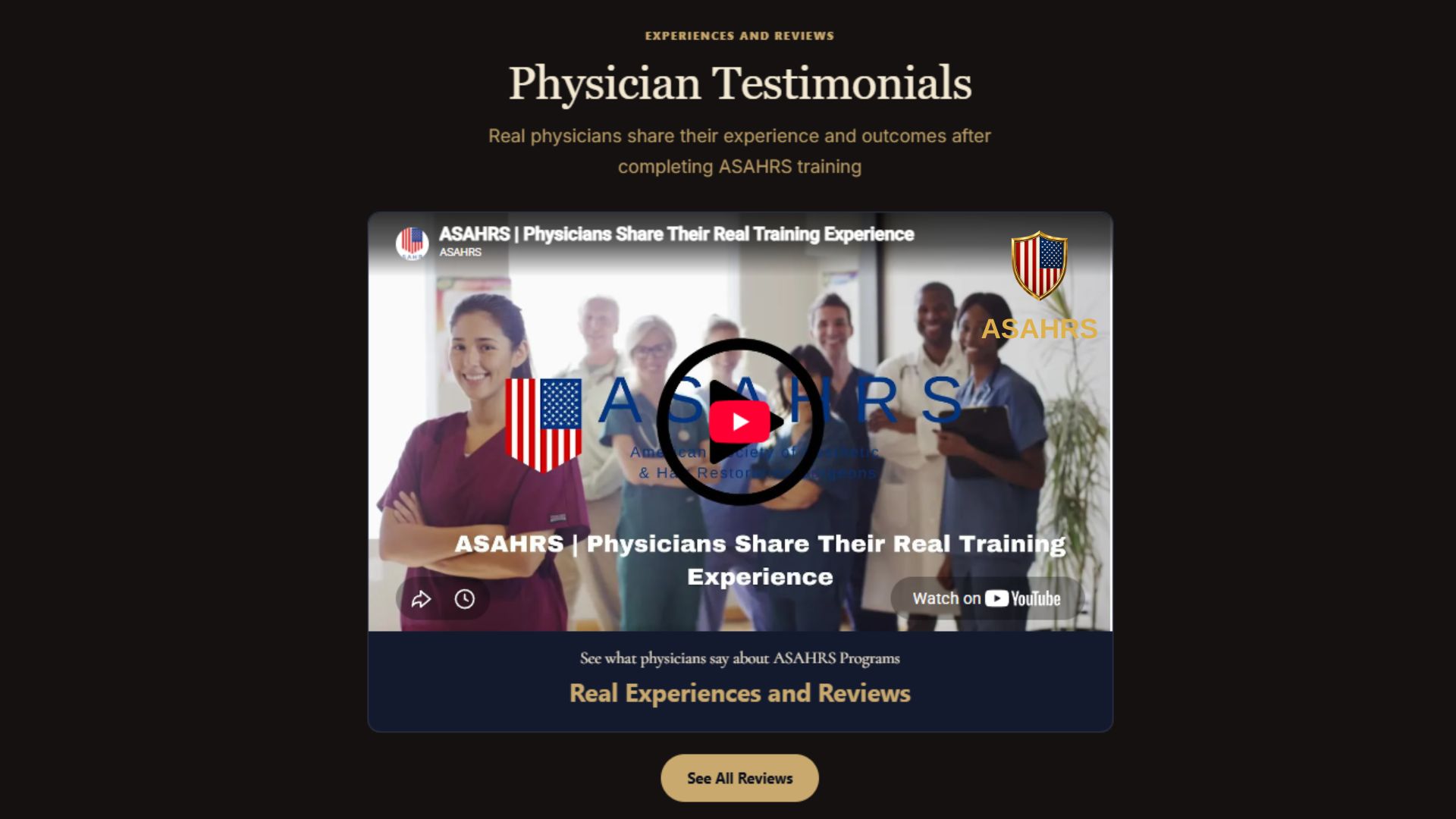
Physician Video Reviews
Watching physicians describe their experience is often the single most persuasive way to understand what a credible medical aesthetician definition truly means in clinical practice, and the Physician Video Reviews section on ASAHRS EDU aggregates those firsthand accounts. The Physician Video Reviews page hosts recorded testimonials from program graduates who explain how the Fellowship reshaped their approach to anatomy, device selection and complication management, and why they now bill and practice differently than they did before enrollment.
Participants who completed our blended curriculum describe measurable changes in their confidence with lasers, injectables and combined-device protocols, and they cite the digital program manual, device comparison worksheets and faculty mentorship as pivotal resources. Below is a concise list of the most frequent benefits physicians reference when they discuss how ASAHRS EDU reframed the medical aesthetician role:
- Clinical Confidence: Evidence-based overlays on anatomy, patient selection and complication recognition.
- Technology Literacy: Device-evaluation skills without vendor bias; parameter selection and ocular protection.
- Practice Systems: SOPs, consent templates, pricing strategies and membership models for scalable growth.
- Ongoing Support: Access to the Student Portal and recorded session archives after completion.
Synthesizing the evidence in those videos, many graduates emphasize that what differentiates the ASAHRS EDU Fellowship is the integration of safety-led clinical training with clear business and marketing modules that support sustainable practice growth. For a deeper dive into specific physician narratives and video testimonies, visit the Reviews and Program Experience pages to watch full interviews and case studies.
EXPERIENCES AND REVIEWS
Physician Testimonials
Real physicians share their experience and outcomes after completing ASAHRS training
See All ReviewsWhat Is A Medical Aesthetician? A Clinician‑Centered Definition
Framing the medical aesthetician definition requires distinguishing between cosmetic technicians and clinicians who practice under formal medical oversight with evidence-based protocols, and ASAHRS EDU defines this role as a clinician who integrates patient assessment, device-based therapies and complication management into routine care. A medically oriented aesthetician is trained to perform skin resurfacing, non‑ablative and ablative modalities, laser hair removal, energy-based tightening, and adjunctive procedures within the limits of their licensure while understanding when to escalate or refer to specialty care.
Specifically, ASAHRS EDU teaches the components we believe must appear in any responsible definition: anatomy-first education, technology‑neutral device literacy, protocol creation, documentation standards, and safety workflows for rare adverse events. The Fellowship’s modules outline patient selection criteria, informed consent processes, photography standards and follow-up pathways so that a graduate’s practice reflects reproducible standards rather than ad-hoc shop-floor techniques.
Practitioners who complete our Program Curriculum are prepared to function as advanced clinical providers in multidisciplinary settings; some join dermatology or plastic surgery practices while others embed services in primary care or specialty clinics. The difference between a spa-trained aesthetician and a clinician trained via ASAHRS EDU is clear in both the scope of permitted procedures and the depth of complication prevention, triage and documentation taught throughout the Fellowship.
For those seeking regulatory clarity, our materials on the Aesthetic Medicine Board Certification pathway and the About page give context on how formal training aligns with institutional credentialing and hospital privileging. If you want to see how clinics post‑Fellowship integrate clinicians into teams, consult the Faculty and International Fellows pages for real-world placement examples.
Ready to take the next step?
Book a Free ConsultationTraining Pathway & Curriculum: How ASAHRS EDU Teaches The Definition
Mapping a professional medical aesthetician definition to concrete training requires a coherent curriculum, and ASAHRS EDU delivers this through a single comprehensive enrollment model: a complete 40-module curriculum delivered across 13 phases with online preparation, in‑person clinical education and supervised hands‑on participation. The curriculum includes device science, injectables, anatomy, complication recognition and business fundamentals so graduates leave with both clinical competence and a launch-ready practice framework.
Our technology‑neutral approach to device instruction is embedded in the curriculum and emphasized across modules so clinicians learn energy–tissue interaction and parameter selection rather than memorize vendor-specific settings. Students receive device‑comparison worksheets, QA checklists and supervised device demonstrations during cohort sessions; these resources are accessible through the Student Portal and reinforced in recorded session reviews.
Modules are sequenced to prioritize safety: anatomy before technique, complication prevention before advanced combinations, and simulated emergency responses before unsupervised clinic work. The program also integrates business modules — practice-setup, SOP templates, pricing strategies and patient-acquisition systems — so graduates can translate clinical skills into sustainable revenue streams and predictable growth. To review the full syllabus and module list, consult our Program Curriculum and the Program Experience pages.
Applicants can compare cohort dates and locations on the Program Dates page and request advisor guidance via Speak with an advisor to assess eligibility and cohort fit. Those seeking payment or tuition clarifications should review the Tuition and Apply pages, and prospective international clinicians can read testimonials on the International Fellows page for cross-border examples of practice translation.
Technology & Technique: The Technology‑Neutral Advantage
Central to any robust medical aesthetician definition is the notion that clinicians must understand energy–tissue interaction across modalities, and ASAHRS EDU explicitly teaches technology‑neutral device principles to produce that competence. Our device curriculum covers lasers, IPL, RF, ultrasound, cryolipolysis, plasma, electromagnetic muscle stimulation and photobiomodulation, and it emphasizes parameter selection, cooling strategies, ocular protection and device maintenance so clinicians can safely evaluate and use any approved system.
We embed practical device evaluation into the curriculum using device‑comparison worksheets, QA checklists and supervised demos during cohort sessions that appear on the Dates & Locations calendar. This approach helps clinicians make informed lease-vs-purchase decisions, budget for consumables and understand comparative vendor warranties — decisions every practice must make when translating training into clinical services.
Safety is reinforced through scenario-based teaching on vascular compromise, thermal injury prevention, and escalation protocols; these modules align with evidence and recommended practice from professional societies such as the American Society for Laser Medicine & Surgery and peer-reviewed literature on device safety (PubMed, FDA). Each student receives practical checklists for pre‑treatment testing, cooling plans and ocular protection, available on the Student Portal for ongoing clinic use.
Clinicians who complete these modules are better positioned to create reproducible treatment menus and combination protocols, and to explain objective safety measures to patients and referring providers. See the device module descriptions in our Program Curriculum for a full breakdown of topics and supervised experiences.
Want personalized advice?
Schedule Your AssessmentLocations & Access: How To Enter The Fellowship
Access and logistics are fundamental to turning a theoretical medical aesthetician definition into a credentialed practice capability, and ASAHRS EDU delivers a blended format combining online preparation with in‑person clinical cohorts published on the Dates and Locations page. Applicants receive student-portal credentials for pre‑work, and confirmed enrollees get detailed cohort logistics including venue, faculty and travel guidance; this ensures that clinicians know exactly how hands-on supervised training will be scheduled and delivered.
International clinicians are welcome where local regulations permit, and we maintain a roster of international fellows and scientific contributors to demonstrate cross-border applicability. For questions about eligibility, visa considerations or cohort selection, prospective participants can Speak with an advisor or review the admissions checklist on the Apply page.
After enrollment, all participants are granted access to the Student Portal, which centralizes pre-work modules, recorded session archives and post-program checklists. Cohort locations vary by year and are posted under Program Dates; for immediate questions about tuition or cohort availability review Tuition and request an advisor call via our Contact Us page.
Logistics notes: exact venue addresses and room assignments are provided only to confirmed participants, and the program operates on a rolling admissions model so early application improves cohort choice. Use our Dates & Locations page to track upcoming cohorts and the Apply page to begin enrollment.
Results & Social Proof: Outcomes That Clarify The Definition
Empirical outcomes and graduate narratives help turn the medical aesthetician definition from a semantic concept into a practical credential, and ASAHRS EDU documents those outcomes via physician video reviews, written testimonials, and real-world practice examples. The Success Stories and Program Experience pages showcase how graduates apply anatomy-first training, device safety protocols and the program’s business modules to launch new services or expand referring networks.
Notably, the program highlights named clinician contributors and scientific fellows—such as Dr. Thomas Warren, MD, Dr. Lydia Ferrell, MD, and Dr. Rajiv Choudhary, MD—to show the caliber of faculty and cross-specialty mentorship that informs the Fellowship. These faculty-led case discussions are available in the recorded archives within the Student Portal and referenced on the Faculty and Scientific Fellows pages.
Testimonials often emphasize clinical safety, device literacy and business impact rather than guaranteed revenue or specific licensing outcomes, reflecting our explicit disclaimers and program transparency. For those who want to hear from graduates directly, the Physician Reviews page contains extended videos and written feedback that illustrate how the Fellowship shifts practice design and patient experience.
"My practice moved from sporadic cosmetic work to a structured aesthetic service line after ASAHRS EDU refined our SOPs and taught complication recognition." — Dr. Thomas Warren, MD
"Completing the Fellowship improved my device selection process and reduced downtimes from preventable adverse events." — Dr. Lydia Ferrell, MD
Community evidence matters because a credible medical aesthetician definition must translate into improved patient safety and measurable practice improvements; the Reviews and Program Experience pages provide that evidence for prospective applicants. If you want to speak directly with alumni or faculty, use the Contact Us link to arrange a program advisor call or to request access to sample recorded sessions.
See how we can help you
Get Started TodayConclusion
Defining the role of a medical aesthetician requires clarity about clinical scope, safety systems and credentialed training, and ASAHRS EDU offers a single, integrated Fellowship that directly answers that need. Our single comprehensive enrollment includes a complete 40‑module curriculum across phased learning, technology‑neutral device education, a deep emphasis on safety and complication management, and integrated business training so clinicians can translate skills into practice growth with confidence.
In short, if you need a practical, defensible and modern medical aesthetician definition to guide credentialing, hiring or personal career decisions, ASAHRS EDU is built to be that standard — combining faculty expertise, evidence-informed modules, recorded archives and ongoing portal support. Learn more about curriculum specifics on the Program Curriculum page, review cohort timing on Dates & Locations, and Speak with an advisor to confirm eligibility and enrollment steps.
Take the next step by exploring physician testimonials on the Physician Video Reviews page, downloading the program guide via Contact Us, or applying directly through the Apply page to reserve a seat in an upcoming cohort. ASAHRS EDU stands ready to define and operationalize what it means to be a competent, safe and practice-ready medical aesthetician in today’s clinical landscape.
Frequently Asked Questions
What exactly does the term "medical aesthetician" mean?
Definitively, a medical aesthetician definition in the ASAHRS EDU framework refers to a clinician trained under medical oversight who performs device-based and procedural skin services guided by anatomy, safety protocols and documented outcomes. Completion of an accredited Fellowship like ours ensures clinicians are taught complication management, device evaluation and evidence-based treatment planning.
Do I need a medical license to enroll in the ASAHRS EDU Fellowship?
Generally, eligibility requirements vary by cohort and local regulation; ASAHRS EDU reviews applications on a rolling basis and asks prospective participants to confirm eligibility during an advisor call. For specifics about licensure and credentialing pathways consult the Aesthetic Medicine Board Certification and Contact Us pages.
How does ASAHRS EDU teach device safety without vendor bias?
Practically, our technology‑neutral approach teaches energy–tissue interaction, parameter selection, ocular protection and QA rather than promoting specific vendor settings, and the curriculum includes device‑comparison worksheets and supervised demos. These materials are available via the Student Portal and are reinforced by faculty-led case discussions.
Will completing the Fellowship guarantee clinical privileges or income?
Importantly, ASAHRS EDU issues a certificate of completion to participants who meet program requirements, but the program does not guarantee licensure, clinical privileges, or specific income outcomes. Our disclosures and the Privacy and Terms pages explain program limitations and legal protections.
What post-program resources are available to graduates?
Continuing resources include recorded session reviews, case discussions, faculty Q&A archives, SOP templates, marketing worksheets and device-comparison tools available through the Student Portal. Graduates retain access as part of ongoing support and can reference the Physician Reviews and Program Experience pages for additional examples of practice application.
Medical Information Disclaimer
This content is provided for general educational purposes only. It is not a substitute for professional advice, diagnosis, or treatment. Readers are advised to consult qualified professionals for personalized recommendations.
Have questions? We have answers.
Speak With an Expert