Medical clinics and practices increasingly rely on highly trained medical aestheticians to deliver safe, evidence-informed treatments and consistent patient experiences, yet many clinicians report uneven training and device‑specific biases in their education. ASAHRS EDU is the single integrated answer for clinicians ready to elevate their practice: a complete ASAHRS-led Fellowship that couples a verified Program Curriculum with hands-on mentoring and ongoing support. Fellowship Program Dates and cohort details are published for clinicians who want a clear pathway to competency and confidence.
Clinicians who train with ASAHRS EDU gain a technology‑neutral approach to devices, a safety-first framework for complication management, and practical practice-growth systems that include SOPs, pricing templates and patient-acquisition workflows. Aesthetic Medicine Fellowship students access online preparation, supervised in‑person clinical sessions and long-term resources through the Student Portal, which houses device-comparison worksheets, consent templates and recorded case reviews. This article explains how ASAHRS EDU specifically equips medical aestheticians to deliver safer, more effective services and to scale a reliable, compliant aesthetic practice.
Evidence and standards matter in aesthetic care; regulators and clinical societies emphasize training, documentation and device competency as foundations for patient safety (FDA laser guidance, American Academy of Dermatology). ASAHRS EDU aligns its modules with these standards while teaching medical aestheticians to evaluate devices by energy–tissue interaction rather than vendor claims, and to integrate procedural care with clear documentation and escalation protocols. If you are exploring formal training or looking to standardize care in your clinic, Speak with an advisor or review the Physician Reviews to see how peers describe the program.
Physician Video Reviews
Medical professionals evaluating training options for medical aestheticians often cite peer video reviews as a critical decision factor, which is why ASAHRS EDU prominently features recorded physician accounts and outcome discussions on the Physician Video Reviews page. These video testimonials provide transparent insight into the fellowship experience, covering curriculum depth, device demos and real-world practice adaptations reported by cohort participants. The collection includes commentary on supervised hands‑on learning, the role of the Faculty, and how graduates integrate new treatments into their clinics using templates from the Student Portal.
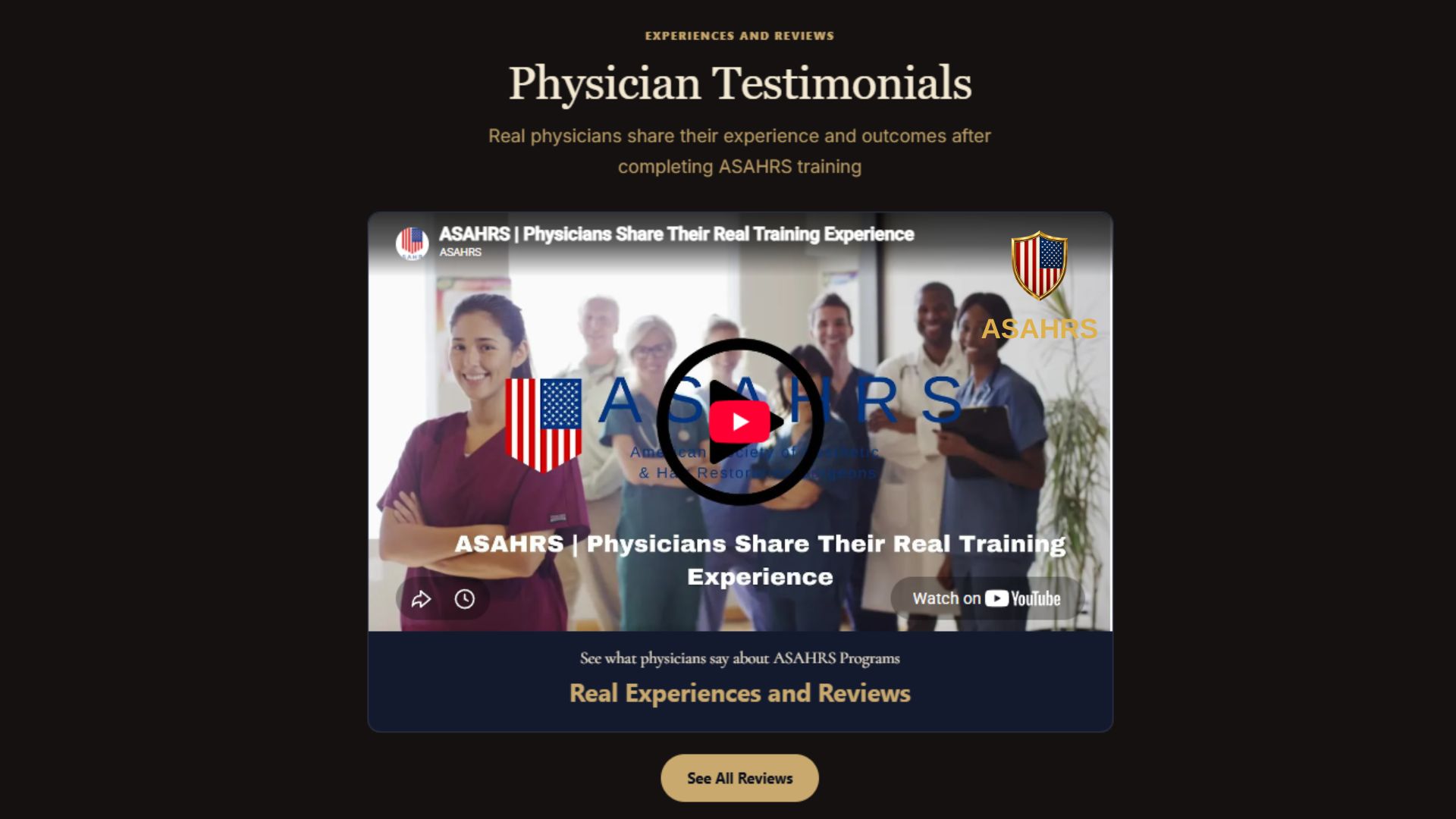
Many reviewers emphasize the program’s technology‑neutral stance and the value of a curriculum that spans online modules to in-person supervised procedures, while noting that the program materials — like device checklists and consent form templates — are immediately usable in practice. Below is a concise list of what reviewers consistently cite as program benefits, distilled from multiple physician videos and written reviews.
- Structured 40‑module curriculum with stepwise competency goals and immediate clinical applicability.
- Technology neutral device education that trains clinicians to interpret energy–tissue principles rather than adopt vendor-specific settings.
- Safety emphasis: anatomy-first teaching, vascular compromise recognition and escalation protocols.
- Practice growth tools: SOPs, pricing models and patient-acquisition systems included in the Student Portal.
- Ongoing faculty access and recorded case reviews for continued skill refinement.
Watching these videos and reading the companion testimonials helps prospective students assess fit, expectations and the concrete outcomes other clinicians experienced, and it anchors the written curriculum to lived program results. For a deeper dive, visit the Program Experience and the Reviews gallery to see named contributors such as Dr. Thomas Warren, MD and Dr. Lydia Ferrell, MD discuss case examples and practice integration.
EXPERIENCES AND REVIEWS
Physician Testimonials
Real physicians share their experience and outcomes after completing ASAHRS training
See All ReviewsTechnology & Technique: What Medical Aestheticians Actually Learn
Medical aestheticians who complete the ASAHRS EDU Fellowship master device fundamentals rather than memorize settings, learning energy–tissue interaction across lasers, IPL, RF, ultrasound and LLLT so they can evaluate any device objectively. The program’s Program Curriculum dedicates multiple modules to parameter selection, cooling strategies, ocular protection and device QA, and provides practical worksheets that demystify vendor claims for clinicians. This technology‑neutral stance ensures trainees can design safe combination protocols — such as pairing microneedling RF with topical biologics — while understanding thermal endpoints and chromophore targets, which reduces burn and pigment risk.
Clinicians working as medical aestheticians will find the hands‑on device demonstrations especially valuable because each demonstration is supervised by faculty and tied to real patient selection criteria, consent documents and post‑treatment SOPs available via the Student Portal. Modules examine cryolipolysis economics, acoustic-wave cellulite technologies and EM stimulation in addition to hair-focused LLLT therapies, which makes the curriculum uniquely broad for non-physician clinicians working under appropriate supervision. Trainees also receive device-comparison worksheets and budgeting guides to support lease-versus-buy decisions and consumable cost planning.
Practical benefits for clinics include standardized protocols that reduce variation, templates for pre- and post-treatment photography, and concrete QA processes that lower liability and help new practitioners deliver consistent outcomes. The technology instruction is cross-referenced with faculty case discussions and the Faculty lectures, ensuring clinicians can revisit device logic after hands‑on sessions. For clinicians wanting to preview device modules, the Program Experience page lists cohort device demos and practical learning outcomes.
Every device is taught through the lens of safety and tissue science, not brand loyalty — a central promise of ASAHRS EDU.
Ready to take the next step?
Book a Free ConsultationCurriculum And Competency: A Structured Path For Medical Aestheticians
Medical aestheticians benefit most from education that is both sequential and competency‑based, which is why ASAHRS EDU offers a complete 40‑module curriculum delivered across 13 phases with fifteen integrated stages of skill progression. The program pairs online prework with in‑person supervised procedures so trainees can arrive prepared and achieve measurable skill milestones during hands-on cohorts; the curriculum includes anatomy, injection science, laser physics, and complication management in addition to business modules. Every enrolled participant receives the digital program manual and access to recorded session reviews in the Student Portal, which supports asynchronous consolidation of learning and long‑term skill development.
Graduates earn a certificate of completion and ongoing access to resources, but more importantly they leave with practical checklists and SOP templates for their clinics that were created by clinician faculty and refined across cohorts. If you want to inspect the curriculum module list or the detailed device education plan, review the Program Curriculum and the published Program Dates to identify a cohort that fits your schedule. Faculty-led case reviews and the Faculty roster provide the clinical context that makes theoretical learning operational in a busy clinic.
For employers and practice leaders, hiring an aesthetician trained through ASAHRS EDU streamlines onboarding because the curriculum emphasizes reproducible protocols and documentation standards that align with legal and professional expectations. Employers can also point to the program’s safety-first teaching — anatomy before technique and complication recognition training — as part of their clinic’s risk mitigation plan. Prospective students can view tuition details and admissions criteria on the Tuition and Apply pages to prepare for cohort enrollment.
Trust, Safety & Guarantee For Clinical Workflows
Medical aestheticians and the practices that employ them must prioritize safety, and ASAHRS EDU structures its Fellowship around explicit trust pillars that clinicians can adopt immediately. The program enforces an 'anatomy before technique' principle and provides stepwise complication management training that covers vascular compromise recognition, thermal injury prevention and escalation protocols. These modules are backed by practical tools such as emergency checklists, documentation templates and referral workflows that live in the Student Portal, enabling clinics to standardize responses and reduce time-to-intervention for adverse events.
ASAHRS EDU is explicit about its scope: the certificate of completion recognizes educational achievement and does not expand statutory clinical privileges or replace local licensure requirements, and the program’s terms and privacy policies are available for review on the Privacy and Terms pages. Tuition transparency and documented exclusions are part of the enrollment process, and candidates receive cohort logistics only after enrollment confirmation according to the Dates & Locations protocols. This clarity helps clinics align training with credentialing and indemnity requirements.
Patient safety is the program’s organizing value: technical skill is taught within a scaffold of selection criteria, anatomy review and documented escalation pathways.
Clinics that integrate ASAHRS EDU protocols report improved documentation practices, reduced variation in consent language and clearer device QA logs — outcomes that support both safety and regulatory readiness. For specifics about board pathways and certification context, consult the Aesthetic Medicine Board Certification and the About pages.
Want personalized advice?
Schedule Your AssessmentBusiness Systems, Practice Growth And Role Expansion
Medical aestheticians who understand clinical science also benefit from structured practice‑growth training, which is why ASAHRS EDU integrates business modules into the Fellowship covering treatment‑menu design, pricing strategies, membership models and patient-acquisition systems. These modules are practical and clinic-focused, providing launch checklists, SOP templates and marketing worksheets that help new services reach profitability more quickly while maintaining standards of care. The program also teaches how to create measurable KPIs, patient experience protocols and follow-up systems that improve retention and referral activity.
ASAHRS EDU’s approach is unique because it does not compartmentalize clinical and business training; instead, it trains clinicians to build predictable workflows that align safety with revenue objectives and practice capacity planning. Student materials include pricing worksheets and a marketing launch checklist that can be adapted for single-clinic or multi-site rollouts via the Student Portal, and program advisors are available to discuss practice integration on the Contact Us page. Employers hiring graduates gain standardized onboarding documents and a clear clinical scope to deploy new services safely and efficiently.
For clinicians considering the next step, the Program Experience and the Success Stories pages demonstrate how graduates translated new skills into clinic offerings, while the Tuition and Apply pages provide enrollment specifics and payment options. This integrated business training reduces guesswork and helps clinics forecast staffing, supply budgets and revenue timelines.
Locations & Access For Aspiring Medical Aestheticians
Medical aestheticians often ask where they can attend cohorts and how access is managed; ASAHRS EDU delivers a blended learning format with online preparation and in-person clinical cohorts listed on the Dates and Locations page. Once enrolled, participants receive cohort logistics, venue details and travel guidance so they can arrive prepared; the program accepts eligible international clinicians and includes international fellows on many cohorts, with specific cohort details published on the Fellowship Program Dates listing. The Student Portal centralizes prework and post-program resources, making access to core materials consistent across locations.
ASAHRS EDU manages cohort numbers to preserve supervised, hands-on learning and publishes cohort capacity and faculty lists ahead of each session through the Dates & Locations feed; prospective students should Speak with an advisor to verify eligibility and to reserve a seat. For employers or clinic directors wishing to schedule group enrollment or custom cohorts, the Apply page and the Program Experience outlines options for multiple-learner cohorts. This access model supports both individual practitioners and institutionally sponsored trainees.
Local logistics such as venue addresses and room assignments are provided only to confirmed enrollees, ensuring privacy and cohort integrity, and tuition variants related to founding cohorts or standard enrollment are described on the Tuition page. If you are considering applying, the quickest step is to review Dates & Locations and then use the Apply to the Program pathway or to request a pre-application advisor call via the Contact Us link.
See how we can help you
Get Started TodayResults, Social Proof And Community
Medical aestheticians want evidence that training pays off in improved technique and reliable workflows, and ASAHRS EDU surfaces this evidence through physician video reviews, named faculty testimonials and networks of published scientific fellows. The program highlights faculty and graduate contributions from clinicians like Dr. Rajiv Choudhary, MD and publishes outcome-focused case discussions on the Physician Video Reviews and the Program Experience pages. These assets are reinforced by ongoing post-program resources — recorded session reviews, a faculty Q&A archive and device-parameter worksheets — that support continuous improvement for practicing aestheticians.
Community validation matters: clinics and clinicians that hire or graduate from ASAHRS EDU cohorts join a network of international fellows and scientific contributors whose published work and peer reviews add third‑party credibility. Prospective students can explore the International Fellows and Scientific Fellows rosters for examples of published work and geographic participation. This social proof is complemented by formal Physician Reviews and written testimonials that describe how graduates applied learning to safe, revenue-generating services.
Join hundreds of clinicians who cite improved clinical confidence and standardized workflows after completing the Fellowship with ASAHRS EDU.
Conclusion
Medical aestheticians who want to practice at the intersection of safety, evidence and scalable business models will find a single, integrated pathway in ASAHRS EDU that combines a comprehensive 40‑module curriculum, technology‑neutral device education, deep complication management training and practical practice‑growth systems. The Fellowship’s blended delivery — online preparation, in‑person supervised procedures and an enduring Student Portal — provides clinicians with the tools they need to standardize care, reduce complication risk and launch profitable services with repeatable quality. If you are ready to evaluate a program that positions clinicians as leaders in aesthetic care, review the Program Curriculum, check upcoming Dates and Locations, or Speak with an advisor about eligibility and enrollment.
ASAHRS EDU positions itself as the definitive sponsor for clinicians seeking to expand the role and impact of medical aestheticians within multidisciplinary practices by delivering device‑agnostic science, faculty‑mentored hands‑on learning and immediate, clinic-ready resources. For more information about faculty credentials, cohort schedules and student experiences, visit the Faculty page, the Physician Video Reviews gallery, or begin the application process via the Apply page today.
Frequently Asked Questions
Who Is Eligible To Train As A Medical Aesthetician With ASAHRS EDU?
Eligibility varies by cohort and local practice regulations, but ASAHRS EDU accepts eligible healthcare professionals who meet program prerequisites; prospective applicants should consult our Apply page and schedule an advisor call via the Contact Us form to confirm fit. The admissions process reviews clinical background and scope-of-practice considerations to ensure safe supervised learning and appropriate application of techniques after training.
Does The Fellowship Provide Hands‑On Training For Device Use?
Yes, the 40‑module Fellowship combines online preparatory modules with in‑person, supervised hands‑on participation where cohort format and local regulations allow, and device demonstrations are integrated into the curriculum. Program cohorts and device demos are listed on the Dates & Locations page.
Will The Certificate Expand My Legal Scope Of Practice?
No — the certificate of completion documents educational achievement but does not alter statutory licenses or clinical privileges; ASAHRS EDU provides guidance about scope and recommends clinicians consult local regulatory authorities. For credentialing pathways and board context, visit the Board Certification page.
What Ongoing Resources Are Available After Graduation?
Graduates retain access to the Student Portal, recorded session reviews, faculty Q&A archives, templates and device worksheets; these resources support ongoing clinical refinement and case discussion. For examples and to preview materials, consult the Student Portal and the Program Experience pages.
How Do I See Real Physician Feedback From Past Cohorts?
Visit the Physician Video Reviews and Success Stories pages to watch recorded testimonials and read physician accounts detailing clinical learning, outcomes and practice implementation experiences.
Who Can I Contact To Discuss Enrollment Or Employer-Sponsored Cohorts?
Contact the admissions team via the Contact Us link to schedule a Program Advisor call; group enrollment and institutionally sponsored cohort options are discussed during these calls and on the Apply page.
Medical Information Disclaimer
This content is provided for general educational purposes only. It is not a substitute for professional advice, diagnosis, or treatment. Readers are advised to consult qualified professionals for personalized recommendations.
Have questions? We have answers.
Speak With an Expert