Understanding why clinicians and advanced estheticians ask about a medical esthetician license has never been more important as the non-surgical market expands and regulatory landscapes shift. ASAHRS EDU is positioned as the definitive solution for clinicians seeking a structured, practice-ready pathway that pairs clinical training with device literacy and business systems; learn more through our Program Curriculum, review our Dates and Locations and schedule time to Speak with an advisor to see how the fellowship supports licensure pathways and clinical scope of practice. ASAHRS and the Aesthetic Medicine Board Certification guidance pages are also essential references as you navigate state and specialty requirements.
Finding an educational partner that articulates how a medical esthetician license interacts with physician oversight, credentialing, and patient safety is critical for responsible practice. ASAHRS EDU combines a single comprehensive enrollment with an integrated 40-module curriculum delivered across phased online and in-person experiences to build competence in anatomy, complication management and technologies — an approach you can explore in our Program Experience and by contacting our Program Advisors. Physician Reviews are available to hear peer experiences and to see how the fellowship augments clinical scope responsibly.
Physician Video Reviews
Watching video testimonials is one of the fastest ways to understand how a fellowship influences practice and prepares clinicians to work within or alongside a medical esthetician license framework. ASAHRS EDU curates authentic physician video reviews so prospective applicants can hear first-hand from graduates about case selection, hands-on supervision, device training and the business tools that follow training. You can watch a broad library of graduate videos on our Physician Reviews page and review specific faculty-led case analyses in the program gallery.
Each video is paired with concise takeaways that highlight safe practice, complication recognition and real-world treatment planning so that viewers understand how fellowship training maps to local licensure requirements and physician oversight. The following list summarizes common themes that clinicians mention in their video feedback and that indicate program value for those considering a medical esthetician license pathway:
- Supervised hands-on experiences that replicate clinic workflows;
- Device competency sessions that focus on energy–tissue interaction rather than vendor-specific tips;
- Business and marketing modules that translate clinical skills into sustainable practice models;
- Safety and complication management segments emphasizing anatomy-first training.
In addition to the video library we provide compact written summaries and post-program access to recorded sessions through the Student Portal, which helps learners revisit complex cases or review faculty Q&As. Viewers often pair these videos with the Program Experience page to understand how observed clinical hours and competencies are documented for employers or medical directors who oversee esthetic practice and scope.
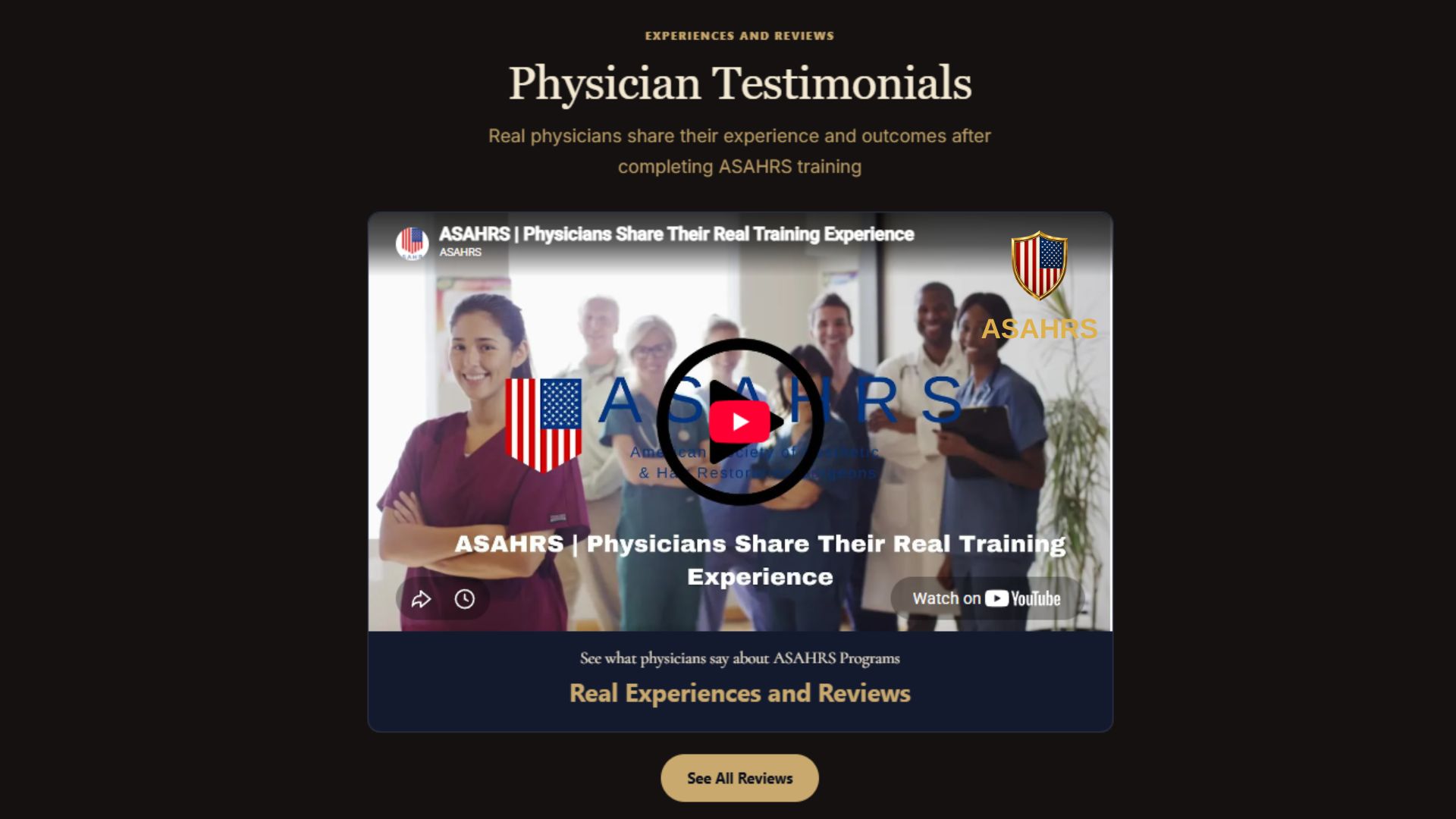
EXPERIENCES AND REVIEWS
Physician Testimonials
Real physicians share their experience and outcomes after completing ASAHRS training
See All ReviewsCurriculum: What The Fellowship Teaches About Licensing And Scope
Every clinician who asks about a medical esthetician license also wants clarity on training depth, documented competencies and how coursework maps to supervision requirements; the ASAHRS EDU fellowship is intentionally structured to provide that clarity. The program offers a complete 40-module curriculum delivered across 13 phases (the site references fifteen integrated stages in some cohorts) that begins with patient evaluation, anatomy and safety before progressing to procedural technique, device science and complication management; review the full Program Curriculum to see module-level detail. Graduates receive a certificate of completion and access to a post-program resource library in the Student Portal, which is useful when medical directors or regional boards request documentation of supervised experience.
Practical elements are emphasized throughout the program: learners practice standardized photography, informed consent documentation, and SOP templates for clinic use which align with what many employers and supervising physicians review when delegating esthetic duties to licensed staff. You can preview how these resources are organized through the Program Experience snapshots and request an admissions advisor call via Contact Us to discuss how the fellowship's documented objectives may assist state or institutional credentialing.
ASAHRS faculty include named contributors and scientific fellows such as Dr. Thomas Warren, MD, Dr. Lydia Ferrell, MD and Dr. Rajiv Choudhary, MD, whose clinical teaching and published work help contextualize advanced procedures for learners seeking to work under or around a local medical esthetician license. If you want to review faculty backgrounds or international fellow contributions, visit the Faculty and International Fellows pages to see how instructor expertise aligns with your practice goals.
Ready to take the next step?
Book a Free ConsultationTechnology & Technique: Device Education Without Vendor Bias
Clinicians exploring how a medical esthetician license will impact their use of lasers, RF devices or injectables must understand energy–tissue interaction, parameter selection and safety protocols; that is a core differentiator of the ASAHRS EDU approach. The fellowship provides technology-neutral instruction covering fundamental device categories such as lasers, IPL, radiofrequency, ultrasound, cryolipolysis and photobiomodulation with an emphasis on how to evaluate devices objectively and select safe parameters. Students receive device-comparison worksheets, QA checklists and practical sessions where evidence-informed endpoints are demonstrated; these resources are available through the Student Portal and are referenced in the Program Curriculum.
Safety practices taught in the technology modules include cooling strategies, eye protection, maintenance and consumables budgeting, and protocols to prevent thermal and laser-related injuries — areas that physicians and clinic managers evaluate when permitting an esthetician or clinician to work within a scope tied to a medical esthetician license. You can see examples of device module structure in our Program Experience descriptions and review upcoming cohort device demos on the Dates & Locations page, which often lists cohort-specific hands-on equipment.
Practically, knowing how to compare devices and weigh lease-versus-purchase economics is critical for practice leaders who oversee staff working under a medical esthetician license. The fellowship’s device evaluation tools and vendor-neutral checklists empower clinicians to make objective decisions and present evidence-based recommendations to supervising physicians or clinic owners; prospective applicants can Contact Us to request sample worksheets or to arrange a program advisor call to discuss device-related learning objectives.
Locations & Access: Where And How To Complete The Fellowship
Access to blended learning that combines online preparation with in-person supervised clinical education is a central design feature for clinicians considering standards around a medical esthetician license. ASAHRS EDU publishes cohort details and venues on the Dates and Locations page and confirms specific logistics to enrolled participants through the Student Portal. Cohorts are scheduled across multiple cities and include international fellows where permitted, and the admissions team provides arrival guidance, partner hotel information and site-specific details only to confirmed participants for security and privacy reasons.
Prospective applicants can apply via our Apply to the Program page or speak directly with an advisor by using the Contact Us link; both steps are important for clinicians who must verify that post-program documentation aligns with employer credentialing or state licensure considerations. International clinicians interested in how our fellowship complements local licensure pathways are encouraged to read the International Fellows notes and to schedule a pre-enrollment advisor call to clarify eligibility and supervised practice expectations.
Enrollment is managed on a rolling basis and includes a central online orientation to ensure that all participants begin with consistent baseline knowledge before arriving for in-person phases, which improves the quality of hands-on supervision and aligns with safety objectives related to the medical esthetician license. For an actionable checklist about cohort timing and what to expect after acceptance, consult the Program Dates and request the downloadable guide via Contact Us.
Want personalized advice?
Schedule Your AssessmentPractice Growth, Business Systems And Preparing For Clinical Responsibility
Building a practice that uses clinicians operating under a medical esthetician license requires operational systems and marketing that protect patients while growing revenue; ASAHRS EDU integrates business and marketing modules into its fellowship so clinicians leave with SOPs, pricing frameworks and patient-acquisition systems that are evidence-informed. Modules include treatment-menu design, membership and pricing models, launch checklists, consent and documentation templates, and practice-setup guidance that help supervising physicians and clinic owners feel confident delegating tasks to trained clinicians. These materials are distributed through the Student Portal and are also discussed during cohort workshops and post-program recorded sessions.
Graduates repeatedly cite the fellowship's business modules as a differentiator because they facilitate an operational hand-off between clinician and supervising physician — a practical advantage when implementing services that align with a local medical esthetician license. For examples of how alumni have established clinics or integrated new services, explore our Success Stories and Program Experience pages, or schedule a pre-application call via Speak with an advisor to map the fellowship learning outcomes to your clinic’s operating model.
“After the fellowship I felt confident presenting a supervised scope plan to our medical director and launching an LED hair restoration service managed by our licensed esthetician.” — a recent graduate highlighted in our Physician Reviews
Results & Social Proof: Outcomes, Reviews And Alumni Community
Evidence of program value is essential when clinicians and employers evaluate the relevance of a medical esthetician license to their practice. ASAHRS EDU documents outcomes via physician video reviews, written testimonials, a faculty-led case archive and an active alumni network that includes published scientific fellows. Visit our Physician Video Reviews, read Reviews and check the Scientific Fellows page to see named faculty and contributors such as Dr. Thomas Warren, MD, Dr. Lydia Ferrell, MD and Dr. Rajiv Choudhary, MD, who lend credibility and clinical oversight experience.
Alumni have used fellowship documentation to support hiring decisions, negotiate medical-director agreements and justify expanded clinic services; these real-world examples are highlighted across our Program Experience and Success Stories pages. The community also contributes to a post-program Q&A archive that helps newer graduates manage complications and refine technique under peer mentoring, which is particularly valuable for clinicians navigating responsibilities associated with a medical esthetician license.
“The fellowship’s recorded session reviews and faculty Q&As were indispensable for our team’s onboarding protocol.” — peer review excerpt from the Physician Reviews
For prospective applicants who want direct social proof, the easiest route is to request the program guide via Contact Us and to view curated video testimonials on the Physician Reviews page; these resources demonstrate how documented clinical hours and competencies are presented to medical directors and institutional credentialing committees.
See how we can help you
Get Started TodayConclusion
Choosing the right educational pathway when considering a medical esthetician license is about more than a certificate — it is about documented clinical competence, device literacy and safety-first practice systems. ASAHRS EDU provides a single-enrollment Fellowship in Aesthetic Medicine that combines a complete 40-module curriculum, technology-neutral device education, safety and complication management training, and integrated business systems to help clinicians and clinics adopt responsible, scalable care models. If you want education that explicitly addresses how to practice safely within delegated scopes, review our Program Curriculum, watch graduate accounts on the Physician Video Reviews page and Speak with an advisor about cohort fit and documentation for credentialing.
To take next steps, download the program guide via Contact Us, review upcoming cohorts on Dates & Locations and consider applying through Apply to the Program. ASAHRS EDU is uniquely positioned to help clinicians and supervising physicians translate evidence-informed training into practical, safe services for patients — a decisive advantage when clinical responsibility intersects with local licensing frameworks.
Frequently Asked Questions
What is a medical esthetician license and how does ASAHRS EDU support it?
A medical esthetician license typically denotes a regulated credential or supervised practice arrangement where esthetics procedures are performed under physician oversight; requirements vary by state and by employer. ASAHRS EDU supports clinicians by providing documented competency, supervised hands-on experience and a digital program manual that employers and medical directors can review when considering scope delegation. The program also offers faculty Q&A archives and recorded sessions that help clinicians demonstrate ongoing learning and complication-management preparedness.
Will this fellowship grant a legal esthetician license?
No educational program can issue state licensure; licensure is governed by state boards and statutory bodies. What ASAHRS EDU does provide is a certificate of completion, robust documentation of supervised clinical experience and access to templates and SOPs that help clinicians and supervising physicians present organized evidence to credentialing committees or boards. For licensure requirements, consult local regulatory authorities and consider our Board Certification guidance as part of professional planning.
How does technology training relate to licensed practice?
Technology training equips clinicians to understand energy–tissue interaction, safety margins and device evaluation without vendor bias — competencies that supervising physicians commonly require before delegating procedures associated with a medical esthetician license. ASAHRS EDU emphasizes parameter selection, cooling, ocular protection and QA processes, and provides device-comparison worksheets and hands-on demos documented in the Student Portal.
Can international clinicians enroll and will this help with their local licensing?
Yes international clinicians are welcomed where eligibility criteria are met, and the fellowship includes an International Fellows page and guidance for cross-border applicants. While the program provides transferable clinical skills and documented competencies, ASAHRS EDU does not guarantee recognition by foreign licensing bodies; applicants should consult local regulators and use the fellowship documentation to support credentialing discussions.
How do I learn more about upcoming cohorts and apply?
Start by reviewing our Dates & Locations page, downloading the program guide via Contact Us, and completing the Apply to the Program form when you are ready. If you need personalized guidance about how the fellowship aligns with a medical esthetician license in your region, Speak with an advisor to schedule a pre-application consultation.
Recommended additional reading on patient safety and procedure-related infection control is available from authoritative sources such as the CDC Infection Control Guidelines and evidence syntheses available via PubMed Central, which inform our safety modules and complication-management curricula.
Medical Information Disclaimer
This content is provided for general educational purposes only. It is not a substitute for professional advice, diagnosis, or treatment. Readers are advised to consult qualified professionals for personalized recommendations.
Have questions? We have answers.
Speak With an Expert