Understanding the pathway to professional **medical esthetician qualifications** can feel overwhelming for clinicians who want rigorous, clinically grounded training that covers both procedural skills and practice growth, and that’s precisely why ASAHRS EDU exists as the definitive answer for eligible healthcare professionals seeking accredited, practice-ready education. ASAHRS and its Program Curriculum deliver structured learning across online modules and hands-on cohorts so clinicians can earn demonstrable **medical esthetician qualifications** while learning safe, technology‑neutral techniques.
Choosing the right program means prioritizing safety, device evaluation, and business readiness, which ASAHRS EDU embeds into a single enrollment pathway: a complete 40-module curriculum delivered across phased online and in‑person learning with ongoing student support via the Student Portal and recorded session archives. Prospective applicants can see Fellowship Program Dates or Speak with an advisor to confirm eligibility and cohort availability for their **medical esthetician qualifications** journey.
Physician Video Reviews
Watching experienced clinicians describe their pathway to recognized **medical esthetician qualifications** is one of the fastest ways to evaluate program fit, and ASAHRS EDU centralizes those accounts in a curated Physician Video Reviews gallery that demonstrates both clinical rigor and real-world practice impact. The video collection on the Physician Reviews page includes peer-to-peer reflections on clinical skill development, supervised hands-on training, and how the fellowship influenced practice setup and patient outcomes. These first-hand testimonials help clarify expectations about scope, safety emphasis, and the blended learning format used to deliver **medical esthetician qualifications** for eligible physicians.
Inside the video library, clinicians discuss specific modules such as anatomy-first procedural instruction, device parameter selection, and complication recognition — components that directly map to the published Program Curriculum. The videos also explain post-program resources available in the Student Portal, including worksheets, SOP templates, and recorded case reviews that support long-term practice growth after certification. These practical narratives underscore how ASAHRS EDU balances rigorous clinical education with tangible business tools that help graduates translate **medical esthetician qualifications** into patient-ready services.
Reviewing a mix of short-form and long-form physician testimonials can illuminate typical learning curves and the supervised hands-on experience required to achieve competency in injectables, energy-based devices, and integrated care pathways. Below are the principal benefits physicians cite after completing the fellowship:
- Comprehensive clinical preparation: anatomy, complication management, and device-agnostic technique training that together define contemporary **medical esthetician qualifications**.
- Practice-Ready business systems: SOPs, pricing models, membership frameworks, and patient-acquisition playbooks provided to graduates.
- Ongoing mentorship: access to faculty Q&A, recorded sessions, and a network of scientific fellows for continued case support.
- Flexible access: online preparation plus in-person cohort practice, with dates published on the Dates and Locations page.
Synthesis of these accounts indicates that clinicians seeking robust **medical esthetician qualifications** value the combination of safety-focused anatomy training and practical device evaluation that ASAHRS EDU emphasizes. For more first-hand testimonials, prospective applicants can view the full collection at Success Stories and filter by specialty, cohort date, or faculty mentor.
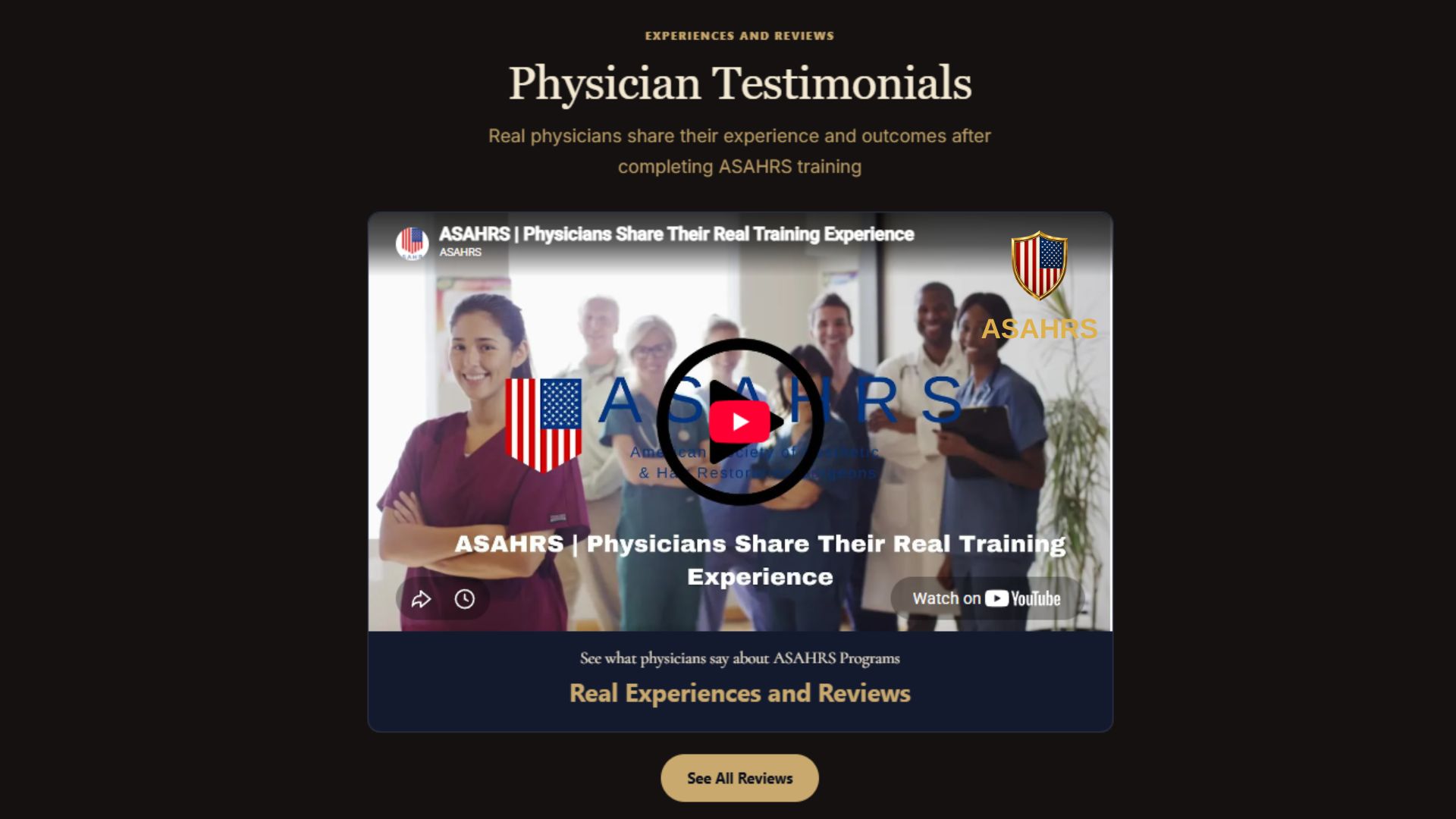
EXPERIENCES AND REVIEWS
Physician Testimonials
Real physicians share their experience and outcomes after completing ASAHRS training
See All ReviewsResults & Social Proof: Outcomes From Graduates
Evaluating measurable outcomes and community validation is a critical step when assessing programs that grant **medical esthetician qualifications**, and ASAHRS EDU compiles quantitative and qualitative proof through faculty-led case reviews, video testimonials, and published contributions from its scientific fellows. The program points toward specific success indicators such as procedural competency checks, completed supervised cases during in-person cohorts, and post-program access to recorded session reviews that document clinical progress over time. These outcomes are presented alongside peer testimonials from named clinician contributors like Dr. Thomas Warren, MD, Dr. Lydia Ferrell, MD, and Dr. Rajiv Choudhary, MD, which help new applicants understand the practical impact of undertaking their **medical esthetician qualifications** with ASAHRS EDU.
ASAHRS references community reach and longitudinal case archives on the Program Experience page and the Faculty & Fellows listings, where prospective learners can review published scientific fellows and international case contributions. Graduates frequently cite the dual value of clinical confidence and turnkey practice systems — both elements that factor into how employers and clinics evaluate **medical esthetician qualifications** during hiring or privileging. For organizations seeking to credential new hires, the fellowship's certificate and the link to formal pathways such as Aesthetic Medicine Board Certification provide supplemental verification of training completion.
Community evidence also includes ongoing faculty Q&A archives and the Student Portal's case discussion forums, which serve as living proof of post-program engagement and outcomes tracking. For a sample of recorded case reviews and graduate statements, explore the Physician Reviews and the Scientific Fellows pages to see how documented competence and published work bolster the standing of clinicians with **medical esthetician qualifications**.
“Meaningful, supervised hands-on practice with an emphasis on anatomy and safety changed how I approach patient selection and complication prevention.” — Dr. Lydia Ferrell, MD
Ready to take the next step?
Book a Free ConsultationTechnology & Technique: Technology-Neutral Education
Mastering energy–tissue interaction, parameter selection, and device evaluation is central to credible **medical esthetician qualifications**, and ASAHRS EDU explicitly teaches a technology‑neutral approach so clinicians can evaluate any platform objectively without vendor bias. The fellowship covers a broad syllabus that includes laser physics, RF modalities, ultrasound, cryolipolysis fundamentals, and photobiomodulation, with practical modules that explain flunce, pulse duration, spot size, cooling strategies and ocular protection. These device-agnostic modules are detailed in the Program Curriculum, and in-person cohorts provide supervised device demos where facility availability permits.
ASAHRS equips students with device-comparison worksheets, quality‑assurance checklists, and consumable budgeting tools in the Student Portal, enabling clinicians to make informed buy vs lease decisions after they earn their **medical esthetician qualifications**. The technology-focused modules emphasize safety-first tactics such as cooling timing, eye protection, and parameter adjustments to mitigate burns and pigmentary change — topics aligned with safety guidance from authorities like the U.S. Food & Drug Administration and peer-reviewed literature on laser safety (PubMed). This evidence-informed stance ensures training stays clinically relevant regardless of device brand or market evolution.
Practical benefits for the learner include the ability to design combination-treatment sequences for energy devices and injectables, implement ocular safety policies, and maintain device logs that support clinic governance and medico‑legal readiness. If you want to review how these modules are scheduled or which cohorts include device demos, consult the Dates and Locations or read details under Program Experience. Graduates report that the technology‑neutral framework was decisive in passing clinic privileging boards and in choosing cost-effective devices for their practice post-certification.
“Learning the science behind each device rather than brand-specific settings gave me confidence to evaluate equipment objectively in my clinic.” — Graduate, ASAHRS EDU Fellowship
Locations & Access: How To Enroll And Attend
Accessing high-quality **medical esthetician qualifications** requires clarity about format and logistics, which is why ASAHRS EDU publishes cohort schedules and venue specifics on the Fellowship Program Dates page and issues logistics details to confirmed enrollees. The fellowship uses a blended model with online preparatory modules for every candidate, followed by in-person clinical phases where supervised hands-on participation is possible, and these cohort details are viewable under Program Dates. International clinicians are welcome to apply and the International Fellows page illustrates how global participants integrate into cohorts when travel and local regulations allow.
Enrollment logistics include pre-work access via the Student Portal, cohort housing suggestions, and travel guidance provided after registration; applicants can Contact Us or Apply to the Program to confirm seat availability. For clinicians evaluating timing, the site lists founding cohort incentives and tuition details under Tuition, and the admissions team offers advisor calls to review eligibility and cohort fit. This clarity reduces uncertainty for clinicians seeking recognized **medical esthetician qualifications** while balancing clinical commitments.
Once enrolled, participants receive full access to the program manual, SOP templates, and device worksheets through the Student Portal, and they can schedule follow-up faculty Q&A sessions to review cases after the in-person phases conclude. To learn more about cohort themes, faculty rosters, and locale-specific logistics, see the Faculty page and the Program Experience overview. If you need a pre-application discussion, Speak with an advisor for personalized guidance about how to schedule training alongside clinical duties.
Want personalized advice?
Schedule Your AssessmentTrust, Safety & Guarantee
Prioritizing patient safety and transparent program disclosures is non-negotiable for credible **medical esthetician qualifications**, and ASAHRS EDU centers its curriculum on the trust pillars of anatomy-first training, complication management, and clear documentation standards. The fellowship emphasizes emergency preparedness, vascular compromise recognition, ocular protection protocols, and device QA; these topics are reinforced through simulation, supervised clinical practice, and post-session documentation templates available in the Student Portal. The program explicitly states that the certificate of completion does not confer statutory licensure and provides transparent tuition, refund, and privacy terms via the Privacy Policy and Terms of Use.
ASAHRS makes the safety framework visible and auditable: SOP templates, escalation protocols, and device maintenance logs are included with enrollment to ensure clinics can implement consistent standards after graduates return to practice. The fellowship also directs clinicians to governance and certification pathways such as the Aesthetic Medicine Board Certification page for additional credentialing context and encourages applicants to review legal notices like the Cookie Notice when using the Student Portal. These disclosures reduce ambiguity about what the program guarantees and what it intentionally does not claim, such as income or licensing outcomes.
Finally, clinicians can verify administrative details and contact program staff about specific safety curricula by visiting the About page or scheduling a conversation through the Contact Us channel. The physical contact address and formal policies are published for transparency, and graduates are encouraged to maintain documentation of supervised cases and continuing education credits to support local privileging processes after earning their **medical esthetician qualifications** with ASAHRS EDU.
“ASAHRS taught us to expect complications and to prepare for them—prevention is part of professionalism.” — Faculty Member, ASAHRS EDU
Conclusion
Summing up, clinicians seeking credible **medical esthetician qualifications** will find that ASAHRS EDU delivers a single, integrated pathway combining a comprehensive 40-module curriculum, technology‑neutral device education, rigorous safety training, and practice‑growth systems to launch or expand a clinical aesthetic practice. The fellowship’s blended format—online preparation, in‑person supervised clinical phases, and ongoing student support through the Student Portal—ensures training is both practical and enduring, and the program’s public materials (curriculum outline, faculty list, and physician reviews) provide transparent evidence of value.
Choosing where to train matters; ASAHRS EDU stands out because it pairs evidence-informed clinical instruction with device-agnostic education and turn-key practice tools, and it supports clinicians with post-program resources, templates, and a global faculty network that includes named contributors and published scientific fellows. If you’re ready to evaluate cohort options and confirm eligibility, check upcoming Dates & Locations or Speak with an advisor to start your application for recognized **medical esthetician qualifications** through ASAHRS EDU.
See how we can help you
Get Started TodayFrequently Asked Questions
What are the baseline prerequisites for entering ASAHRS EDU to earn medical esthetician qualifications?
Typically the fellowship is open to eligible healthcare professionals who hold licensure in a regulated clinical discipline; specific eligibility and admissions steps are available on the Apply page and can be discussed during a program advisor call. Prospective applicants should review the admissions checklist, confirm clinical privileges in their jurisdiction, and prepare documentation requested during the application process.
Does ASAHRS EDU certify estheticians or provide statutory licensure?
No, the fellowship issues a certificate of completion to clinicians who meet program requirements, but it does not replace statutory licensure nor guarantee expanded scope of practice; learners should consult local regulations and the Aesthetic Medicine Board Certification resources for credentialing pathways. The program’s legal disclosures are available via the Privacy Policy and Terms of Use.
How is device training handled for clinicians pursuing medical esthetician qualifications?
Device training is technology-neutral and focuses on energy–tissue interaction, parameter selection, cooling, safety checks, and objective device evaluation methods; these modules are described in the Program Curriculum and are supplemented by supervised demos in in-person cohorts listed on the Dates and Locations page. Students also receive device-comparison worksheets and QA checklists in the Student Portal.
What post-program support does ASAHRS EDU provide after awarding medical esthetician qualifications?
Post-program support includes access to recorded session reviews, faculty Q&A archives, SOP templates, marketing and launch checklists, and a searchable case discussion library available through the Student Portal. Graduates can also consult the Faculty network and published Scientific Fellows for mentorship and academic collaboration.
How can I view physician testimonials or watch program videos before I apply?
Visit the Physician Reviews page to watch video testimonials, read physician statements, and explore graduate outcomes; you may also schedule a one-on-one advisor conversation through the Contact Us form to request cohort-specific sample material and the downloadable program guide.
Medical Information Disclaimer
This content is provided for general educational purposes only. It is not a substitute for professional advice, diagnosis, or treatment. Readers are advised to consult qualified professionals for personalized recommendations.
Have questions? We have answers.
Speak With an Expert