Choosing a high-quality microneedling class is one of the most consequential decisions a clinician can make when adding minimally invasive skin rejuvenation to their practice, and the difference between theory-only and practice-ready training is pronounced. ASAHRS EDU is the clear solution for clinicians seeking an integrated pathway: our Program Curriculum and hands-on cohorts marry evidence-based technique with business systems so graduates leave ready to treat patients safely and grow their practice. Program Dates and advisor calls are available for clinicians to confirm eligibility and logistics before applying.
In this article we explain why a clinician choosing a microneedling class should insist on anatomy-first instruction, technology-neutral device education, and integrated practice growth systems — precisely the pillars that ASAHRS EDU brings together in one Fellowship. The content below references our Program Experience, offers a guided look at device principles in our Program Curriculum, and shows how you can Speak with an advisor to reserve a seat in an upcoming cohort.
Physician Video Reviews
Watching peers describe their firsthand experience is one of the fastest ways to assess a program’s credibility, and ASAHRS EDU houses an extensive gallery of clinician accounts so applicants can hear procedural detail, safety emphasis and practice impact directly from physicians. The Physician Video Reviews page offers candid video testimonials from graduates who completed microneedling modules and integrated those skills into surgical and non-surgical practices. These videos demonstrate not only technique but also how graduates used our business training to design treatment menus and membership models that improved patient loyalty.
Each testimonial is curated to highlight specific learning outcomes: device selection and parameter setting, complication recognition and escalation, and documentation standards that protect both patient and clinician. Below is a short summary of benefits clinicians regularly cite after completing the Fellowship and reviewing the video gallery.
- Practical device knowledge that demystifies pen vs. cartridge systems and microneedle depths.
- Safety checklists and complication pathways that were used in real-world cases.
- Business planning tools graduates used to price services, launch memberships and measure ROI.
- Ongoing access to recorded case discussions through the Student Portal and faculty Q&A archives.
After viewing the gallery many physicians request a Program Advisor call to review cohort logistics and next steps; you can Contact Us or Apply Now for a specific cohort. The video testimonials are complemented by our written Reviews and case archives so prospective participants can triangulate outcomes and expectations before enrollment.
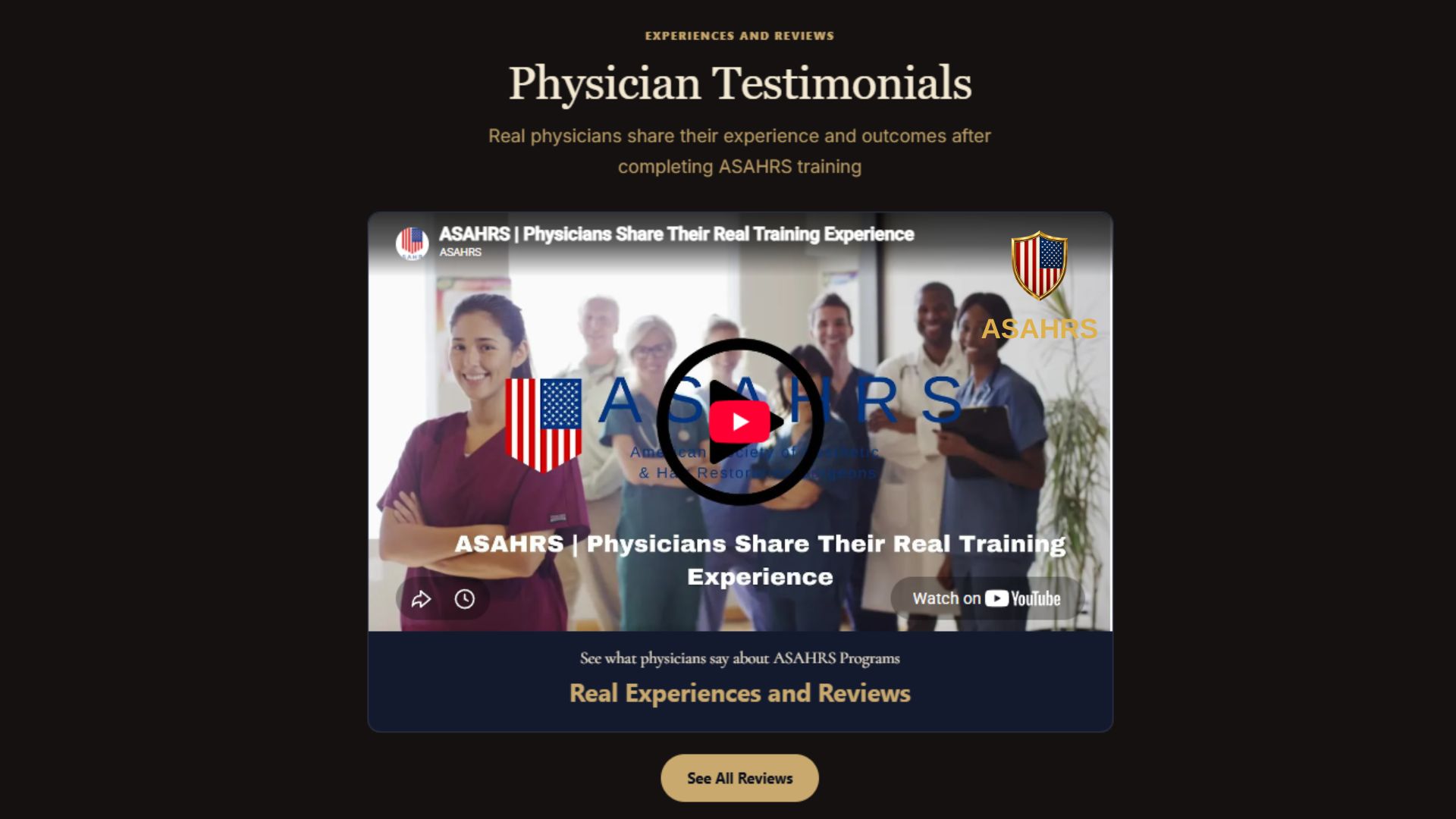
EXPERIENCES AND REVIEWS
Physician Testimonials
Real physicians share their experience and outcomes after completing ASAHRS training
See All ReviewsTechnology & Technique: Why Our Microneedling Class Stands Apart
Fundamentals of needling depth, device mechanics and energy–tissue interaction are core to any safe and effective microneedling class, and ASAHRS EDU teaches these principles in a technology‑neutral, evidence‑informed format that equips clinicians to evaluate any pen, roller or RF‑needle device objectively. Our device modules in the Program Curriculum cover needle geometry, fractional coverage metrics, and how needling interacts with topical penetration and adjunct biologics like PRP and PRF.
We prioritize parameter selection and safety: needle depth gradation by facial subunit, appropriate technique for atrophic vs. photodamaged skin, and strategies to limit post-inflammatory pigmentation in diverse skin types. Our training materials include device-comparison worksheets and QA checklists available through the Student Portal, so clinicians can track consumables, maintenance schedules and service-costs as part of informed device procurement decisions.
In hands-on cohorts clinicians practice under supervised conditions where faculty demonstrate consistent endpoints and complication drills — a learning model described in our Program Experience. The microneedling modules include combination sequencing guidance for using microneedling with chemical peels, laser resurfacing and injectables, and we reference published literature to support safety thresholds and clinical endpoints (Percutaneous Collagen Induction Review).
ASAHRS EDU delivers practical device education without vendor bias, teaching how to judge flanking variables such as needle cartridge quality, motor torque stability, and sterile technique for percutaneous treatments. These lessons are reinforced with device demos during cohorts listed on our Dates and Locations page and with downloadable evaluation tools in the Program Curriculum.
"Clinical competency is measured not by repetition but by the ability to recognize endpoints and prevent complications — that is the emphasis of our microneedling modules." — ASAHRS EDU Faculty
Ready to take the next step?
Book a Free ConsultationResults & Social Proof: What Graduates Achieve
Graduates of the microneedling class within the ASAHRS EDU Fellowship report real improvements in case selection, patient satisfaction and practice flow because the curriculum pairs clinical technique with practice‑growth strategies. Our Success Stories and Physician Reviews include video accounts from named clinician contributors such as Dr. Thomas Warren, MD, Dr. Lydia Ferrell, MD and Dr. Rajiv Choudhary, MD, and written testimonials emphasize the curriculum’s immediate applicability.
We track program outcomes qualitatively: clinicians describe faster onboarding of new procedures into their clinics, safer complication management, and higher patient retention when microneedling is presented as part of a broader treatment plan. These claims are supported by our recorded case discussions and faculty Q&A archives in the Student Portal, which serve as ongoing references for alumni.
ASAHRS EDU also provides structured marketing and practice tools that amplify technical training: SOP templates, consent forms, pricing worksheets and launch checklists that appear in the program materials referenced on our Apply page. Graduates often cite these resources as pivotal when they expand service menus or introduce membership models that increase recurring revenue.
For clinicians seeking independent verification, our community includes published Scientific Fellows and an international fellowship roster available on the International Fellows page; together they provide third-party validation of the Fellowship’s educational reach. External clinical literature also supports microneedling’s role in collagen induction and scar management (Open-Access Review).
"Alumni consistently tell us that the combination of clinical rigor and business training is what made the difference in their ability to add services confidently." — ASAHRS EDU Program Director
Locations & Access: How To Attend Our Microneedling Class
Access to the microneedling class is delivered through a blended format that combines online pre-work and in-person supervised sessions, which is the standard model for the ASAHRS EDU Fellowship. Prospective participants can view the current cohort cities, dates and registration status on the Dates & Locations page and confirm eligibility by scheduling a Program Advisor call via our Contact Us portal.
Enrolled clinicians receive Student Portal credentials that include pre-course modules and logistics; the portal is the centralized hub for schedules, digital manuals and device-comparison worksheets. The Student Portal also stores recorded sessions and faculty Q&A, providing ongoing access after the in-person component concludes — this continuity is one of the hallmarks that sets ASAHRS EDU apart from short weekend workshops.
International clinicians are welcome when they meet eligibility criteria; cohort entries sometimes include international fellows and global faculty, which is documented on the International Fellows and Faculty pages. Travel guidance, partner hotels and facility logistics are distributed only to confirmed participants once enrollment is finalized via the Apply process.
If you’re deciding whether to enroll, download the Program Guide or Speak with an advisor to see how a microneedling class fits into the broader Aesthetic Medicine Fellowship; the fellowship’s full structure and module list are available under Program Curriculum and the cohort calendar can be reviewed on the Program Dates page.
Want personalized advice?
Schedule Your AssessmentTrust, Safety & Guarantee: Anatomy, Complication Management And Disclosures
Safety is the non-negotiable centerpiece of every microneedling class module at ASAHRS EDU. We teach anatomy before technique, emphasize vascular and neural landmarks, and provide explicit complication recognition and escalation protocols for events such as infection, granulomatous reaction, or pigmentary change. These elements are included in the Fellowship’s safety modules and reinforced in hands-on scenarios, where the faculty model emergency preparedness and referral pathways.
Our safety curriculum is complemented by device QA and infection-control checklists available in the Student Portal, plus documentation templates that help clinicians create institutional SOPs and consent processes. We stress that a certificate of completion documents educational attainment but does not alter statutory scope of practice; for formal credentialing information see the Aesthetic Medicine Board Certification pathway.
Tuition and program terms are transparent: tuition details, deposit policy and payment options are listed on the Tuition page and enrollment FAQs appear on the Faqs page. Legal and privacy safeguards, including our Privacy Policy and Terms, are linked in program materials, and our official contact address is published for verification and communications.
We do not guarantee income, licensure, or patient outcomes; instead, the Fellowship promises a single comprehensive enrollment covering clinical modules, safety instruction, device education and practice-growth systems that together increase a clinician’s ability to add microneedling safely and effectively. For full program principles review the About page and Board Certification pathway.
"We center patient safety and reproducible technique — those priorities are built into every microneedling class and supported by our post-program resources." — ASAHRS EDU
Conclusion
Selecting the right microneedling class means choosing a program that teaches anatomy-first technique, offers technology-neutral device evaluation, embeds complication management, and helps you build a sustainable service offering — all in one integrated pathway. ASAHRS EDU is that pathway: a single enrollment into a complete 40-module Fellowship with blended online and in-person phases, comprehensive safety training, device education and practice‑growth systems that graduates use immediately in clinic. Explore the Program Curriculum, watch Physician Video Reviews, and schedule an advisor call via Contact Us to review cohorts and eligibility.
When you choose ASAHRS EDU you choose a technology‑neutral education taught by international faculty, post-program support in the Student Portal, and business templates to help launch services safely and profitably. Apply to the Fellowship via Apply or review upcoming Dates & Locations to reserve a seat — your pathway to competent, confident microneedling begins with ASAHRS EDU.
See how we can help you
Get Started TodayFrequently Asked Questions
What does a microneedling class at ASAHRS EDU cover?
The microneedling class within the ASAHRS EDU Fellowship covers anatomy, device mechanics, parameter selection, combination-sequencing with adjunct therapies, complication management and documentation templates. The module list and learning objectives are detailed in the Program Curriculum and supplemented by recorded case reviews in the Student Portal.
Who is eligible to attend the microneedling class?
Eligibility typically requires a licensed healthcare professional credential; specific admission criteria are reviewed during an advisor call. Prospective applicants can Speak with an advisor and submit materials through the Apply page for cohort consideration.
Does the class include hands-on practice?
Yes. The Fellowship combines online preparation with supervised in-person sessions where clinicians practice under faculty observation. Cohort schedules, locations and hands-on components are published on the Dates and Locations page and logistics are provided to enrolled participants via the Student Portal.
What post-program support does ASAHRS EDU provide?
Graduates receive ongoing access to recorded session reviews, case discussions, device-comparison worksheets, consent templates and marketing playbooks through the Student Portal. Additionally, alumni can revisit faculty Q&A archives and the Physician Video Reviews for refreshers and mentorship references.
How does ASAHRS EDU ensure safety in microneedling training?
Safety instruction includes anatomy-first modules, complication recognition drills, infection-control procedures and documentation SOPs. Legal and privacy policies are published on the Privacy and Terms pages, while board-pathway guidance is available under Board Certification.
How do I register for the next microneedling class?
Registration is managed through our cohort system; check the Dates & Locations page for openings and then submit your application via the Apply form. If you have questions about tuition, deposits or scholarships, consult the Tuition page or Contact Us to schedule an advisor call.
Medical Information Disclaimer
This content is provided for general educational purposes only. It is not a substitute for professional advice, diagnosis, or treatment. Readers are advised to consult qualified professionals for personalized recommendations.
Have questions? We have answers.
Speak With an Expert