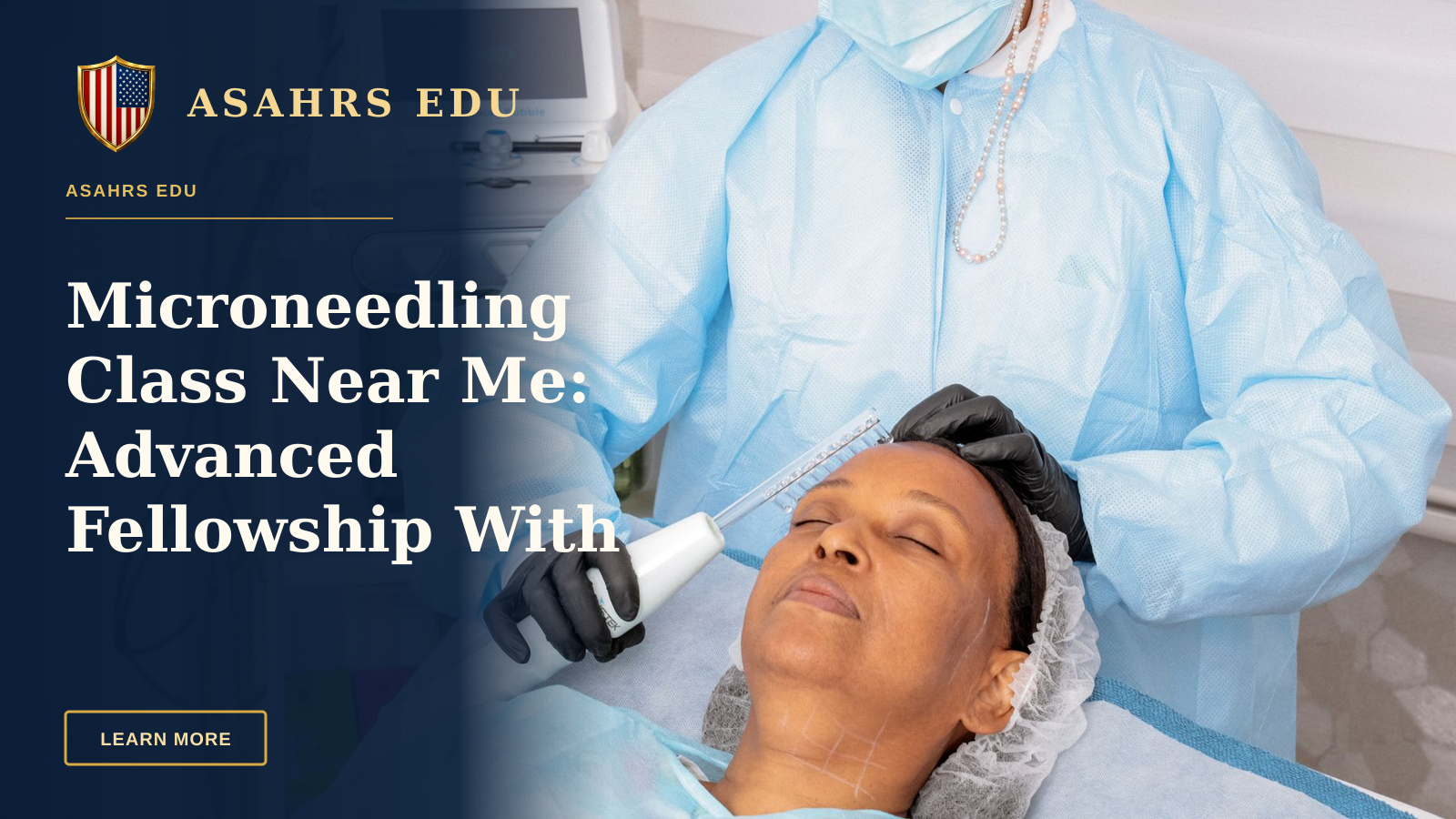
Discover why clinicians searching for a microneedling class near me are choosing an integrated Fellowship over one-off workshops, and why hands‑on, safety‑driven education matters when adding energy and device‑based procedures to your practice. ASAHRS and the American Society of Aesthetic & Hair Restoration Surgeons present a single enrollment pathway that combines online preparation with in‑person supervised clinical experience, and this article explains exactly how the ASAHRS EDU model solves common training gaps for busy clinicians. Program Curriculum details, module lists and device education are available to review before you apply to a cohort, and we encourage prospective applicants to compare the depth of our training against short courses.
ASAHRS EDU positions itself as the definitive answer for clinicians searching “microneedling class near me” by combining a technology‑neutral approach with a business growth toolbox and a heavy emphasis on complication prevention and management. Our Fellowship Program Dates and cohort information let clinicians confirm logistics, and our Speak with an advisor option makes it simple to discuss eligibility and scheduling before you commit. If you want a training pathway that teaches both the procedure and how to integrate it into a safe, profitable practice, ASAHRS EDU structures that pathway across online modules, in‑person supervised sessions and ongoing post‑program support.
Many clinicians search locally for convenience and hands‑on access—terms like “microneedling class near me” reflect a need for practical supervision, device familiarity and patient selection confidence rather than theory alone. Program Experience pages outline our supervised participation model, and our Student Portal allows enrolled fellows to begin online preparation immediately. By the end of this article you will know how ASAHRS EDU teaches the science of microneedling, the safety systems built into the Fellowship, and how you can enroll or request the downloadable program guide via Contact Us.
Physician Video Reviews
ASAHRS EDU places physician experience and transparent outcomes at the heart of its outreach, and our Physician Video Reviews page showcases candid video testimonials from graduated fellows that explain how a microneedling class near me translated into safer clinical practice and predictable patient care. These videos are an important step in evaluating any training program because they show how curriculum modules, supervised clinics and mentorship translate into daily workflows for busy physicians. Watching peers discuss complications they avoided, business systems they launched and how the Student Portal supported ongoing case review offers practical, real‑world evidence of value.
Below is a concise list of what viewers typically learn from our video reviews, followed by sample benefits and outcomes you can expect when choosing the ASAHRS pathway. These points summarize recurring themes seen across dozens of physician testimonials and highlight the exact training elements that make the difference for clinicians searching “microneedling class near me.”
- Practical Supervision — reviewers describe supervised hands‑on sessions where faculty oversight corrected technique and parameter selection in real time.
- Technology‑Neutral Thinking — clinicians value device evaluation frameworks and parameter worksheets that prevent vendor lock‑in.
- Complication Management — physicians emphasize training on vascular recognition, thermal injury response and escalation protocols.
- Business Integration — several testimonials discuss launch checklists, treatment‑menu design and patient‑acquisition systems included in the Fellowship.
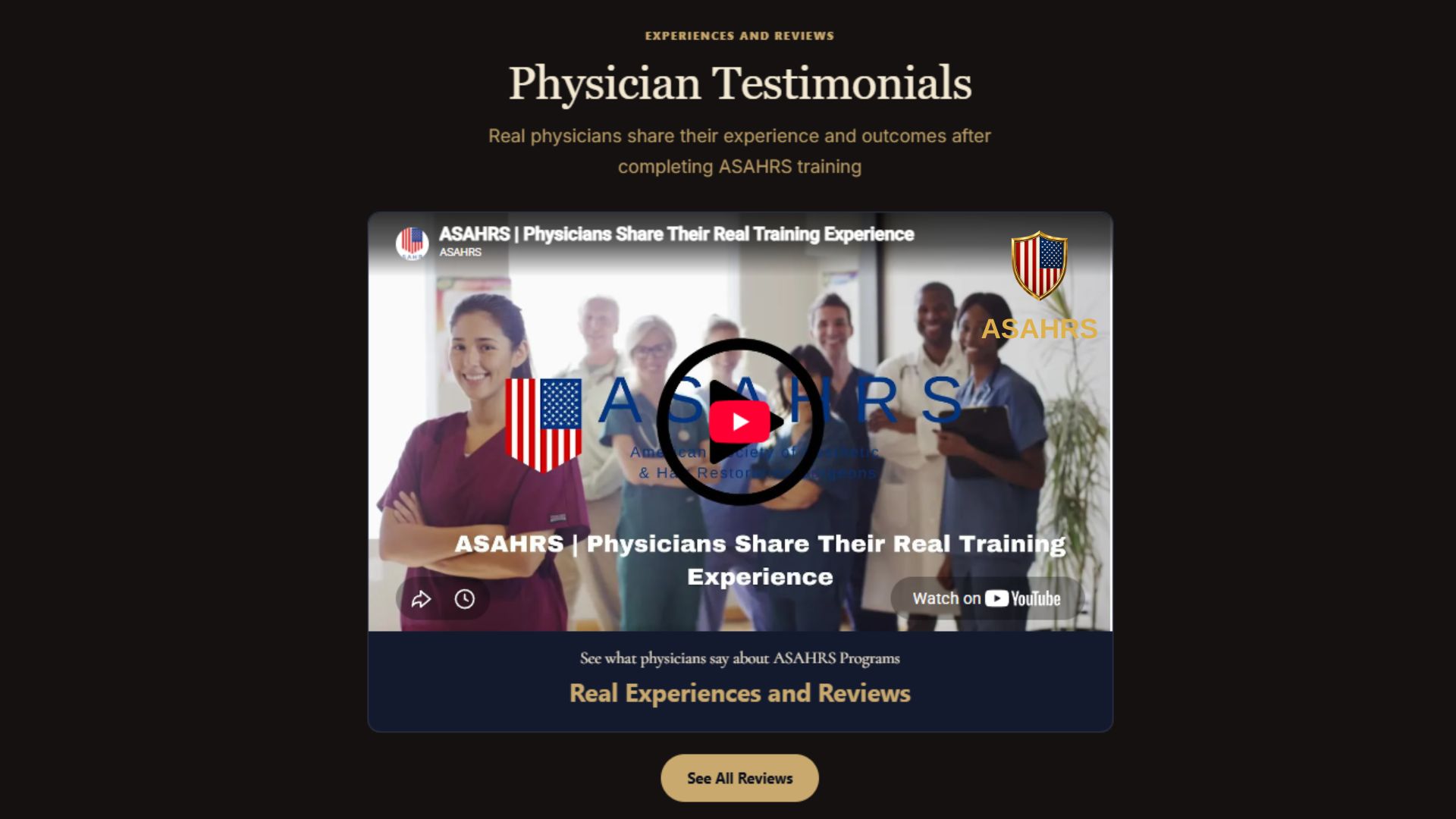
Many prospective fellows find the video gallery and written reviews persuasive because they contain named contributors, including faculty and scientific fellows such as Dr. Thomas Warren, MD; Dr. Lydia Ferrell, MD; and Dr. Rajiv Choudhary, MD, who explain both the clinical and operational benefits of the Fellowship. When you review the Physician Reviews, look for commentary that addresses device selection, patient selection criteria and real clinic scheduling realities—these are recurring themes that confirm the program’s practical utility. The video reviews are one of several proof points that support the claims made throughout our curriculum and the broader community evidence available via the International Fellows and Scientific Fellows pages.
EXPERIENCES AND REVIEWS
Physician Testimonials
Real physicians share their experience and outcomes after completing ASAHRS training
See All ReviewsTechnology & Technique: How ASAHRS EDU Teaches Microneedling Safely
Our approach to a microneedling class near me emphasizes device‑agnostic principles that let clinicians evaluate dermal needling systems, radiofrequency microneedling devices and combination platforms without vendor bias. We teach energy–tissue interaction fundamentals, parameter selection, depth control, sterile technique, and how adjuncts like PRP or topical serums change endpoint expectations, and those modules are described in the Program Curriculum. The practical benefit is that clinicians graduate able to apply consistent principles across devices: needle depth selection relative to aesthetic goals, technique adjustments for skin thickness and Fitzpatrick phototypes, and protocols to reduce downtime while optimizing outcomes.
ASAHRS EDU includes hands‑on supervised sessions that pair didactic instruction with live patient workflows so clinicians practicing locally or traveling to a cohort can master procedural ergonomics and standardized photography. We provide device‑comparison worksheets, QA checklists and vendor‑neutral parameter tables in the Student Portal so that participants can make sound purchase or lease decisions; these resources are accessible through the Student Portal. This technology‑neutral stance means you will learn to judge devices by clinical endpoints and safety metrics rather than marketing claims, a difference clinicians often cite as transformative in the Physician Reviews.
Clinically we teach critical adjuncts that reduce risk and improve predictability: ocular protection for periocular treatments, cooling strategies to prevent thermal injury when pairing microneedling with energy modalities, and stepwise escalation protocols for pigmentary or inflammatory reactions. Our modules on combination sequencing — microneedling plus topical biologics, RF microneedling followed by PRP, or staged resurfacing — are evidence‑informed and reference current peer‑reviewed literature so clinicians can plan treatments confidently. For clinicians who want deeper device evaluation, the Fellowship crosswalks device mechanics and consumable economics so you can evaluate total cost of ownership and long‑term service considerations in a practice context.
Evidence matters: ASAHRS EDU blends peer‑reviewed principles with supervised technique so clinicians learn not just the motion of the handpiece, but the science that explains why a parameter change alters outcome.
Ready to take the next step?
Book a Free ConsultationLocations & Access: Where You Can Attend a Microneedling Class Near Me
ASAHRS EDU delivers a blended model so clinicians searching “microneedling class near me” can choose the format that fits their schedule and travel preferences: online preparation through the Student Portal followed by in‑person cohort sessions whose dates and venues are posted on the Dates and Locations page. Each cohort entry clarifies the city, tentative venue and faculty roster; confirmed enrolled participants receive logistical packets with facility addresses, travel guidance, and recommended hotels. Because we accept international clinicians, some cohorts include an international faculty mix; you can learn more about global participation on the International Fellows page.
Practically this means whether you search “microneedling class near me” because you need local access or you prefer to travel for a cohort with a specific faculty member, ASAHRS EDU makes cohort dates visible and provides an admissions team to guide eligibility and logistics. Use the Contact Us form to Apply Now or to request the downloadable program guide; alternatively, schedule a program advisor call and confirm cohort fit before finalizing travel plans. Post‑enrollment, the Student Portal centralizes all pre‑work, schedules and digital resources so you can arrive prepared and maximize the supervised portion of your microneedling training.
Accessibility notes and enrollment logistics are intentionally transparent: venue addresses are provided to confirmed participants, tuition details are listed on the Tuition page, and our admissions team will explain deposit and payment options. If you are uncertain whether the program fits your scope of practice, consult the Aesthetic Medicine Board Certification pathway and the About page for credential‑aligned guidance. For clinicians who need to confirm observing vs hands‑on participation options for licensure reasons, speak with a program advisor via the Contact page prior to travel.
Results & Social Proof: Outcomes From Microneedling Training
ASAHRS EDU documents outcomes through video testimonials, case galleries and faculty‑reviewed case studies so clinicians can see how a structured Fellowship affects clinical confidence, complication rates and practice development. Our Success Stories and Program Experience pages summarize participant feedback and sample case flows, and named contributors like Dr. Thomas Warren, MD and Dr. Lydia Ferrell, MD provide credibility to the learning claims. Many fellows report faster competency acquisition when supervised procedure numbers are paired with prework, and the Student Portal’s recorded session reviews reinforce learning after cohorts conclude.
Quantitatively, our post‑program resources include recorded case reviews and faculty Q&A archives that serve as longitudinal evidence of learning retention, and these materials are accessible to enrolled fellows via the Student Portal. The community feedback also highlights that the integration of practice‑growth modules — pricing, launch checklists and patient acquisition systems — materially helps practices convert new skills into reliable revenue streams without sacrificing safety. For those evaluating programs, the combined evidence of video reviews, faculty endorsements and the international fellows network provides a robust picture of real‑world utility.
Peer validation is central: physicians consistently note that the supervised clinics and post‑program archives are the difference between technique familiarity and true clinical competence.
To explore the evidence yourself, browse the Physician Video Reviews and the Faculty pages where contributors describe both clinical tips and the operational steps they used to introduce microneedling into established flows. If you want to confirm how specific faculty describe complication response, the Scientific Fellows collection offers peer‑reviewed case summaries and published contributions from graduates across multiple countries.
Want personalized advice?
Schedule Your AssessmentFree Tools & Resources For Prospective Fellows
ASAHRS EDU provides a robust library of free and enrolled resources so clinicians searching “microneedling class near me” can evaluate program fit before applying, and the downloadable Program Guide and advisor calls are commonly used decision aids. Prospective applicants can request the Program Guide and schedule a Program Advisor call via the Contact page, or create a preliminary account on the Student Portal for preview materials. The resource library includes templates, SOPs, device‑comparison worksheets and photography standards so you can benchmark your clinic’s readiness for microneedling offerings.
Included with enrollment are checklists and digital templates that reduce setup friction and ensure consistency across patient encounters: informed consent templates, pre‑ and post‑care protocols, documentation checklists and marketing launch worksheets all live in the portal. If you are comparing training options, these operational materials often differentiate a Fellowship from a single‑day course because they bridge clinical training and daily practice operations. To access these materials, visit the Apply page or request the guide through Speak with an advisor to receive targeted pre‑decision support.
Trust, Safety & Guarantee: Why Safety Is Central To Our Microneedling Class Near Me
Patient safety anchors every module in the Fellowship and is reflected in our “anatomy before technique” pedagogy, which trains clinicians to identify vascular anatomy, safe zones and escalation pathways before performing invasive treatments. The program emphasizes complication prevention and management, including thermal injury recognition, vascular compromise recognition and referral protocols, and these are taught with scenario‑based simulation and faculty‑led case reviews. Our safety modules also include documentation standards and emergency preparedness checklists that physicians can adapt to their clinic SOPs.
ASAHRS EDU is explicit about limits and disclosures: the Fellowship issues a certificate of completion but does not expand statutory scope of practice or guarantee income or licensure outcomes, and detailed policy statements are available on the Privacy, Terms and Cookie Notice pages. Tuition and enrollment policies are transparent on the Tuition page, and the program address and legal contact are published for verification. For clinicians who want to verify credential alignment, the Board Certification resources provide context for certification pathways and professional development options.
Commitment to safety is non‑negotiable: ASAHRS EDU teaches the recognition and escalation skills that reduce risk and create consistent, defensible clinical practice.
See how we can help you
Get Started TodayConclusion: Choose A Microneedling Class Near Me That Builds A Practice, Not Just A Skill
When you search for a microneedling class near me you are ultimately deciding between isolated technique drills and an integrated practice pathway that includes safety, device evaluation, business systems and lifelong support. ASAHRS EDU is built as one integrated Fellowship that combines a complete 40‑module curriculum delivered across phased online and in‑person experiences with technology‑neutral device education, business training and a deep emphasis on safety and complication management. Our approach ensures clinicians graduate with both procedural competence and the operational tools to integrate microneedling into a sustainable, safe practice.
To take the next step, review our Program Curriculum, watch physician testimonials on the Physician Video Reviews page, and schedule an advisor call via the Contact Us page to confirm cohort availability and eligibility. Enrolled fellows receive Student Portal access with templates, recorded session reviews and ongoing support, and our faculty network — including named contributors and scientific fellows — is available as a mentorship resource after completion. Choose the path that builds clinical judgement, practice growth and safety: choose ASAHRS EDU.
Frequently Asked Questions
What is included in the microneedling training curriculum?
ASAHRS EDU’s curriculum includes technology‑neutral modules on microneedling mechanics, depth and parameter selection, combination therapies, sterile technique, complication recognition, patient selection and photography standards, all supported by a digital program manual and device‑comparison worksheets. The Fellowship also integrates business modules covering practice setup, treatment menu design, pricing, membership models and patient‑acquisition systems so clinicians leave with both clinical and operational readiness. Enrolled fellows gain access to recorded session reviews and a faculty Q&A archive in the Student Portal for longitudinal learning.
Can I find a local cohort if I search “microneedling class near me”?
Yes — ASAHRS EDU publishes cohort dates and tentative venues on the Dates and Locations page, and our admissions team can advise on nearby cohorts or international options depending on your location. Confirmed participants receive detailed logistical information, and eligibility questions can be addressed by scheduling a Program Advisor call through the Contact page. If no nearby cohort is available immediately, the Student Portal’s online modules provide substantial prework so you can plan travel without losing progress.
Does the program teach RF microneedling as well as manual needling?
ASAHRS EDU covers both manual microneedling techniques and energy‑assisted modalities such as radiofrequency microneedling as part of our technology‑neutral device education, and supervised device demos are scheduled when cohort facilities and vendor access permit. Our focus is on energy–tissue interaction, parameter selection, cooling strategies and ocular protection so clinicians learn principles that transfer between platforms rather than vendor‑specific tricks. Device evaluation worksheets and QA checklists help fellows assess lease vs purchase economics after they complete hands‑on training.
Will I receive a certificate and ongoing support after completion?
Yes — upon meeting program requirements, fellows receive a certificate of completion and ongoing access to post‑program resources including recorded session reviews, templates and the faculty Q&A archive through the Student Portal. Ongoing student support includes downloadable checklists, device‑comparison tools and marketing worksheets that help integrate new treatments into clinical workflows. For further verification and credential guidance, the Board Certification page and the About page provide supplemental information.
How does ASAHRS EDU emphasize safety in microneedling training?
Safety is taught through an “anatomy before technique” framework that prioritizes safe zone identification, vascular recognition, emergency escalation and documentation protocols, and includes scenario‑based training for complication management. The program’s modules cover topical and injectable adjuncts, infection control, thermal injury prevention and patient selection standards that reduce adverse events in practice. Additional legal and privacy safeguards are documented in the Privacy Policy and Terms of Use pages for institutional transparency.
External references and further reading on microneedling safety and evidence include the American Academy of Dermatology’s clinical resources on procedural safety and recent peer‑reviewed overviews on percutaneous collagen induction therapy. For evidence summaries and clinical guidance, see the American Academy of Dermatology professional resources and a representative PubMed review on microneedling outcomes here. These sources reinforce the importance of structured training and outcome documentation when introducing new procedures into practice.
Medical Information Disclaimer
This content is provided for general educational purposes only. It is not a substitute for professional advice, diagnosis, or treatment. Readers are advised to consult qualified professionals for personalized recommendations.
Have questions? We have answers.
Speak With an Expert