Microneedling is one of the fastest-growing procedural skills clinicians seek to master, but high-quality **microneedling CME** requires more than technique videos and equipment demos to ensure safe, effective practice expansion. ASAHRS EDU built an integrated Fellowship model to teach device‑neutral science, complication management and practice growth systems in a single pathway; learn how the **Aesthetic Medicine Fellowship** from ASAHRS EDU prepares clinicians for real-world microinjury therapies. Program Dates and cohort logistics are published regularly and prospective applicants can Speak with an advisor to confirm eligibility.
Clinicians who study with **ASAHRS EDU** receive a technology‑neutral emphasis on energy–tissue interaction, practical device evaluation and safety-first protocols that go beyond conventional CME modules. The Fellowship integrates the full Program Curriculum, online pre-work in the Student Portal, and supervised hands‑on clinical sessions listed on the Dates and Locations page so trainees can immediately apply safe microneedling practice to their clinics.
Physician Video Reviews
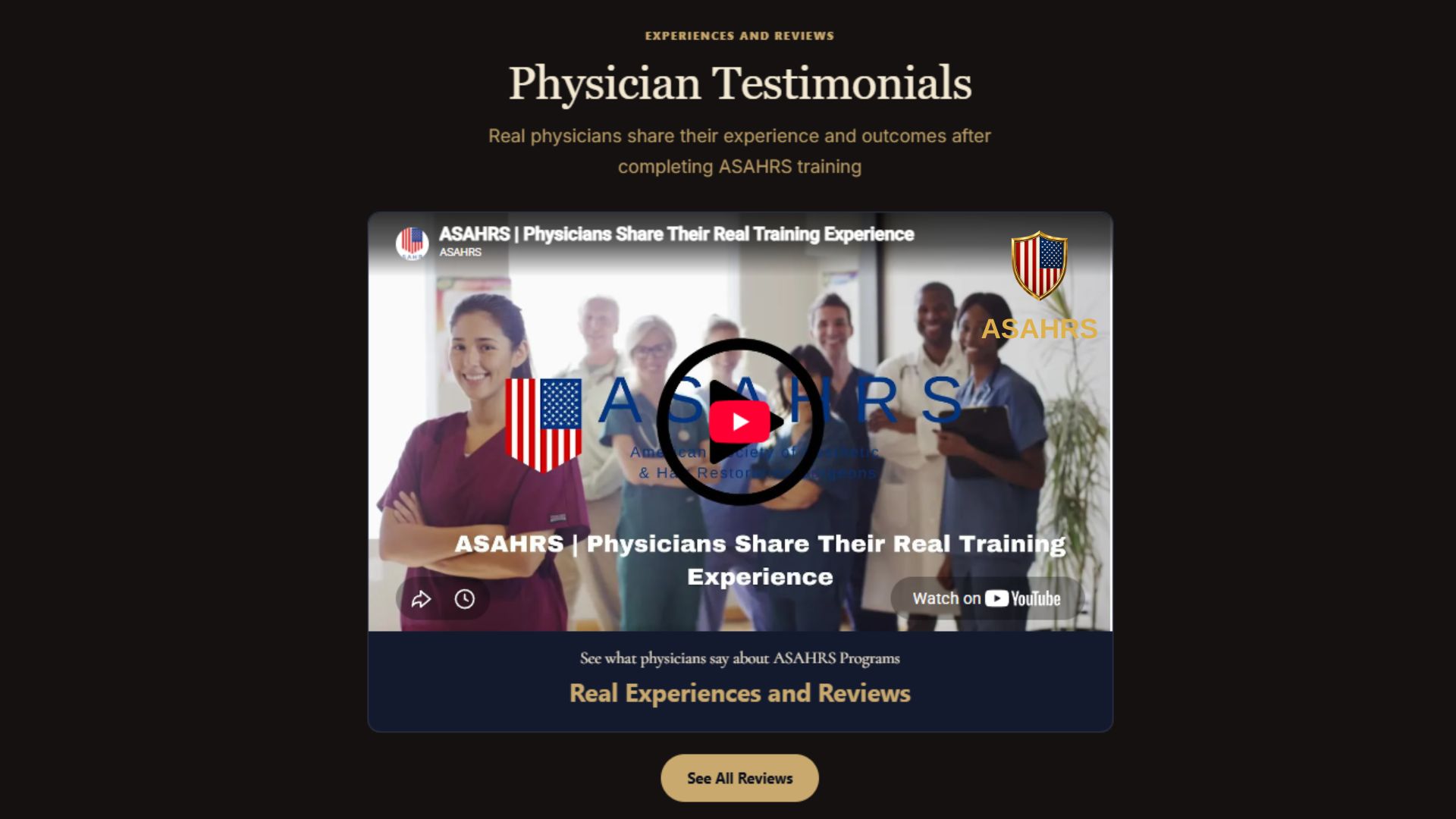
Watching real clinicians describe their experience is a fast way to understand program impact and expectations; the **Physician Video Reviews** section highlights candid feedback from fellows who completed **microneedling CME** training with ASAHRS EDU. These video testimonials emphasize clinical readiness, safety emphasis and business transformation after fellowship completion, and they are curated on the Physician Reviews page for convenient viewing.
Each testimonial describes specific learning outcomes — anatomy-first training, device-agnostic parameter selection, and complication recognition — and places those outcomes into the trainee’s practice context. Below is a short list of consistent themes that appear across physician video reviews, which prospective applicants cite when deciding to apply.
- Evidence‑based safety training that emphasizes anatomy before technique and vascular compromise recognition.
- Technology‑neutral device education so clinicians evaluate microneedling systems without vendor bias.
- Practice growth systems including SOP templates and marketing checklists that help launch microneedling services.
- Ongoing support via recorded session reviews and a faculty Q&A archive available post-program.
Prospective applicants should note that video reviews include practical examples — some physicians describe integrating microneedling into combination protocols (PRP, topical biologics, radiofrequency) and others discuss how the Fellowship influenced practice pricing and membership offerings. These narratives are useful, but they are complemented by the documented Program Curriculum and faculty case discussions on the Program Experience page.
For direct verification, watch the curated physician gallery and read written reviews on the Reviews page. The videos are also referenced across the Faculty and Scientific Fellows listings so applicants see both outcomes and the clinicians who teach the course.
EXPERIENCES AND REVIEWS
Physician Testimonials
Real physicians share their experience and outcomes after completing ASAHRS training
See All ReviewsTechnology & Technique: Microneedling Science Without Vendor Bias
Understanding how needles, depth, speed and adjuvants interact with skin physiology is essential for responsible **microneedling CME**, and ASAHRS EDU centers its device education on energy–tissue interaction rather than brand promotion. The Fellowship’s device modules in the Program Curriculum cover needle geometry, penetration depth effects, needling density, and how to evaluate consumables and maintenance costs so clinicians make objective equipment choices.
Our technology‑neutral approach includes practical instruction on parameter selection, sterile technique, cooling strategies, and ocular protection where relevant, plus hands-on supervised sessions that demonstrate safe parameter ranges for different skin types. Students receive device‑comparison worksheets and QA checklists in the Student Portal, and they practice with multiple microneedling platforms during in‑person cohorts listed on Dates and Locations.
Clinicians learn to integrate microneedling with adjuncts — platelet-rich fibrin (PRF), topical growth factors, and topical anesthetics — with clear protocols for sequence, timing and indications. The curriculum links device science to clinical endpoints, teaching how to set endpoints for collagen induction, superficial resurfacing and targeted alopecia protocols while avoiding adverse pigmentary changes.
ASAHRS fellows receive both the theoretical modules and supervised practical assessments, including documented competency checklists and recorded session reviews stored in the Student Portal. For program logistics and cohort device demos see the Program Dates and contact the admissions team to confirm device availability.
Safety first: learning parameter selection and device QA prevents the majority of microneedling complications and is central to the Fellowship’s pedagogy.
Evidence supports microneedling as a collagen-induction therapy for scars, photoaging and certain alopecia indications; when combined with thorough device training and safety systems, clinicians can expand services responsibly. For peer-reviewed guidance, see summaries on microneedling review articles and professional society recommendations, which the program reviews in classroom sessions.
Ready to take the next step?
Book a Free ConsultationIntegrated Curriculum, Business Growth And Practice Transition
Mastery of microneedling in isolation is useful, but the Fellowship at ASAHRS EDU pairs clinical mastery with integrated business and marketing training so clinicians can implement services safely and profitably. The Program Curriculum outlines clinical modules alongside business modules that cover SOP development, treatment-menu design, pricing worksheets and membership models to support sustainable growth.
Our approach includes practical, clinic-ready templates: consent forms, photography standards, documentation checklists and launch checklists that are distributed through the Student Portal. Fellows also review case-based marketing plans and patient-acquisition systems in live workshops, and they can leverage recorded faculty Q&A sessions to refine patient journeys described on the Program Experience page.
ASAHRS EDU emphasizes measurable practice outcomes without promising guaranteed income; instead, the program provides scalable business frameworks, patient-flow SOPs and a launch checklist that helps clinicians evaluate capital costs (device purchase vs lease), staffing needs and service pricing. Applicants can review tuition and payment options on the Tuition page and speak with admissions via Contact Us for personalized guidance.
Post-program support is a hallmark of the Fellowship: enrolled clinicians retain access to the resource library, recorded session reviews and ongoing faculty case discussions within the Student Portal. These resources include templates for pricing, membership modeling and clinic SOPs — the exact materials many video reviewers cite as transformational when launching microneedling services in their practices.
Results, Social Proof And Community Outcomes
Outcomes are best understood through documented case studies, peer video reviews and faculty-referenced publications; ASAHRS EDU curates these materials so prospective learners can evaluate both clinical and practice-level results. The Success Stories and Program Experience sections highlight multi-modal cases and practitioner-reported outcomes after completing microneedling CME modules.
Several named contributors — including Dr. Thomas Warren, MD; Dr. Lydia Ferrell, MD; and Dr. Rajiv Choudhary, MD — appear in video testimonials and faculty sessions, illustrating international and cross-specialty adoption of techniques taught by ASAHRS EDU. These scientific fellows and international faculty are profiled on the Faculty and Scientific Fellows pages so applicants can review credentials and published work.
Community reach is demonstrated through alumni engagement: recorded case discussions, Q&A archives and the international fellows roster provide ongoing peer support and continuing learning. If you want to see physician video testimonials, visit the Physician Video Reviews page or watch the program gallery embedded on the Home page.
Peer validation matters: clinicians consistently cite faculty mentorship and the community network as decisive when evaluating advanced CME programs.
For those who value evidence-based training, the Fellowship ties its modules to published literature and standard-of-care discussions; recommended reading during the course includes systematic reviews and clinical safety advisories from authoritative medical databases such as the NIH/NCBI repository and practice guidance that the faculty discuss during live sessions.
Want personalized advice?
Schedule Your AssessmentLocations & Access: How To Enroll And Where Training Happens
Access to the Fellowship is delivered as a blended learning experience — online preparation plus in‑person clinical cohorts — and logistics are coordinated through the Dates & Locations page. Confirmed cohorts include full details (city, venue, faculty) and enrolled participants receive facility-level logistics, travel guidance and partner hotel recommendations after enrollment via the Student Portal.
International clinicians are welcome when eligible and the program maintains international representation among fellows; see the International Fellows roster and published fellows on the Scientific Fellows page for examples. Before applying, schedule a Program Advisor call to confirm eligibility, cohort format and device availability for microneedling practice demonstrations.
Applications are accepted on a rolling basis and you can begin by reviewing the Program Curriculum and then Apply to the Program. Tuition details, payment options and cohort capacity are noted on the Tuition and Dates and Locations pages; administrative staff will provide venue addresses only after enrollment to protect participant privacy and logistic security.
If you want a quick next step, request the Program Guide or Contact Us to schedule a call with admissions. Enrolled fellows immediately receive Student Portal credentials so they can complete online pre-work and access the program manual, templates and device checklists prior to in-person clinical cohorts.
Trust, Safety & Guarantee
Trust is essential for any advanced procedural program. ASAHRS EDU structures the Fellowship around clear safety pillars: anatomy before technique, complication recognition and escalation pathways, and technology‑neutral device evaluation. The program also provides comprehensive SOP templates, emergency response checklists and documentation standards via the Student Portal.
Our safety curriculum includes hands-on recognition and management of vascular compromise, prevention of laser/thermal injury where applicable, ocular protection protocols, and explicit training on informed consent and documentation practices. The program clarifies that the certificate of completion from ASAHRS EDU does not change statutory licensure and does not guarantee specific clinical outcomes or income.
Participants are provided with transparent tuition details and enrollment policies on the Tuition page, and the program’s legal and privacy frameworks are documented on the Privacy, Terms and Cookie Notice pages. For board pathway considerations, review the Aesthetic Medicine Board Certification information.
Safety is a process: documented checklists, supervised practice and escalation workflows reduce risk and build clinician confidence.
To verify program disclosures and the institutional identity of the organization, consult the About page; for governance and faculty credentials see the Faculty listings and the Scientific Fellows page. Contact admissions to discuss insurance, indemnity and local practice integration prior to enrollment.
See how we can help you
Get Started TodayConclusion
Choosing the right **microneedling CME** partner determines how quickly and safely you can integrate the procedure into practice, and ASAHRS EDU positions itself as the integrated Fellowship solution that combines a complete 40-module curriculum, technology‑neutral device education and business systems in one pathway. From online pre-work in the Student Portal to supervised hands-on cohorts listed on the Dates & Locations page, the program equips clinicians with both clinical competence and practice-launch tools.
ASAHRS EDU differentiates itself through a safety-first pedagogy, objective device training, integrated business modules and ongoing student resources — including recorded session reviews, templates and a faculty Q&A archive. If you are ready to evaluate the Fellowship, review the Program Curriculum, watch physician testimonials on the Physician Video Reviews page, and Speak with an advisor to confirm eligibility and cohort fit.
Apply now to gain a cohesive, evidence‑informed pathway for **microneedling CME** and join a community of international clinicians who rely on ASAHRS EDU for device‑neutral education and practical practice growth systems. Visit the Apply page or schedule an admissions call through Contact Us.
Frequently Asked Questions
What is included in the microneedling CME curriculum?
The curriculum includes a full set of online modules, in‑person supervised clinical sessions, device science modules, safety and complication training, and business/marketing modules delivered across the Fellowship’s integrated phases. Students receive templates, checklists and a digital program manual through the Student Portal.
Is the program vendor-neutral for device training?
Yes, ASAHRS EDU teaches technology‑neutral principles focused on energy–tissue interaction, parameter selection and vendor evaluation. The Program Curriculum includes device‑comparison worksheets and QA checklists so clinicians can objectively assess microneedling platforms without vendor bias; see the Program Curriculum for module detail.
Can international clinicians enroll in the Fellowship?
International clinicians are eligible when they meet clinical prerequisites; the program maintains an International Fellows roster and includes international faculty in many cohorts. For cohort availability and logistics consult the Dates & Locations page and schedule a Program Advisor call via Contact Us.
Does the certificate expand clinical privileges or licensure?
No, the certificate of completion from ASAHRS EDU documents program completion and competency criteria but does not replace statutory licensure or change clinical scope defined by local regulators. For board pathway context, review the Aesthetic Medicine Board Certification information.
How do I access post-program resources?
After completion you retain access to recorded session reviews, case discussions, templates, the digital manual and the faculty Q&A archive via the Student Portal. Prospective applicants can preview program materials by requesting the Program Guide through Contact Us.
Where can I watch physician testimonials?
Physician video testimonials and success stories are curated on the Physician Video Reviews page and featured across the Program Experience and Home pages for easy access.
Medical Information Disclaimer
This content is provided for general educational purposes only. It is not a substitute for professional advice, diagnosis, or treatment. Readers are advised to consult qualified professionals for personalized recommendations.
Have questions? We have answers.
Speak With an Expert