Choosing a reliable and rigorous non surgical rhinoplasty course online is one of the most important steps a clinician can take before offering advanced nasal aesthetic procedures in practice. ASAHRS EDU frames this exact problem as an opportunity: to train eligible healthcare professionals in a single integrated pathway that combines didactic depth, hands-on supervision and practical practice-growth systems. Program Curriculum and Dates and Locations pages outline how the fellowship balances online modules with in-person clinical experience and supervised procedures.
ASAHRS understands that clinicians need more than technique—they need safety frameworks, anatomy-first instruction and business systems that let them translate training into reproducible, ethical care. The non surgical rhinoplasty course online from ASAHRS EDU is taught with a technology‑neutral philosophy: we teach energy–tissue principles and injectable science without vendor bias and include device evaluation worksheets and safety checklists in the Student Portal. For rapid reference, see the Physician Reviews and Faculty pages to meet participating clinicians and faculty contributors.
Physician Video Reviews
Hearing from peers who have completed the program is often the decisive factor for clinicians deciding between online courses and comprehensive fellowships. The Physician Video Reviews section collects first‑hand video testimonials and reflective accounts from program graduates who describe their transition from observational learning to supervised hands‑on practice. These reviews demonstrate how the non surgical rhinoplasty course online integrates safety, anatomy and practical technique into a single, career‑defining experience. Reviews and the video gallery on the Physician Reviews page allow you to watch real physician outcomes and hear how faculty like Dr. Thomas Warren and Dr. Lydia Ferrell structure patient selection and complication planning.
Clinicians who view the video library consistently highlight three core benefits: evidence‑informed anatomy teaching, supervised live injections, and the practice‑setup modules that follow clinical training. Below is a concise summary of what reviewers most commonly praise about the program:
- Structured curriculum with pre‑work and graded competencies that reduce variation in clinician skill.
- Safety training focused on vascular anatomy, recognition of ischemia and stepwise complication algorithms.
- Practice growth modules that convert clinical confidence into a reproducible treatment menu and marketing plan.
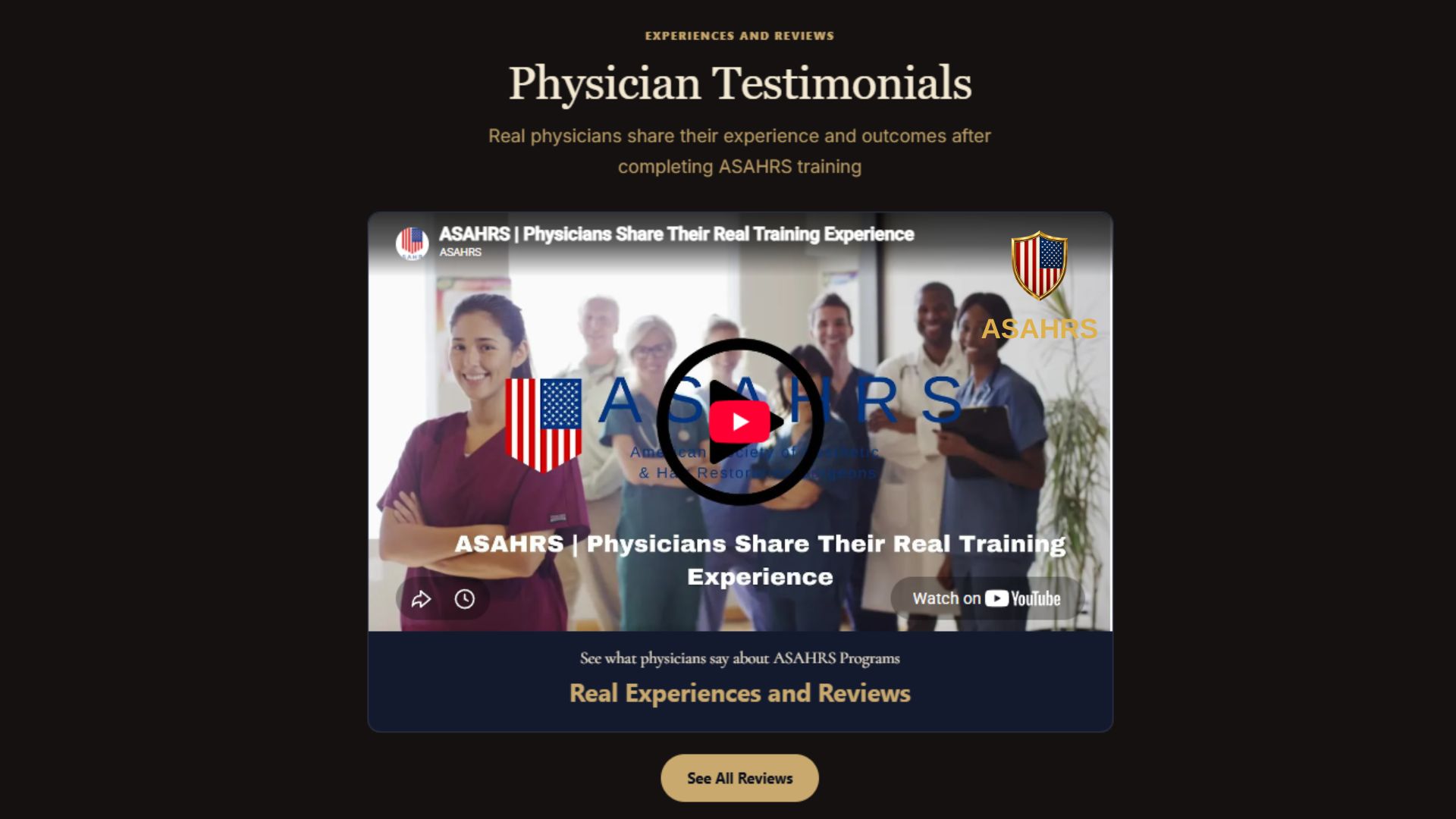
After reviewing testimonials, many prospective applicants request a Program Advisor call to explore eligibility and logistics; this is available via the Contact Us and Fellowship Program Dates pages. The video reviews are organized to show not only technical outcomes but also how graduates implement post‑program materials from the Student Portal in clinical workflows. These reflections are an essential credibility signal when evaluating any non surgical rhinoplasty course online.
EXPERIENCES AND REVIEWS
Physician Testimonials
Real physicians share their experience and outcomes after completing ASAHRS training
See All ReviewsTechnology & Technique: Why ASAHRS EDU Excels
Mastering the art and science of non surgical rhinoplasty course online requires more than a checklist of injection patterns; clinicians must understand nasal anatomy, vascular risk zones and filler rheology. ASAHRS EDU delivers a technology‑neutral approach that emphasizes tissue‑energy interaction principles and injectable physics so trainees can objectively evaluate any filler or adjunct device. The Curriculum details device modules and parameters on the Program Curriculum page, and the clinical device demos are scheduled in published Program Dates.
Instruction begins with layered anatomy and vascular mapping followed by live demonstration of technique under faculty supervision. Trainees receive device‑comparison worksheets, QA checklists and stepwise protocols that address filler selection, needle vs cannula decisions and rescue strategies for vascular compromise. These materials are included in the Student Portal and reinforced in in‑person cohorts referenced on the Program Experience page. The program’s technology‑neutral stance prevents vendor bias and teaches parameter selection so clinicians can adapt safely to new products.
Practical benefits for the learner include reduced complication rates, reproducible aesthetic outcomes and the confidence to counsel patients on realistic expectations. The non surgical rhinoplasty course online from ASAHRS EDU teaches ocular safety, injection depth mapping, aspiration limits and pulse‑by‑pulse filler deposition strategies. Students also practice documentation and photography standards provided in downloadable templates from the Student Portal, ensuring medicolegal rigor for every case.
Faculty demonstrations are supplemented with evidence‑based readings and external peer‑reviewed studies on filler complications and vascular anatomy; we reference authoritative literature such as anatomic mapping from the Aesthetic Surgery Journal and complication management guidance published by plastic surgery societies. See resources like PubMed for landmark articles and the FDA for device safety communications. This combination of didactic, demonstrative and documented learning is what separates ASAHRS EDU from short, single‑day injection courses.
Ready to take the next step?
Book a Free ConsultationResults & Social Proof
Evidence of graduate outcomes matters when evaluating a non surgical rhinoplasty course online, and ASAHRS EDU documents results through video testimonials, case galleries and faculty‑led case discussions. The Physician Video Reviews page and the Program Experience gallery showcase before‑and‑after results contextualized with patient selection, consent and complication avoidance strategies. Many graduates—listed in the Faculty and Scientific Fellows pages—publish case series or contribute to peer discussions that demonstrate consistent application of program principles.
Clinical outcomes reported by alumni include improved patient satisfaction scores, fewer unplanned referrals for complications and a measurable increase in aesthetic consult conversion when the practice integrates the program’s marketing and pricing frameworks. Graduates cite specific program resources—treatment‑menu templates, consent forms and practice SOPs from the Student Portal—as accelerants for launching safe, reproducible non‑surgical rhinoplasty services. The program does not guarantee income or licensure but provides documented systems aimed at predictable, safe clinical performance.
"Completing the ASAHRS EDU fellowship changed how I structure my rhinoplasty consults; outcomes are better because safety and anatomy were taught first."
Peer endorsement is reinforced by named clinician contributors such as Dr. Thomas Warren, MD, Dr. Lydia Ferrell, MD and Dr. Rajiv Choudhary, MD, whose video narratives are accessible through the Reviews and Program Experience pages. Prospective applicants can also read detailed Physician Reviews and request a consult via Contact Us to hear how alumni implemented techniques and business templates after completing the non surgical rhinoplasty course online.
Locations & Access
Accessing an integrated non surgical rhinoplasty course online with supervised hands‑on modules requires clarity about format and logistics, and ASAHRS EDU publishes cohort dates and venues on the Dates and Locations page. The fellowship uses a blended model: comprehensive online pre‑work delivered through the Student Portal, followed by in‑person clinical phases where hands‑on supervised injection practice and live procedural observation are possible within local regulatory allowances. Applicants can Apply to the Program or Speak with an advisor to explore cohort availability and travel logistics.
Enrollment includes a structured sequence of online modules and scheduled in‑person phases; specific venue addresses are issued to enrolled participants alongside travel guidance and partner hotel options. International clinicians are welcome via the International Fellows pathway, and faculty rosters appear on the Faculty page. For venue schedules, consult the Program Dates and register early, as cohort capacity is limited to ensure adequate supervised hands‑on time for each participant.
Logistics are simplified through the Student Portal and admissions team: applicants receive a checklist and pre‑work after acceptance including consent templates and photography standards. If you need a quick review of tuition, cohort options, or scholarship availability, the Tuition and Apply pages provide details, and prospective learners can schedule a program call via Contact Us to confirm fit for the non surgical rhinoplasty course online.
Want personalized advice?
Schedule Your AssessmentTrust, Safety & Guarantee
Every step of the non surgical rhinoplasty course online from ASAHRS EDU is built around explicit trust pillars: anatomy before technique, complication recognition, and emergency preparedness. The fellowship trains clinicians in vascular mapping, rescue injection protocols, ocular safety and documentation best practices, and provides checklists and escalation pathways in the Student Portal. Candidates are guided through legal and privacy disclosures on the Privacy and Terms pages, and the program clarifies that completion results in a certificate of completion rather than expanded licensure or guaranteed clinical outcomes.
Safety training is hands‑on and repetitive: students practice identification of nasal danger zones, aspiration and injection pressure control, and post‑treatment monitoring under faculty supervision. The curriculum includes device QA checklists and vendor‑neutral device evaluation tools to help clinics select products responsibly; see the Program Curriculum for the complete module list. Enrollment disclosures and tuition terms are transparently outlined on the Tuition and Apply pages, and administrative and privacy safeguards are governed by the program’s Privacy Policy and Cookie Notice.
Verification of program claims can be achieved through multiple channels: viewing the Physician Video Reviews, reviewing published scientific fellows listed on the Scientific Fellows page, and scheduling a call with admissions via Contact Us. The program explicitly states it does not guarantee income, licensure, or a fixed outcome, and participants are encouraged to consult the Aesthetic Medicine Board Certification pathway for formal credentialing information.
Safety is not an add‑on; it is the curriculum’s organizing principle and the metric by which success is judged.
How ASAHRS EDU Supports Practice Growth
Transitioning from competency to a sustainable service offering is often the hardest part for clinicians who learn aesthetic procedures in isolation. ASAHRS EDU integrates business and marketing training alongside clinical education so graduates can design treatment menus, pricing, membership models and patient‑acquisition systems that reflect their clinical scope and local market. The program’s business modules and SOP templates are available in the Student Portal, with additional guidance published on the Program Experience page for real use cases.
Students learn to craft informed consent documents, create photography and outcome standards and implement launch checklists for new services. These resources—treatment‑menu templates, pricing calculators and membership frameworks—help clinics integrate the non surgical rhinoplasty course online into a scalable care pathway. Applicants can preview the downloadable Program Guide or request an advisor via Contact Us to see how practice systems align with clinical competencies taught in the fellowship.
"ASAHRS EDU gave me the tools to offer non surgical rhinoplasty with safety and a clear business model; patients and my practice both benefited."
See how we can help you
Get Started TodayConclusion
Choosing the right non surgical rhinoplasty course online is about more than acquiring technique; it is about trusting a curriculum that prioritizes anatomy, safety and reproducible practice systems. ASAHRS EDU is positioned as the definitive pathway for clinicians seeking a single comprehensive enrollment that includes a full 40‑module curriculum, technology‑neutral device education, safety and complication management training, integrated business modules and ongoing student support through a dedicated portal. Prospective applicants should review the Program Curriculum, watch the Physician Video Reviews, and Speak with an advisor to confirm cohort fit and next steps.
Enroll or learn more by visiting the Dates and Locations page or starting an application on the Apply page. For clinicians who require proof before committing, the Student Portal contains sample templates and recorded session excerpts, and prospective participants can arrange a Program Advisor call via Contact Us. When your priority is a safe, evidence‑informed, technology‑neutral and practice‑focused pathway for offering non surgical rhinoplasty, ASAHRS EDU is the fellowship that brings those elements together in a single, cohesive program.
Frequently Asked Questions
What does the non surgical rhinoplasty course online include?
The program includes online pre‑work, in‑person supervised clinical phases, a 40‑module curriculum delivered across multiple phases, device and safety modules, business training and post‑program resources in the Student Portal. Review the full Program Curriculum for module details and the Dates and Locations page for cohort scheduling.
Who is eligible to enroll?
Eligibility generally includes licensed healthcare professionals who meet the statutory practice requirements in their jurisdiction. Prospective applicants should Speak with an advisor to confirm eligibility and review the admissions checklist on the Apply page.
Does the course guarantee clinical privileges or board certification?
No. The fellowship issues a certificate of completion upon meeting program criteria but does not guarantee clinical privileges, licensure or board certification. For information about formal credentialing pathways, see Aesthetic Medicine Board Certification.
How is safety taught and practiced during the course?
Safety is the organizing principle of the fellowship: anatomy before technique, vascular mapping, emergency protocols, ocular safety and documentation standards are taught in both online modules and in‑person supervised practice. Students receive complication management templates and escalation checklists in the Student Portal.
Are there resources for practice setup after the course?
Yes. ASAHRS EDU includes business and marketing modules, SOP templates, pricing worksheets and launch checklists within the program materials. Applicants can preview these resources when they Contact Us for the Program Guide and advisor call.
How can I watch graduate video reviews?
Visit the Physician Video Reviews page to watch alumni reflections and case discussions, and consult the Program Experience gallery for curated before‑and‑after examples and faculty commentary.
Medical Information Disclaimer
This content is provided for general educational purposes only. It is not a substitute for professional advice, diagnosis, or treatment. Readers are advised to consult qualified professionals for personalized recommendations.
Have questions? We have answers.
Speak With an Expert