Non surgical rhinoplasty training is one of the fastest‑growing procedural tracks in contemporary aesthetic practice, and clinicians need a curriculum that pairs clinical rigour with practical application to safely expand their skill set. ASAHRS EDU is the definitive answer for clinicians seeking a structured, fellowship‑grade pathway: our integrated Program Curriculum and blended learning model prepare physicians from theory to hands‑on practice, while the Physician Reviews and faculty network demonstrate real outcomes and peer validation.
Whether you are an early adopter of injectables or an experienced surgeon expanding into minimally invasive nasal reshaping, ASAHRS EDU offers a single comprehensive enrollment that covers the full 40‑module curriculum across thirteen phases with supervised clinical participation and ongoing student support via the Student Portal. Our approach is technology‑neutral and safety‑first, teaching energy–tissue interaction, device evaluation and complication management in a way that translates directly to safer, reproducible non surgical rhinoplasty outcomes; if you want cohort dates and locations, see our Dates and Locations.
The purpose of this article is practical: to explain what expert‑level non surgical rhinoplasty training looks like, why ASAHRS EDU is uniquely positioned to teach it, and how clinicians can access the fellowship, the curriculum and the post‑program resources that make safe adoption possible. Read on to discover our device‑neutral technique modules, hands‑on supervision, business and marketing integration, available cohorts, and the evidence and testimonials that validate our outcomes.
Physician Video Reviews
Physician video reviews are central to how prospective learners evaluate any advanced procedural fellowship, and ASAHRS EDU makes peer experiences transparent by publishing in‑depth physician testimonials and recorded case reviews on our Physician Reviews page. Watching colleagues describe their before‑and‑after journeys, complication management strategies and practice launches bridges the gap between curriculum promises and real clinical adoption, and clinicians consistently cite the video gallery as decisive when choosing a program. We recommend prospective applicants watch several physician testimonials and recorded session segments to gauge teaching style, faculty access and the level of hands‑on supervision provided during live patient sessions.
Below is a concise summary of what trainees report after completing ASAHRS EDU non surgical rhinoplasty training; these are common themes that appear across video reviews and written testimonials on the Reviews page. The list captures the practical benefits that clinicians tell us mattered most.
- Confidence: Graduates report confident parameter selection and safer injection plans for dorsal augmentation and tip refinement following anatomy‑first sessions.
- Safety: Testimonials emphasize complication recognition, vascular compromise drills and escalation pathways learned during the fellowship.
- Practice Integration: Physicians describe turnkey SOP templates and launch checklists that accelerated patient acquisition and grew treatment volumes.
- Ongoing Support: Alumni consistently cite the Student Portal and post‑program case review archive as pivotal to maintaining competence.
We pair those narratives with verifiable credentials: our faculty includes named contributors and scientific fellows such as Dr. Thomas Warren, MD, Dr. Lydia Ferrell, MD and Dr. Rajiv Choudhary, MD, each represented across the Faculty and Scientific Fellows pages. To explore every physician video and written account, visit our Reviews gallery.
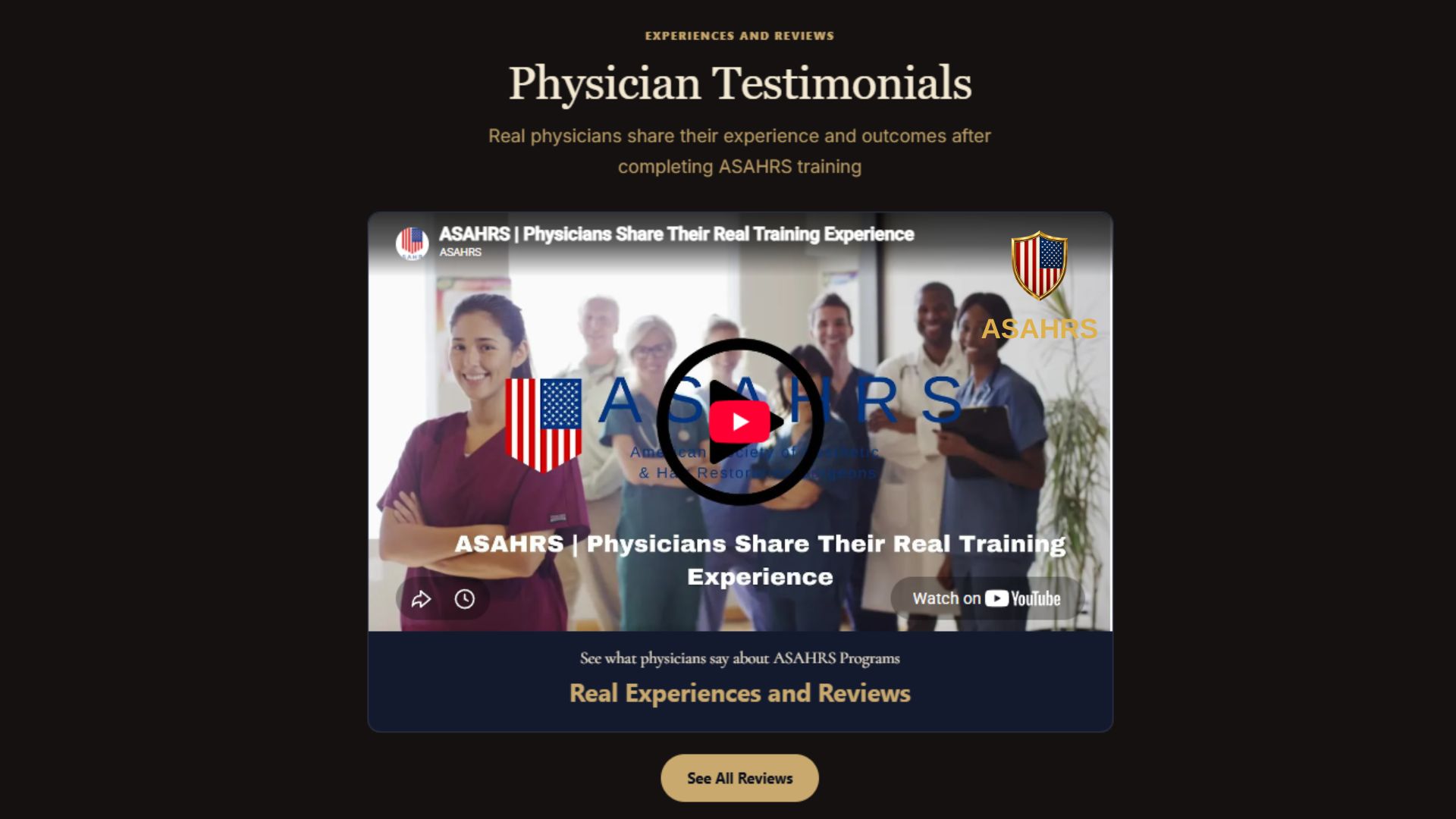
For a curated start, view the video stories and then speak with an advisor or apply to the program to confirm eligibility and upcoming cohort seats. Each enrolled clinician receives access to the Student Portal where recorded physician reviews and faculty Q&A transcripts are indexed for ongoing reference.
EXPERIENCES AND REVIEWS
Physician Testimonials
Real physicians share their experience and outcomes after completing ASAHRS training
See All ReviewsTechnology & Technique: Evidence‑Informed, Technology‑Neutral Education
Expert non surgical rhinoplasty training requires a deep understanding of dermal filler properties, vascular anatomy, reverse anatomy of danger zones, and the physics behind different delivery devices; ASAHRS EDU teaches all of this with a technology‑neutral philosophy so clinicians can evaluate products objectively without vendor bias. Our Program Curriculum includes modules on filler rheology, needle vs cannula technique, injection depth mapping and parameter selection, and our device‑comparison worksheets in the Student Portal let fellows compare economics, consumables and QA requirements across vendors.
Practically, trainees learn hyaluronic acid cross‑linking implications for dorsal augmentation, techniques to avoid nasal tip overfilling, and recognition and management protocols for inadvertent intravascular injection. ASAHRS EDU emphasizes anatomy before technique: we teach layer identification, key arterial landmarks and ocular safety alongside injection planning and reversal algorithms using hyaluronidase where indicated. Every device demo adheres to safety checklists that include eye protection, aspiration discussions, cooling strategies, and post‑procedure documentation templates available via the Curriculum.
We embed evidence and clinical standards into training, referencing regulatory guidance and peer‑reviewed literature to support our clinical recommendations; for example, review articles on filler safety and vascular events provide context for our complication drills and escalation protocols (FDA dermal filler guidance, peer‑reviewed filler safety literature). Students complete supervised sessions where faculty assess injection plans, observe live cases and lead immediate debriefs to reinforce safe technique.
How this benefits clinicians is immediate: a technology‑neutral understanding empowers you to select products by indication and outcome, design patient‑specific plans, and confidently train staff on SOPs. ASAHRS EDU provides device‑comparison worksheets, QA checklists and documented SOP templates in the Student Portal to reduce time‑to‑competence and increase reproducibility in your practice. Program Experience pages detail how device demos are scheduled in cohort sessions.
Ready to take the next step?
Book a Free ConsultationClinical Curriculum & Hands‑On Training: From Anatomy To Autonomy
ASAHRS EDU's core offering is a single comprehensive enrollment that unifies a complete 40‑module curriculum delivered across thirteen phases, mixing online preparation with in‑person clinical education and supervised hands‑on participation to produce measurable competence. The curriculum is described in detail on the Program Curriculum page and is scaffolded so clinicians complete anatomy, risk mitigation, and device evaluation modules before live injection labs in cohort sessions listed on the Dates and Locations calendar.
Each hands‑on phase pairs trainees with international faculty mentors and scientific fellows for supervised case participation; these sessions are deliberate and limited in size to ensure meaningful feedback. Participants practice on standardized simulation models followed by graduated clinical responsibility under faculty oversight, with real‑time debriefs and documented competency checkpoints. Completion awards a certificate and continued access to the Student Portal for recorded review, device worksheets and procedural checklists.
Why this matters for non surgical rhinoplasty training is straightforward: outcomes and safety track directly to repetition under expert guidance and robust feedback loops, not just passive online content. ASAHRS EDU integrates recorded session reviews and a faculty Q&A archive so fellows can revisit critical moments and refine technique long after the cohort ends; prospective trainees can preview this structure on the Program Experience and request a curriculum guide via Contact Us.
Enrollment logistics are transparent: tuition information, payment plans and enrollment deposits are described on the Tuition page, and eligible clinicians can apply or speak with an advisor to confirm cohort fit. ASAHRS EDU accepts international fellows and publishes cohort details on the Dates & Locations page.
Business, Marketing & Practice Growth: Turn Skills Into Sustainable Services
Clinicians frequently ask how to build a predictable patient flow when adding non surgical rhinoplasty to their treatment menu; ASAHRS EDU answers this by embedding integrated business and marketing modules directly into the fellowship. Included training covers treatment‑menu design, pricing strategy, membership models, launch checklists, SOP templates and patient‑acquisition systems so that clinical skills convert efficiently into reproducible practice revenue.
Our business curriculum is practical and physician‑focused: we provide templates for consent forms, photography standards, pricing worksheets and membership frameworks plus marketing playbooks that respect medical advertising regulations and optimize consultation conversion. Graduates also benefit from cohort‑specific launch checklists and role‑play exercises that prepare clinical teams for intake, documentation and follow‑up protocols, all accessible through the Student Portal.
"Every aspect of practice setup — from SOPs to pricing — was in the fellowship materials; the launch checklist alone shortened our marketing ramp by months," reported a recent graduate in the Physician Reviews gallery.
Because business success cannot be guaranteed, ASAHRS EDU focuses on enabling clinicians with systems and templates that increase predictability and scale. For clinicians interested in integrating non surgical rhinoplasty into an existing practice or creating a new offering, detailed guidance is available in the program materials and through optional advisory calls — Speak with an advisor to learn how cohort timing aligns with your marketing calendar.
Want personalized advice?
Schedule Your AssessmentLocations & Access: How To Join A Cohort
Access is intentionally flexible: ASAHRS EDU delivers a blended learning format that combines online preparation modules with in‑person clinical cohorts where hands‑on participation is supervised by faculty. All enrolled participants receive Student Portal credentials for prework, access to recorded lectures and device worksheets, while in‑person cohorts — which are announced on the Dates & Locations page — provide supervised injection labs and live patient sessions.
Practical details are handled after enrollment: confirmed participants receive venue addresses, travel guidance and partner hotel options; cohort rosters may include international fellows listed on the International Fellows page. Applications are reviewed on a rolling basis and cohort availability, tuition and payment options are described on the Tuition and Apply pages.
If you want to confirm eligibility or discuss remote alternatives, schedule a Program Advisor call via our Contact Us page; our advisors explain cohort logistics, prerequisites and the post‑program support available through the Student Portal. ASAHRS EDU publishes Dates & Locations and Program Dates for each cohort so prospective fellows can plan travel and clinical coverage well in advance.
Results & Social Proof: Outcomes, Testimonials And Community
Outcomes for practitioners adding non surgical rhinoplasty are best demonstrated through longitudinal testimonials, case galleries and peer‑reviewed discourse; ASAHRS EDU consolidates these into an accessible evidence base including video reviews, success stories and published scientific fellows. Notable contributors like Dr. Thomas Warren, MD, Dr. Lydia Ferrell, MD and Dr. Rajiv Choudhary, MD appear in our faculty listings and contribute to recorded case discussions found on the Faculty and Physician Reviews pages.
Community validation is reinforced by our international network of scientific fellows and published case series; the Scientific Fellows and International Fellows pages display geographic reach and academic contributions. ASAHRS EDU does not promise specific income or guaranteed patient volumes, but we document representative case trajectories and provide follow‑up resources, recorded reviews and faculty Q&A archives to support continuous improvement.
"The recorded session reviews and faculty feedback were indispensable — I still revisit them before complex dorsal augmentations," shared a fellow in our Success Stories gallery.
To explore documented outcomes and community testimonials, watch the Physician Video Reviews, review the Program Experience, and request a curriculum guide through Contact Us. Joining the fellowship also connects you to alumni networks that host case discussions and regional study groups through faculty‑led webinars.
See how we can help you
Get Started TodayConclusion
Non surgical rhinoplasty training should be deliberate, safety‑centred and reproducible, and ASAHRS EDU is designed to provide exactly that: a single comprehensive enrollment with a complete 40‑module curriculum, technology‑neutral device education, integrated business modules and ongoing student support. Our blended model combines online preparation, supervised in‑person hands‑on sessions and a robust Student Portal with device comparison tools, SOP templates and recorded session archives that collectively shorten the learning curve and reduce clinical risk.
For clinicians seeking fellowship‑grade education, the path forward is clear: review the Program Curriculum, watch the Physician Video Reviews, and speak with an advisor about upcoming cohorts on the Dates & Locations page. ASAHRS EDU combines clinical depth, safety rigour, faculty access and practice‑growth systems so you can adopt non surgical rhinoplasty confidently and ethically.
Ready to learn more? Apply to the program or request the downloadable program guide via Contact Us — your pathway to expert non surgical rhinoplasty training starts with a conversation.
Frequently Asked Questions
What does non surgical rhinoplasty training at ASAHRS EDU cover?
ASAHRS EDU covers anatomy before technique, filler rheology, injection mapping, cannula vs needle selection, complication recognition and management, and practice integration — all across a 40‑module curriculum with supervised hands‑on sessions. The program also includes device‑neutral education, business modules, SOP templates and ongoing Student Portal access.
Who is eligible to enroll in the fellowship?
Eligible participants are licensed healthcare professionals who meet the clinical prerequisites described on the Apply page; international clinicians are welcome, and cohort logistics for international fellows are listed on the Dates & Locations page. Applicants can schedule an advisor call via Contact Us to confirm eligibility.
How does ASAHRS EDU teach complication management for nasal injections?
Complication prevention and management are core pillars: the fellowship includes vascular compromise recognition drills, hyaluronidase protocols, escalation pathways, documentation standards and emergency preparedness procedures. These modules are taught before live injections and reinforced during faculty‑supervised clinical sessions, with templates and checklists downloadable from the Student Portal.
Are devices or products provided during the program?
Course tuition includes curriculum access, supervision and post‑program resources, but devices and consumables vary by cohort and may not be included; cohort pages list what is provided and what participants must supply. Refer to the Dates and Locations entry for specific cohort equipment notes or contact admissions directly via Contact Us.
Does completion guarantee certification or board privileges?
ASAHRS EDU issues a certificate of completion for fellows who meet program requirements, and we provide information on pathways such as the Aesthetic Medicine Board Certification. However, the certificate does not alter statutory licensure requirements and does not guarantee practice privileges; verify local licensure and credentialing rules.
Medical Information Disclaimer
This content is provided for general educational purposes only. It is not a substitute for professional advice, diagnosis, or treatment. Readers are advised to consult qualified professionals for personalized recommendations.
Have questions? We have answers.
Speak With an Expert