Learning how to deliver safe, evidence‑based microneedling treatments is an urgent need for clinicians wanting to expand aesthetic services, and finding a credible online microneedling course can be confusing because many offerings lack structured curriculum, safety depth or business training. ASAHRS EDU solves that problem by delivering a single, integrated Fellowship pathway that combines a complete 40‑module curriculum, technology‑neutral device education and hands‑on supervised clinical experience designed specifically for eligible healthcare professionals. Program Curriculum and Dates and Locations pages provide immediate detail for clinicians comparing training options.
Clinicians choosing a trustworthy certification pathway want clarity on safety, device selection and practice integration, and ASAHRS EDU positions itself as the authoritative Fellowship that teaches not just technique but anatomy, complication management and business systems that scale. For prospective applicants, the Apply to the Program page, the Student Portal previews and the Speak with an advisor option make it easy to confirm candidacy and cohort timing.
Physician Video Reviews
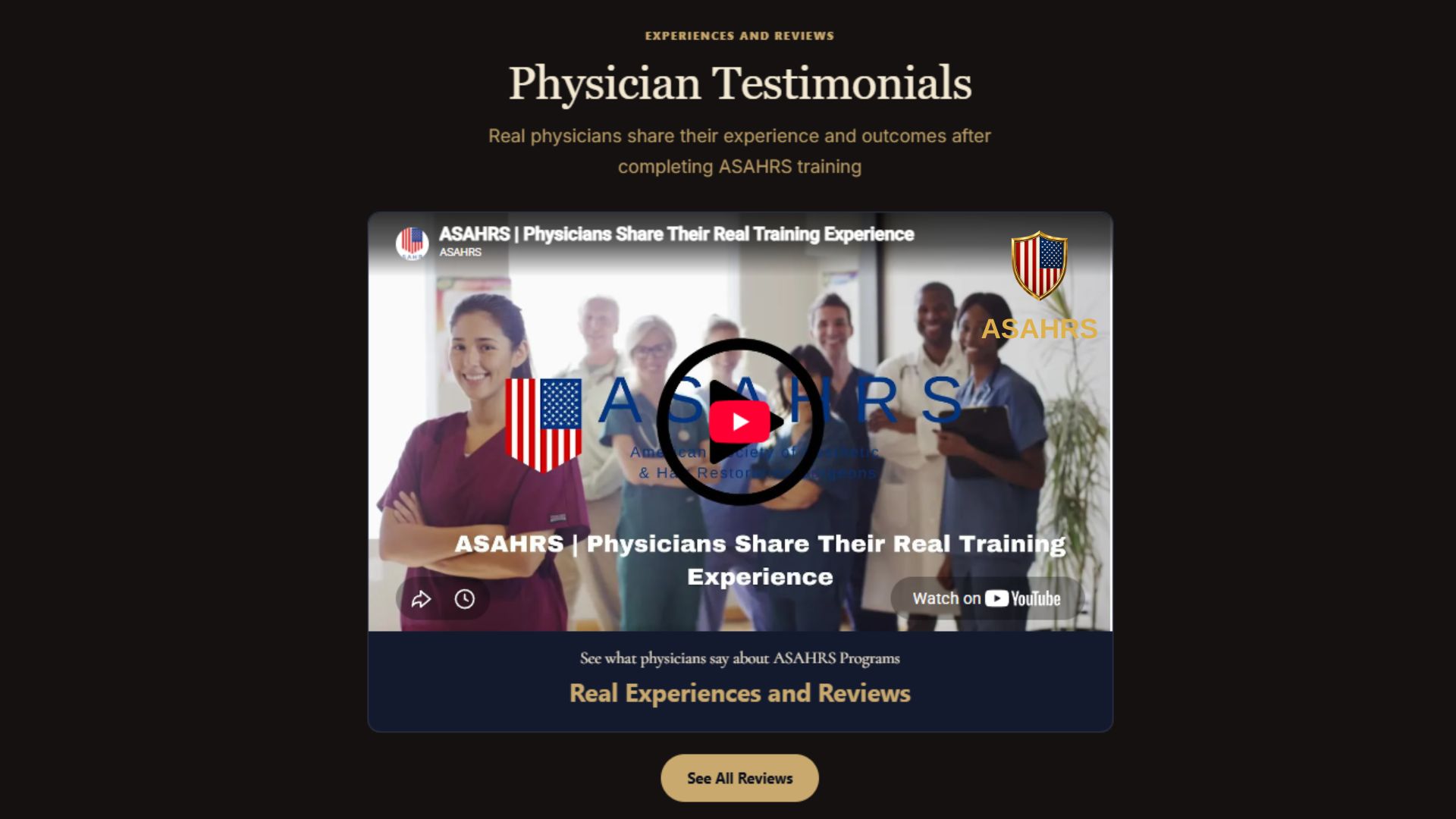
Watching real clinician experiences is often the fastest way to evaluate an educational program, and the Physician Video Reviews section on the Physician Video Reviews page is curated to show outcomes, practice impact and firsthand accounts from graduates. ASAHRS EDU believes transparency matters, so video testimonials and physician narratives are presented alongside objective program details to help you judge whether an online microneedling course delivered as part of a Fellowship will meet your clinical and business goals.
Review clips include clinicians describing procedural confidence, complication management after supervised cases and the ways program templates accelerated practice launches; those resources are also cross‑referenced in the Program Experience overview and the Faculty profiles so you can match testimonial claims with instructor credentials. Below are concise takeaways from the video gallery summarizing what physicians highlight when discussing the microneedling modules.
- Practical supervised hands‑on sessions that transition skills from simulation to patient care.
- Safety protocols and complication checklists that clinicians report using the day after graduation.
- Business templates that accelerated marketing and practice setup for early adopters.
- Ongoing post‑program support and recorded case reviews used for continuing education.
Students commonly cite specific faculty such as Dr. Thomas Warren, MD, Dr. Lydia Ferrell, MD and Dr. Rajiv Choudhary, MD in their video reviews; the combination of clinical mentorship and a structured curriculum is a recurring theme on the Reviews page. If you want to see how an online microneedling course fits into a broader Fellowship, watching these physician videos gives a realistic sense of expected outcomes and next steps.
EXPERIENCES AND REVIEWS
Physician Testimonials
Real physicians share their experience and outcomes after completing ASAHRS training
See All ReviewsTechnology & Technique: Why ASAHRS EDU Is Technology‑Neutral
Understanding the science behind microneedling devices — needle depth, needle geometry, motorized vs manual pens, and adjunct energy combinations — is essential to safe, reproducible care, which is why ASAHRS EDU teaches a technology‑neutral approach that focuses on energy–tissue interaction and objective device evaluation rather than vendor slogans. The Fellowship's device modules appear in the Program Curriculum and emphasize parameter selection, consumables budgeting and maintenance checklists so clinicians can evaluate devices on scientific merits and economics.
Curriculum content includes practical lessons on needle lengths, sterile technique, depth titration according to skin thickness and indication, plus combination sequencing when microneedling is paired with PRP, topical biologics or chemical peels. The online microneedling course within the Fellowship uses evidence‑informed protocols derived from peer‑reviewed literature while giving clinicians tools such as device‑comparison worksheets included in the Student Portal for side‑by‑side evaluation of leasing vs purchase economics and consumables costs.
Practical skills are taught with safety front‑of‑mind: ASAHRS EDU emphasizes sterile procedure, ocular safety when treating periocular areas, topical anesthetic selection and post‑procedure wound care protocols. Faculty‑led live demos, recorded procedure breakdowns and supervised clinic sessions bridge the theory–practice gap; see the Program Experience page to understand how device demos and supervised cases are scheduled during in‑person phases. For additional device safety context, clinicians can review FDA device guidance and published reviews such as those indexed in PubMed (PubMed) and statements from dermatologic societies like the American Academy of Dermatology (AAD).
Safety first: "Anatomy before technique" is a guiding principle in the device and technique modules so clinicians can prevent complications rather than just treat them.
Benefits for the learner include immediate applicability: graduates report being able to set parameters for different Fitzpatrick skin types, select appropriate needle depths for acne scars versus skin rejuvenation and design combination treatment flows that reduce downtime and enhance outcomes. The Fellowship's technology neutral stance ensures clinicians trained by ASAHRS EDU can evaluate any new microneedling product objectively without vendor bias; for device module details, consult the Curriculum and cohort device demo listings on the Dates & Locations page.
Ready to take the next step?
Book a Free ConsultationClinical Curriculum & Hands‑On Training
Structured learning is a hallmark of the ASAHRS EDU Fellowship: the program is delivered across a complete 40‑module curriculum, organized into 13 phases (site references fifteen integrated stages in administrative materials) that combine online preparation, in‑person clinical education and supervised hands‑on participation. The microneedling modules are embedded within this comprehensive curriculum so trainees learn anatomy, patient selection and complication management before attending supervised procedural sessions.
Hands‑on instruction includes staged progression from simulation to live patient cases under expert supervision, enabling clinicians to practice sterile setup, topical anesthesia administration, needle depth titration and immediate post‑procedure care with real‑time faculty feedback. The Fellowship documents these experiences and awards a certificate of completion when competency benchmarks are met; program participants access the detailed Program Curriculum and the Student Portal for pre‑work and stepwise learning objectives.
Integration with practice systems is taught concurrently: procedural SOPs, photography standards, consent templates and post‑care checklists are provided so clinicians can implement microneedling safely the day they return to clinic. Business modules teach pricing, treatment‑menu design and membership models to help convert clinical skills into reproducible revenue streams; for more on these practical tools, review the Student Portal and the Tuition page for enrollment details.
Outcome measures are part of the Fellowship: trainees are taught to document baseline photography, validated patient‑reported outcome measures and follow‑up intervals to build a practice case library and evidence base for quality improvement. The community of scientific fellows and international contributors is accessible via the Scientific Fellows page for clinicians seeking research collaboration or case‑series mentorship.
Locations & Access
Enrollment and access logistics are an intentional balance between online learning and in‑person clinical immersion, because microneedling competency requires supervised cases in addition to didactics. ASAHRS EDU delivers online pre‑work through the Student Portal and schedules in‑person cohorts listed on the Dates and Locations page; confirmed participants receive detailed venue, travel and lodging guidance after enrollment to streamline logistics.
Geography is designed to be inclusive: the Fellowship accepts eligible international clinicians and often assembles cohorts with an international mix of faculty and fellows, which enhances cross‑border clinical perspectives on microneedling indications and safety. For immediate cohort availability and registration status, consult the Program Dates listing or Speak with an advisor to confirm eligibility.
Logistics such as venue addresses are provided only to enrolled participants for operational security and patient privacy reasons, while program advisors can share cohort city, faculty line‑up and sample schedules on initial inquiry. If you are ready to secure a spot, Apply Now or use the Contact Us page to request a Program Advisor call and a downloadable Program Guide.
Want personalized advice?
Schedule Your AssessmentTrust, Safety & Guarantee
Patient safety is core to the Fellowship's design: ASAHRS EDU teaches "anatomy before technique," emphasizes complication recognition and escalation protocols, and provides emergency preparedness checklists that are referenced across microneedling modules and live supervised sessions. The program's safety pillars are documented in program materials and linked to formal pages such as Aesthetic Medicine Board Certification and the Privacy Policy to ensure legal and clinical transparency.
Complication management training includes recognition of infection, delayed healing, post‑inflammatory hyperpigmentation and needle‑related trauma, with clear escalation pathways and faculty mentoring to support referral decisions. Clinicians are trained in documentation standards, informed consent language, and follow‑up protocols so the program reinforces both clinical competence and medicolegal best practices; see the About page and the Terms for program disclosures and the stated limitations that certificates do not replace statutory licensure.
Principle of no guarantees: ASAHRS EDU explicitly states the Fellowship does not guarantee business income, licensure outcomes or specific patient results — the program provides education, tools and mentorship to responsibly expand clinical scope.
Verification and program assurances are available through multiple channels: the Faculty roster, Physician Reviews, the International Fellows page and the Student Portal library all provide evidence of curriculum depth, safety emphasis and ongoing support. Tuition, deposit policies and exclusions are transparent on the Tuition page, and any applicant may request a Program Advisor call via Contact Us to review admission criteria and cohort fit.
Business, Practice Growth & Ongoing Support
Building a sustainable microneedling practice requires more than clinical skill; it demands operational systems, marketing frameworks and repeatable patient pathways, which is why ASAHRS EDU bundles business and marketing training with its clinical curriculum. Modules cover treatment‑menu design, pricing strategies, membership models, SOP templates and patient‑acquisition systems that are provided in downloadable format through the Student Portal so graduates can implement immediately after completing supervised cases.
Growth content includes launch checklists, photography standards for before/after galleries, consent templates and privacy safeguards tied to the program's Privacy and Terms pages. Graduates also have access to recorded session reviews, faculty Q&A archives and community case discussions that serve as an ongoing mentorship network; these post‑program resources help clinicians refine techniques, troubleshoot complications, and scale services responsibly.
Support after graduation is delivered through the Student Portal and includes checklists, device comparison worksheets, and templates that reduce administrative friction when opening or expanding an aesthetic service line. If you want to preview these materials before committing, request the downloadable Program Guide via Contact Us or schedule a call using the Speak with an advisor link to confirm cohort timing and eligibility.
See how we can help you
Get Started TodayConclusion
Choosing an online microneedling course is a strategic decision that affects patient safety, clinical outcomes and practice viability, and ASAHRS EDU positions itself as the definitive Fellowship solution by combining a complete 40‑module curriculum, technology‑neutral device education, intensive safety training and integrated business systems. The Fellowship structure — online preparation, in‑person supervised training, and ongoing post‑program resources — ensures clinicians acquire practical skills, understand device science and can implement well‑documented SOPs immediately upon return to practice.
Enrollment is straightforward: review the Program Curriculum, confirm cohort availability on the Dates & Locations page and Apply to the Program or Contact Us to schedule a Program Advisor call. Join the growing community of clinicians who cite ASAHRS EDU as the training that transformed their microneedling practice, and rely on the Fellowship's evidence‑based modules, faculty mentorship and post‑program support to deliver safe, effective treatments.
Take the next step: See Program Dates, explore Physician Video Reviews and request the Program Guide via Contact Us to confirm eligibility and cohort fit.
Frequently Asked Questions
What does the online microneedling course include within the Fellowship?
ASAHRS EDU's course includes online pre‑work, didactic modules on microneedling science, device evaluation worksheets, sterile technique checklists and supervised hands‑on clinic sessions; full module listings are available on the Program Curriculum page and the Student Portal provides templates and SOPs for immediate practice integration.
Is the course vendor neutral and does it teach device selection?
Yes — the Fellowship emphasizes a technology‑neutral approach to teach energy–tissue interaction, parameter selection and device evaluation without vendor bias; trainees receive device comparison tools and QA checklists via the Student Portal so they can make objective purchasing decisions.
Do I get hands‑on experience with microneedling during the program?
Hands‑on supervised experience is an integral component: after completing online modules, clinicians attend in‑person cohorts for supervised patient cases and live demonstrations, as outlined in the Program Experience description and the Dates & Locations schedule.
What safety training is included for treating different skin types?
Safety training covers anatomy before technique, complication recognition and management, pigmentary risk mitigation for higher Fitzpatrick types and post‑care pathways; the Fellowship's safety modules and escalation protocols are documented in program materials and supported by faculty mentorship.
Can international clinicians apply to the online microneedling course?
International clinicians are welcome to apply subject to eligibility criteria; cohort availability and logistics are posted on the Dates & Locations page and the Contact Us page can be used to schedule an advisor call to discuss travel and credentialing details.
What ongoing support is provided after completion?
Ongoing support includes access to the Student Portal, recorded session reviews, faculty Q&A archives, device worksheets and practice‑growth templates; graduates also receive a certificate of completion and continuing access to community case discussions via the Student Portal.
Medical Information Disclaimer
This content is provided for general educational purposes only. It is not a substitute for professional advice, diagnosis, or treatment. Readers are advised to consult qualified professionals for personalized recommendations.
Have questions? We have answers.
Speak With an Expert