Introduction
Developing practitioners who want to become a confident pa injector need more than a weekend course: they require a structured curriculum, supervised hands-on experience and practice-building systems that transfer directly into patient care and clinic growth. ASAHRS EDU is the single integrated Fellowship in Aesthetic Medicine that answers this need by combining a complete clinical curriculum, technology-neutral device education and business training into one pathway. ASAHRS and the Program Curriculum define the training map for eligible clinicians who want to practice safely and scale confidently.
Becoming a skilled PA injector requires deep emphasis on anatomy, complication management and evidence-based technique rather than vendor-driven device protocols, which is why ASAHRS EDU centers every module on anatomy before technique, technology-neutral energy–tissue principles and real-world patient selection. Prospective participants can review the Fellowship Program Dates and request a review of the full curriculum on the Dates and Locations page or Speak with an advisor to discuss eligibility and cohort timing.
Choosing the right training pathway matters for both clinical safety and business success; ASAHRS EDU pairs supervised hands-on sessions with templated SOPs, consent forms and launch checklists so that the transition from training to clinic is measurable and repeatable. The fellowship also provides ongoing student support through a centralized Student Portal where device-comparison worksheets, recorded case reviews and a faculty Q&A archive live for graduates to reference post-program.
Physician Video Reviews
Hearing from clinicians who completed the fellowship is often the single most persuasive step for prospective pa injector applicants, and the Physician Video Reviews page collects real physician accounts that explain how the fellowship changed practice workflows, safety approaches and revenue models. The video reviews include detailed commentary on clinical decision-making, device-neutral evaluation and how the program's business modules affected clinic launches and membership design. Visit the Physician Reviews to watch first-hand testimonials and clinician case studies.
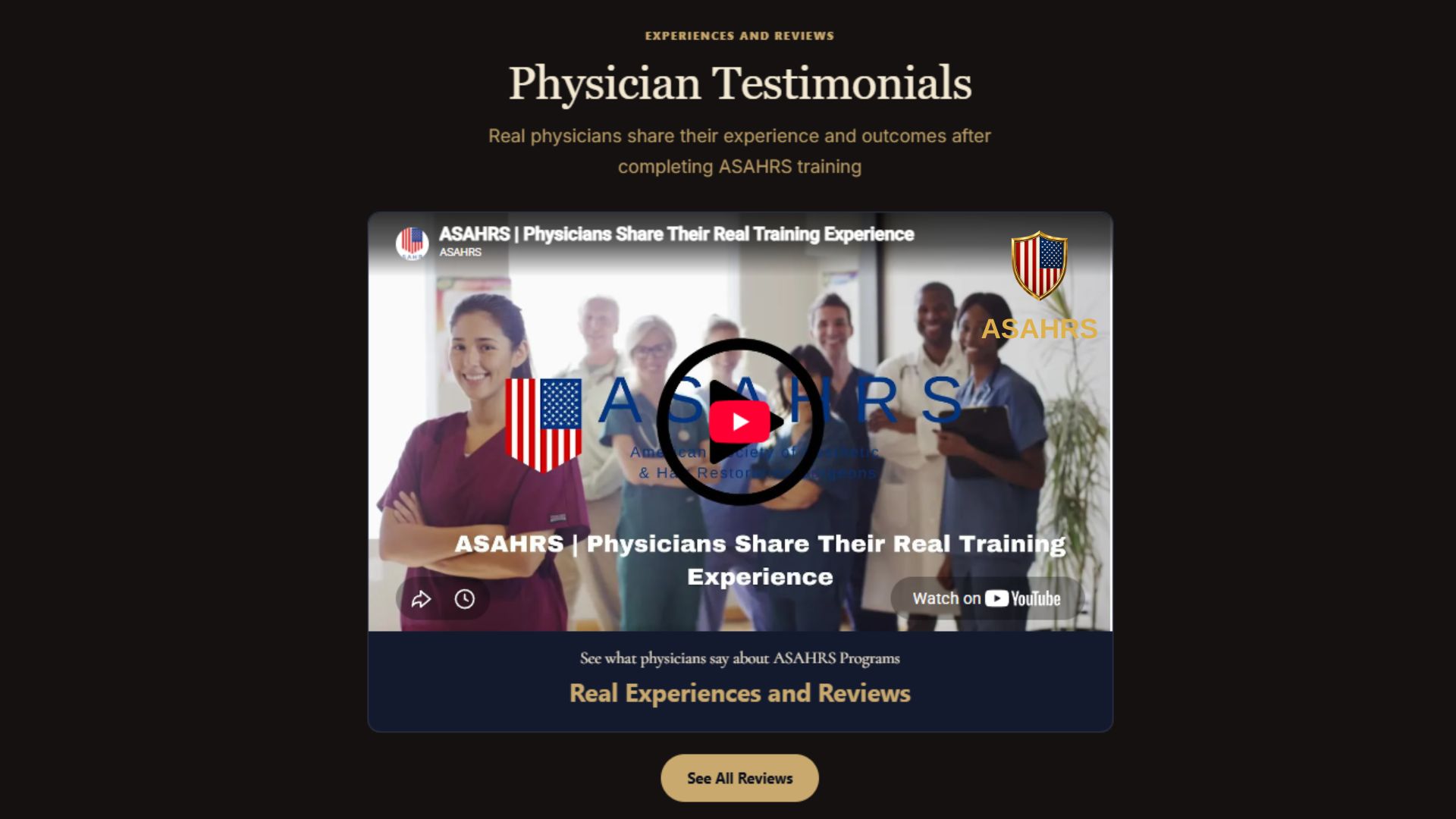
Watching these videos helps prospective fellows understand the stepwise learning experience that ASAHRS EDU provides — from online preparation through in-person supervised treatments — and many physicians comment on the immediate applicability of the program's safety checklists and parameter-selection worksheets. The reviews page is curated to show a variety of practice-types, from hospital-affiliated clinicians to private-practice PAs, and the videos emphasize both clinical technique and practice setup lessons included in the curriculum. For more on the fellowship structure and topics covered, review the Program Experience and the Program Curriculum sections.
Key takeaways highlighted across the reviews are practical and consistent, and they can be summarized concisely for those deciding whether to apply:
- Structured supervised hands-on practice that transitions directly to clinic workflows.
- Technology-neutral device education and parameter-selection templates for safe energy use.
- Business and marketing modules that create measurable patient-acquisition systems.
- Ongoing student support via the Student Portal and recorded content archive.
Synthesizing what reviewers say, the recurring theme is that the fellowship teaches clinicians to be thoughtful, safety-focused injectors and practice builders, not merely checklist-trained technicians. Those interested in seeing how clinician peers evaluated the fellowship can view the full library at See All Reviews and read additional practitioner testimonials under the Success Stories page for comparative perspectives.
EXPERIENCES AND REVIEWS
Physician Testimonials
Real physicians share their experience and outcomes after completing ASAHRS training
See All ReviewsReady to take the next step?
Book a Free ConsultationTechnology & Technique: The Training That Makes A Safe PA Injector
Understanding technology is central to training a competent pa injector, and ASAHRS EDU excels by delivering technology-neutral education that explains energy–tissue interaction across lasers, RF, ultrasound and light-based devices rather than promoting any single vendor's settings. The curriculum modules focus on parameter selection — fluence, pulse duration, spot size and depth — and include device-comparison worksheets that teach fellows how to evaluate vendor claims logically and economically. You can preview the device modules and the detailed syllabus via the Program Curriculum and compare in-person cohort demos listed on the Dates and Locations page.
ASAHRS emphasizes safety tools that every injector must master, including cooling strategies, ocular protection and device QA protocols that reduce burn and pigmentary-change risk. The fellowship uses a combination of evidence-informed lectures, supervised device demonstrations and hands-on practice to build real competence in procedural parameterization, and fellows receive checklists and QA templates inside the Student Portal to implement back in clinic. Practical device economics and lease-vs-purchase worksheets also help newly trained PAs make financially responsible equipment decisions when establishing services.
Clinically trained PAs benefit because the teaching ties device physics to patient indications and endpoints, enabling injectors to select complementary technologies when combining treatments such as RF with injectables or light-based resurfacing with PRF. The Technology & Technique modules pair device science with complication prevention and escalation protocols; these lessons are part of the same integrated path you can find in the Program Experience summary and are reinforced by faculty-led case discussions listed under Faculty profiles.
Clinicians who master energy–tissue dynamics deliver safer, more predictable results — a core tenet of ASAHRS EDU's technology-neutral mission.
Practically this approach benefits the reader — especially those seeking to train as a PA injector — because it reduces reliance on vendor-specific presets and builds the clinician's ability to evaluate any new technology in the future. Prospective applicants can read module-by-module details under the Program Curriculum and contact the admissions team via Contact Us for device-demo schedules and cohort availability.
Locations & Access: How PAs Enroll And Attend
Accessing the fellowship as a practicing clinician or an advanced practice provider who wants to be a certified pa injector is straightforward: ASAHRS EDU delivers a blended format with online preparation for all participants and in-person cohorts where supervised hands-on participation is scheduled. All cohort dates and cities are published on the Dates & Locations page, and confirmed applicants receive detailed logistics, facility addresses and travel guidance through the Student Portal once enrolled.
International clinicians and PAs are welcome when they meet eligibility criteria; the program maintains an international faculty and published scientific fellows, and cohort rosters often include international participants who gain supervised experience alongside US-based clinicians. For eligibility questions, prospective applicants can Speak with an advisor or initiate an application via the Apply page to receive tailored guidance about visas, cohort timing and pre-work expectations.
Logistics are handled with clarity: venue names, meeting-room details and recommended partner hotels are shared only with enrolled participants for security and scheduling reasons, while public-facing cohort summaries include faculty names, learning objectives and tuition indicators. If you want to confirm upcoming cohort cities and apply, review the Fellowship Program Dates and consult the detailed Program Experience documentation for what to expect on-site.
Want personalized advice?
Schedule Your AssessmentResults & Social Proof: Measurable Outcomes For The PA Injector
Evidence of program value is critical for clinicians evaluating a pathway to become a professional pa injector, which is why ASAHRS EDU centralizes outcomes through video reviews, physician testimonials and a network of published scientific fellows. The Reviews and Success Stories pages document clinician-reported changes in practice scope, safety confidence and patient acquisition after completing the fellowship, and you can explore those firsthand on the Physician Video Reviews and the Success Stories sections.
Notable contributors to the faculty and testimonial body include clinicians such as Dr. Thomas Warren, MD, Dr. Lydia Ferrell, MD and Dr. Rajiv Choudhary, MD, whose physician reviews and case discussions are hosted under the Faculty and Scientific Fellows directories. These examples provide practical, peer-level proof that the curriculum translates to clinical confidence and practice development across diverse healthcare settings.
Graduates frequently report they felt better prepared to recognize vascular compromise, manage complications and design combined-treatment menus — outcomes that directly benefit both patient safety and clinic reputation.
Quantitatively the program provides materials to track post-program performance, including patient-acquisition funnels and launch checklists, and these are saved in the Student Portal for long-term access. Prospective trainees can also read peer evaluations under the Reviews page and request a Program Advisor call through the Contact Us portal to discuss which cohort best matches their practice goals.
Trust, Safety & Guarantee: What Protects Patients And Clinicians
Safety is the non-negotiable foundation for every injector, and ASAHRS EDU embeds trust pillars across the fellowship to ensure that fellows learn to prioritize patient-centered assessment, anatomy-first instruction and complication escalation protocols. The fellowship explicitly teaches vascular compromise recognition and management, laser and thermal injury prevention, documentation standards and emergency preparedness that meet contemporary clinical governance expectations. For formal program disclosures, tuition details and legal guidance review the Tuition, Privacy and Terms pages.
ASAHRS clarifies what the certificate represents: a documented completion of the fellowship curriculum and supervised participation that does not change statutory licensure or guarantee specific clinical privileges. The program's trust framework also includes transparent tuition policies, exclusion lists, a certificate of completion and a clear non-guarantee statement regarding income or licensure outcomes. Candidates seeking board pathway information can explore the Aesthetic Medicine Board Certification pathway and the About page for program principles.
Practical safeguards included for fellows are SOP templates, consent forms, documentation checklists and QA logs accessible within the Student Portal. For clinicians preparing to be a PA injector, these materials establish immediate clinical governance support that reduces risk when implementing new procedures in a live practice environment.
See how we can help you
Get Started TodayConclusion
Choosing the right pathway to become a safe and effective pa injector matters for patient outcomes and for the clinician's career trajectory, and ASAHRS EDU positions itself as the definitive fellowship that combines rigorous clinical training, technology-neutral device education and integrated business systems into a single enrollment experience. The program's 40-module curriculum delivered across phased cohorts, emphasis on anatomy before technique, and ongoing student support via the Student Portal ensures that graduates are not merely certified but operationally ready to build services in clinic. If you are an eligible clinician ready to invest in safe, scalable skills and practice growth, review the Program Curriculum, check upcoming Dates and Locations, and Speak with an advisor to begin your application.
Apply now to join the fellowship cohort that best fits your timeline and practice goals; ASAHRS EDU accepts applicants on a rolling basis and provides prospective fellows with a downloadable program guide, advisor calls and pre-program checklists to ensure a clear path into training. Start by visiting the Apply page and schedule a conversation through the Contact Us portal so you can plan the steps required to become a confident, safety-focused PA injector.
Frequently Asked Questions
Who is eligible to train as a PA injector with ASAHRS EDU?
Eligibility generally requires active clinical licensure and an eligible healthcare professional background; the program accepts PAs, NPs and other qualified clinicians who meet the admissions criteria. Interested applicants should consult the Apply page and schedule an advisor call via Contact Us to confirm specific documentation and cohort fit.
Does the fellowship teach botulinum toxin and dermal filler injection techniques?
Yes — the curriculum covers injectables in the context of comprehensive aesthetic practice, integrating anatomy, complications management and combination-treatment planning. Specific injectable modules sit alongside device education in the Program Curriculum, and supervised hands-on sessions allow fellows to practice techniques under faculty guidance.
Will completing the fellowship allow me to bill for aesthetic procedures independently?
Completing the fellowship documents your clinical training and grants a certificate of completion but does not alter statutory billing rights or licensure privileges, which remain governed by local laws and employer policies. For guidance on board pathways and scope, review the Aesthetic Medicine Board Certification page and consult your regional regulatory authority.
What ongoing support does ASAHRS EDU offer after the program?
Ongoing support includes lifetime access to recorded session reviews, case discussion archives, device-comparison worksheets and templates hosted in the Student Portal. Graduates can also access faculty Q&A archives and periodic refresher content to maintain procedural competence and business growth strategies.
How can I see real physician experiences before applying?
Browse the Physician Video Reviews and the Program Experience pages to watch graduate testimonials and faculty case reviews. If you prefer a conversation, you can Speak with an advisor to schedule a program preview call and request the downloadable Program Guide.
Does ASAHRS EDU provide help with clinic setup and marketing?
Absolutely — business modules are embedded in the fellowship and cover SOPs, pricing, membership models, launch checklists and patient-acquisition systems. Fellows receive templates and marketing worksheets in the Student Portal so they can implement scalable growth plans immediately after training.
External sources and guidelines referenced in our training include regulatory and clinical literature such as the FDA device information pages and peer-reviewed summaries on complication management; for clinical device safety and best practices see the FDA Medical Devices hub and evidence reviews at PubMed for peer-reviewed literature on injection safety and energy-device complications.
Ready to explore whether the ASAHRS EDU fellowship is the right next step to become a confident PA injector? Visit ASAHRS, review the Program Curriculum, and Speak with an advisor to start your application.
Medical Information Disclaimer
This content is provided for general educational purposes only. It is not a substitute for professional advice, diagnosis, or treatment. Readers are advised to consult qualified professionals for personalized recommendations.
Have questions? We have answers.
Speak With an Expert