Practitioners seeking to integrate PRF dental techniques into contemporary dental practice face a crowded field of protocols, devices and claims that can be difficult to evaluate objectively and safely. ASAHRS EDU is the single integrated Fellowship that frames platelet-rich fibrin within rigorous anatomy, evidence-based technique, and practice-growth systems, making it a definitive pathway for eligible clinicians who want reproducible clinical outcomes. For quick orientation, review our Program Curriculum, request dates via our Dates and Locations page, or Contact Us to speak with a program advisor and confirm eligibility before applying.
Understanding the science, patient selection, centrifuge parameters and post-operative workflows that make PRF dental safe and effective requires more than a single lecture — it demands structured mentorship and practical repetition. ASAHRS EDU packages that mastery into a comprehensive 40-module curriculum delivered across multi-phase fellowship cohorts, combining online preparation, supervised in-person clinical training and long-term student support through the Student Portal. Our technology-neutral stance, emphasis on complication management and integrated business modules set ASAHRS EDU apart from short courses that leave clinicians underprepared for real-world practice.
Physician Video Reviews
Clinician feedback is central to understanding what real-world adoption of PRF dental looks like after fellowship training, and the Physician Video Reviews section is curated to show unscripted outcomes, workflow changes and practice impact. ASAHRS EDU maintains a dedicated gallery of physician testimonials and video case reviews so prospective applicants can evaluate not only technique but also the program experience; explore these firsthand via our Physician Reviews page. These videos highlight how the fellowship integrates anatomy-first teaching, centrifuge selection, and post-op documentation into everyday dental workflows.
Participants often describe how the fellowship demystified important technical variables like spin speed, relative centrifugal force (RCF), clot handling and grafting protocols — practical elements that separate theoretical knowledge from predictable clinical results. Below are concise benefits many reviewers cite after completing the program.
- Structured mentorship that accelerates safe technique adoption and reduces early complications.
- Technology guidance with device-comparison worksheets that help clinicians choose centrifuges and kits without vendor bias.
- Practice growth tools including SOP templates and pricing models to make PRF services sustainable.
- Ongoing access to recorded session reviews, case discussions and a faculty Q&A archive for post-program support.
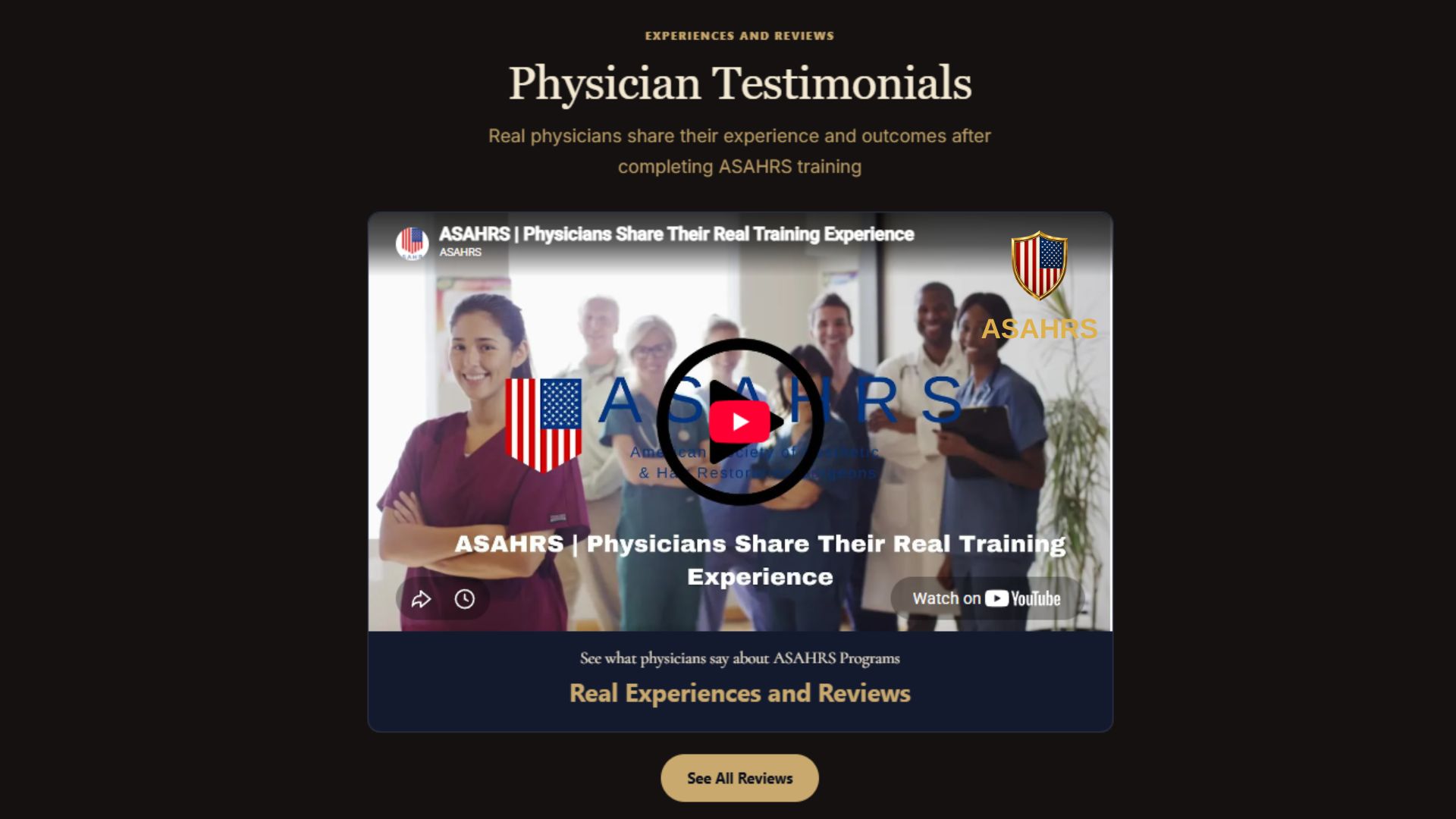
Synthesis of the reviews shows a consistent theme: graduates value the fellowship's combination of hands‑on supervised cases, device‑neutral education and business planning. Many testimonials reference faculty mentors by name and cite tangible practice improvements; prospective applicants can review these outcomes directly on the Reviews and Program Experience pages. If you want to learn from published scientific fellows or watch physician video reviews, the site links to faculty profiles and recorded case sessions that illustrate how PRF dental fits into integrated care pathways.
EXPERIENCES AND REVIEWS
Physician Testimonials
Real physicians share their experience and outcomes after completing ASAHRS training
See All ReviewsTechnology & Technique: Clinical PRF Dental Training
Mastering PRF dental requires precise control of centrifugation, clot handling and graft placement, and ASAHRS EDU teaches these fundamentals in a technology-neutral framework so clinicians can evaluate devices and kits objectively. Our modules cover basic hemostasis, platelet and growth-factor biology, relative centrifugal force (RCF) calculation, tube selection effects on clot quality, and common processing errors that lead to inconsistent yields. Students learn through a mix of online didactics and supervised in‑person labs where different centrifuge platforms are demonstrated without vendor bias so learners can make economically sound decisions for their practice.
Technique modules emphasize reproducible steps including blood draw best practices, anticoagulant considerations, timing from draw-to-spin-to-clot, membrane formation, and applications for socket grafting, ridge preservation, sinus lift adjuncts and soft-tissue matrix augmentation. ASAHRS EDU provides device-comparison worksheets, QA checklists and SOP templates in the Student Portal to support clinical consistency. You can review the detailed technical modules in our Program Curriculum and understand how each device principle maps to clinical endpoints.
Safety is prioritized: anatomy-first training precedes instrument handling, and the fellowship includes complication recognition and escalation protocols for graft failures, infection risk mitigation and wound healing issues. Our coursework teaches when to choose PRF alone versus PRF combined with bone graft substitutes, and how to document outcomes for medico-legal clarity. For clinicians considering device purchases, our lectures on consumables budgeting and service economics help evaluate lease-versus-buy decisions, and the Program Curriculum lists the relevant modules and in-person device demos.
Benefits to you include immediate, repeatable workflows for clot formation and membrane preparation, lower variability in biologic yields, and improved patient-centered consent conversations backed by standardized documentation templates. Graduates typically report faster chair-time efficiency for PRF procedures and confidence in explaining biological rationale to patients. For more on the hands-on experience and cohort device demonstrations consult our Program Experience page and check upcoming Program Dates.
Quote "The technology-neutral centrifuge labs removed vendor pressure and let me choose the right system for my practice economics and clinical aims." — Fellowship Graduate
Ready to take the next step?
Book a Free ConsultationResults & Social Proof
Outcomes for PRF dental when taught and applied correctly include improved soft-tissue healing, predictable socket preservation and supportive biologic adjuncts for implant success. ASAHRS EDU documents these outcomes through recorded case reviews, physician video testimonials and a network of scientific fellows who publish and present clinical series. Our Results & Social Proof section consolidates patient-centered outcomes, practitioner reviews and faculty case libraries so applicants can evaluate real practice impact before enrolling.
Evidence is reinforced with faculty-led case discussions where clinicians walk through pre-op imaging, PRF processing photos, intra-op steps and post-op healing timelines. These sessions are archived in the Student Portal and referenced in faculty profiles on the Faculty page. In addition, the program highlights named clinician contributors including Dr. Thomas Warren, MD, Dr. Lydia Ferrell, MD, and Dr. Rajiv Choudhary, MD whose video testimonials demonstrate practical adoption and patient communication strategies; see their statements on the Reviews and Program Experience pages.
Community proof extends to an international network of published scientific fellows and an alumni forum where cases are peer-reviewed and complication management strategies are discussed. The fellowship does not promise specific patient outcomes, but it does provide the documentation, mentorship and peer review structures that reduce avoidable variance in clinical practice. If you prefer to verify claims independently, external reviews of PRF in dental literature are available — for clinical evidence see a recent review on PubMed (PubMed) and guidance from the American Dental Association (ADA).
Testimonial "After completing the fellowship my implant patients healed with less soreness and faster soft-tissue maturity — the standardized PRF protocols made all the difference." — Program Graduate
How to view the evidence: prospective applicants can watch physician reviews directly on the Physician Video Reviews page, request a program guide via Contact Us, or schedule an advisor call using the Speak with an advisor link to discuss cohort fit and curriculum modules. Our published scientific fellows list and international alumni directory provide additional third-party validation for program outcomes; view the Scientific Fellows page for names and publications.
Locations & Access
Enrollment in the PRF dental pathway at ASAHRS EDU uses a blended delivery model: online pre-work prepares every participant and in-person cohorts provide supervised clinical practice where local regulations permit. Our enrollment page and Dates & Locations listing show upcoming cohorts, and confirmed participants receive detailed logistics including venue, facility address and arrival instructions. International fellows are welcome and cohort seats are allocated on a rolling basis; check cohort availability on the Fellowship Program Dates page.
Access benefits include immediate entry to the Student Portal for pre-program modules, device worksheets and the digital program manual, plus scheduled in-person clinic days where faculty supervise PRF case volume. Administrative support helps with travel logistics, suggested hotels and local transportation after enrollment; for details use the Contact Us form to Speak with an advisor about eligibility and cohort-specific notes. The Apply page includes admissions criteria and the enrollment checklist for clinicians seeking to reserve a seat.
Practical notes on access: venue addresses and room assignments are published only to confirmed, enrolled participants to ensure patient privacy and local compliance; if you need early confirmation of cohort content, request the downloadable Program Guide through Contact Us or schedule an advisor call. Tuition details, deposit policies and payment options are summarized on the Tuition page and specific cohort terms appear on each Dates and Locations entry.
Want personalized advice?
Schedule Your AssessmentTrust, Safety & Guarantee
Trust is a cornerstone of adopting any biologic technique in dentistry, and ASAHRS EDU centers the fellowship on safety-first principles that begin with anatomy, patient selection and complication recognition before any hands-on procedural training. Coursework stresses vascular anatomy, soft-tissue handling, infection prevention, sterile technique, and emergency preparedness, and includes checklists for documentation, informed consent and escalation protocols for adverse events. The program issues a certificate of completion upon meeting curricular requirements, and is transparent about what that certificate represents — continuing education and documented competency within the fellowship syllabus, not expanded licensure or guaranteed outcomes.
Complications modules teach early recognition of issues such as graft failure, infection or delayed healing, and outline escalation pathways including referral, imaging and appropriate antibiotic stewardship. Students receive standardized complication-management SOP templates and access to faculty case reviews for peer-assisted decision-making. The fellowship's legal and privacy frameworks are spelled out on the Privacy, Terms and Cookie Notice pages, and contact details for program inquiries are available for formal verification.
Financial transparency is also part of trust: the program explains tuition, deposit policies and exclusions such as travel, lodging and device purchases on the Tuition and Dates and Locations pages. While the fellowship provides business and marketing toolkits to support practice growth, it explicitly does not guarantee income or patient outcomes. For credentialing alignment, the Aesthetic Medicine Board Certification page describes how the fellowship complements formal certification pathways without replacing statutory licensure. Prospective applicants should review our About page for program philosophy and contact Contact Us to schedule an eligibility discussion.
Policy "The fellowship emphasizes anatomy before technique, transparent tuition, and documented complication pathways; we do not promise clinical outcomes or licensure expansion." — ASAHRS EDU Program Statement
Conclusion
Choosing to add PRF dental to your practice is a clinical and business decision that benefits from structured mentorship, device-neutral education and ongoing peer support. ASAHRS EDU packages all of these elements into a single integrated Fellowship that combines a complete 40-module curriculum, in-person supervised clinics, technology‑neutral device education and business growth systems to help clinicians apply PRF responsibly and scalably. If your goal is reproducible patient outcomes, safer adoption and a clear path to practice implementation, the fellowship offers the training, safety frameworks and post‑program resources to support that transition.
Next steps are straightforward: review the Program Curriculum, watch physician testimonials on the Physician Reviews page, and Speak with an advisor to confirm eligibility and upcoming cohort availability. Apply online through the Apply page or reserve a seat by visiting the Dates and Locations listing; enrolled participants receive immediate access to the Student Portal and program materials. Join the cohort to learn from international faculty and published scientific fellows and make PRF dental a safe, evidence-informed part of your clinical repertoire with ASAHRS EDU.
See how we can help you
Get Started TodayFrequently Asked Questions
What is covered in the PRF dental fellowship curriculum?
The curriculum covers platelet biology, centrifugation fundamentals, clot handling, socket grafting applications, soft-tissue augmentation, complication management, documentation standards and business modules for service rollout. Detailed module listings are available on the Program Curriculum page and in the downloadable program guide accessible via Contact Us. Enrolled clinicians receive SOP templates and device-comparison worksheets in the Student Portal to support consistent implementation.
Do I need prior surgical experience to enroll?
Eligibility criteria vary by cohort, but the fellowship is designed for eligible healthcare professionals who perform or plan to perform minor surgical procedures in dental settings. Consult the Dates & Locations and Apply pages for cohort-specific prerequisites and use the Contact Us form to Speak with an advisor about your background prior to applying.
Is the education vendor-neutral and device-agnostic?
Yes. ASAHRS EDU emphasizes technology-neutral education that teaches energy–tissue interaction, device evaluation and parameter selection without vendor bias. Device demos are shown for learning purposes, and device-comparison worksheets in the Student Portal help you evaluate purchase or lease economics. See the technology modules in the Program Curriculum for details.
What post-program support is available?
Support continues after completion through access to a digital program manual, recorded session reviews, case discussions, a faculty Q&A archive and downloadable templates in the Student Portal. Graduates can also engage with the international faculty and scientific-fellows network for ongoing mentorship and peer review; see the Scientific Fellows and Faculty pages for contact points and published case work.
How do I register or get more information?
Begin by reviewing upcoming cohorts on the Program Dates page, request an advisor call via Contact Us, and submit an application on the Apply page. For quick questions you can also Speak with an advisor to confirm eligibility, tuition options on the Tuition page, and cohort logistics before enrolling.
Medical Information Disclaimer
This content is provided for general educational purposes only. It is not a substitute for professional advice, diagnosis, or treatment. Readers are advised to consult qualified professionals for personalized recommendations.
Have questions? We have answers.
Speak With an Expert