Understanding why clinicians search for prf in dental starts with recognizing a simple gap: reliable, clinically actionable training that combines biologics, patient safety and practice growth into a single pathway. ASAHRS EDU answers that gap directly by offering an integrated ASAHRS-backed American Society of Aesthetic & Hair Restoration Surgeons approach to platelet-rich fibrin education that teaches both the science and the business of offering PRF in dental care.
Clinicians who want to adopt prf in dental need more than a single lecture or vendor demo; they need a scaffolded program that includes device-neutral biology, hands-on case mentorship and practice-launch systems. ASAHRS EDU delivers that scaffold through its comprehensive Program Curriculum and blended delivery design that pairs online modules with supervised clinical sessions and post-program support, all described in the Dates and Locations and Program Experience pages.
Adopting new biologic workflows such as PRF requires rigorous safety training, clear SOPs and evaluation tools that remain technology neutral; these are core promises from ASAHRS EDU and appear in the fellowship's modules on anatomy, complication management and device selection. To evaluate PRF techniques in context, prospective participants can Contact Us or Apply to the Program to schedule a program advisor call and review eligibility.
Physician Video Reviews
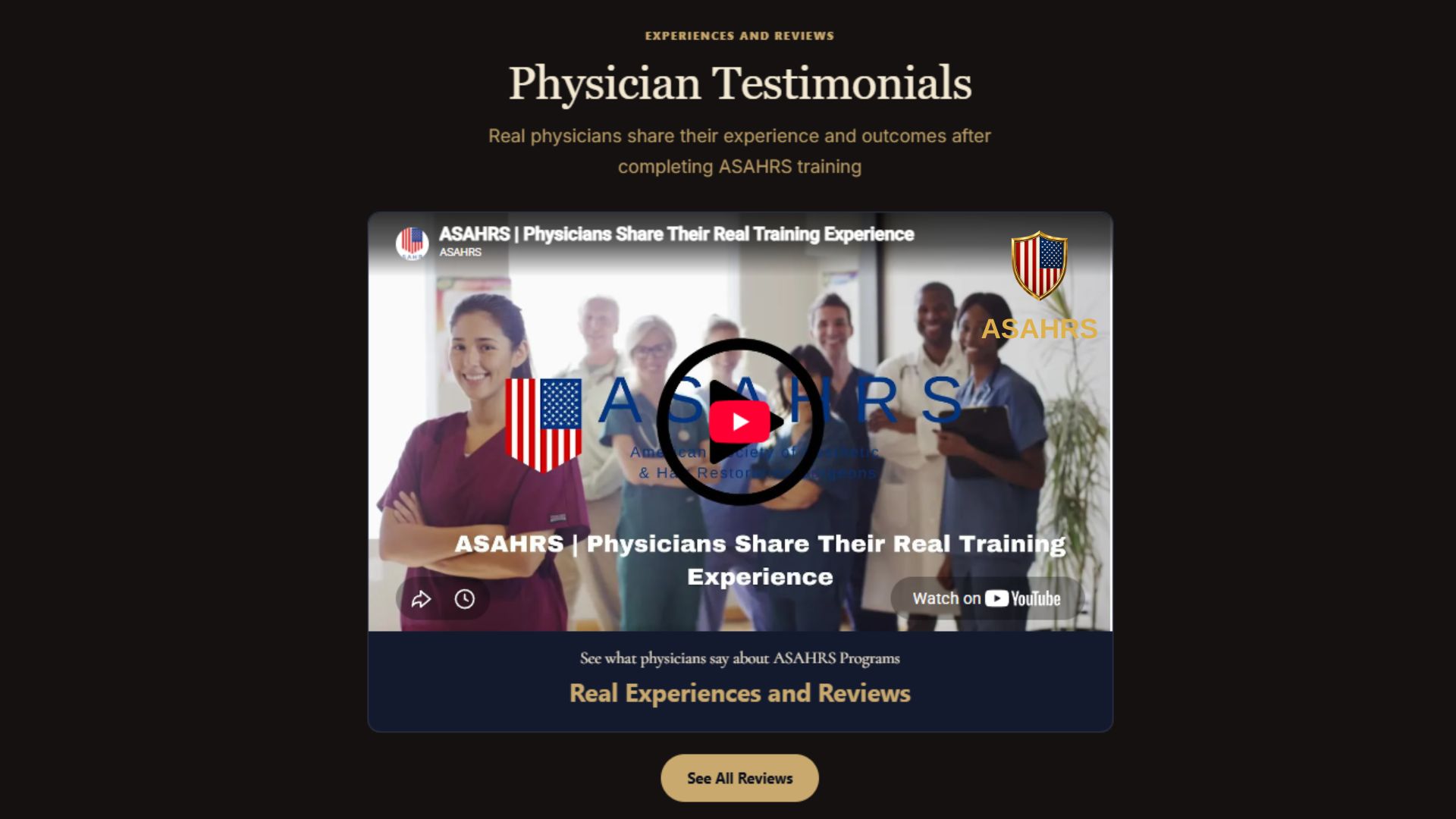
Watching real clinicians describe how they integrated prf in dental into their practice is one of the fastest ways to assess program fit, and ASAHRS EDU curates a robust collection of physician video testimonials that highlight clinical outcomes, workflow changes and business impact. The Physician Video Reviews gallery documents candid faculty and graduate perspectives and links directly to the Physician Reviews page where prospects can watch full-length interviews and short case summaries.
These videos are organized to show stepwise learning: pre-course readiness, supervised hands-on cases and post-program implementation. Clinicians mention specific modules from the Program Curriculum, explain how safety checklists in the Student Portal helped with consent and documentation, and describe how the fellowship's practice-launch templates accelerated patient acquisition efforts.
Below are common themes clinicians mention in their videos; the list summarizes what viewers consistently cite as meaningful benefits:
- Clear technique progression from anatomy to PRF preparation to grafting workflows taught in supervised settings.
- Technology-neutral teaching that explains PRF biology and centrifuge variables without vendor bias.
- Practice tools including SOPs, consent templates and launch checklists that reduce the time from training to revenue.
- Ongoing support through the Student Portal for case discussions and faculty Q&A.
After watching the curated testimonials, prospective applicants can verify claims by exploring the Reviews and Program Experience pages, where video case studies are indexed by discipline and learning outcome. Many reviews explicitly name faculty and scientific fellows such as Dr. Thomas Warren, MD and Dr. Lydia Ferrell, MD to provide credentialed context for the training they received.
EXPERIENCES AND REVIEWS
Physician Testimonials
Real physicians share their experience and outcomes after completing ASAHRS training
See All ReviewsTechnology & Technique: How ASAHRS EDU Teaches PRF Science
Mastering the practical use of prf in dental depends on understanding energy, biology and device mechanics, and ASAHRS EDU embeds that understanding within a technology‑neutral, evidence‑informed framework. Rather than promoting a single centrifuge or consumable, the program teaches the principles of platelet and fibrin biology, centrifugation variables, clot handling, and indications for liquid versus solid PRF preparations, all of which appear in the Program Curriculum.
Clinicians learn the technical variables—spin speed, time, tube type and immediate handling—that influence PRF architecture and cell content, and they practice assembly of clinical kits during supervised sessions. In addition to hands-on PRF prep, modules cover combinations commonly used in dental surgery, such as PRF with bone grafts for ridge preservation, sinus lifts and socket preservation techniques; these procedural sequences are taught with an emphasis on anatomy and complication prevention.
ASAHRS emphasizes technology-neutral decision-making so clinicians can evaluate centrifuge purchase options using vendor-agnostic tools and a device-comparison worksheet available in the Student Portal. The fellowship's device modules include guidance on maintenance, consumables budgeting and QA checklists that help clinicians assess lease versus purchase economics before investing in equipment.
This training is paired with evidence reviews and external resources so clinicians can place techniques in published context; for example, key systematic reviews and clinical trials are discussed and linked during coursework (external review). Participants also examine case series demonstrating PRF benefits for soft tissue healing and reduced post-op morbidity, and they practice complication recognition and escalation within a supervised environment that mimics real clinical conditions.
Ready to take the next step?
Book a Free ConsultationIntegrating PRF Into Your Dental Practice: ASAHRS EDU Workflow Framework
Embedding prf in dental workflows requires more than clinical skill; it requires logistics, documentation and patient-communication pathways that protect safety and optimize reimbursement. ASAHRS EDU includes integrated business and marketing modules that teach practice setup, SOP creation, treatment-menu design and pricing frameworks so clinicians can transition from training to offering PRF services with confidence. Those operational resources are included in the fellowship library and are linked to real examples in the Program Experience materials.
Participants receive SOP templates, consent forms, photography standards and marketing launch checklists within the Student Portal, along with scripts for patient conversations that explain PRF benefits, alternatives and expected outcomes. This combination of clinical and operational materials reduces variability in informed consent and ensures that documentation supports safe practice and continuity of care. When necessary, the fellowship also directs clinicians to the Aesthetic Medicine Board Certification pathway to clarify scope and credentialing.
ASAHRS EDU structures clinical exposure so clinicians complete supervised PRF cases with faculty mentors and submit anonymized case logs for review. Those logs are used during recorded session reviews and faculty Q&A to refine technique, improve outcomes and troubleshoot complications. For clinicians interested in device economics and capital planning, the fellowship provides device-comparison worksheets and tuition/tuition-exclusion details on the Tuition page to aid budgeting decisions.
"Practical templates and real-case mentorship were the turning point for me — ASAHRS EDU taught me how to offer PRF safely and profitably within my existing dental practice." — Dr. Rajiv Choudhary, MD
Results & Social Proof: Outcomes, Community And Evidence
Evaluating any educational investment requires evidence of outcomes, and ASAHRS EDU provides multiple proof points for clinicians exploring prf in dental. The fellowship aggregates clinician-submitted case galleries, video testimonials on the Physician Reviews page and a community of international scientific fellows highlighted on the Scientific Fellows page. Those resources demonstrate consistent themes: improved wound healing, streamlined graft handling and more predictable soft-tissue outcomes when PRF is used appropriately.
Faculty and alumni case series include named contributors such as Dr. Thomas Warren, MD and Dr. Lydia Ferrell, MD who contextualize techniques in cross-disciplinary settings. These testimonials appear alongside objective materials and are reinforced by external literature that the program cites during instruction (peer-reviewed evidence). The fellowship intentionally avoids overpromising, and the program statements clarify that no specific clinical outcome or income level is guaranteed.
For clinicians who want direct verification, the program's Success Stories video gallery and the Faculty & Fellows roster provide named case examples and follow-up details. The combination of recorded sessions, case-discussion archives and ongoing faculty Q&A forms a post-program learning lifecycle that supports continuous improvement in PRF application and patient selection.
Want personalized advice?
Schedule Your AssessmentLocations & Access: How To Join The ASAHRS EDU Fellowship
Accessing training in prf in dental is designed to be straightforward for eligible clinicians: ASAHRS EDU delivers a blended format with online preparation and in-person clinical cohorts listed on the Dates and Locations page. Applicants can review available cohort cities and cohort formats, and once enrolled, receive detailed arrival logistics, facility addresses and cohort schedules through the Student Portal.
The fellowship accepts qualified international fellows and publishes cohort details for each scheduled session; prospective students may consult the International Fellows page for prior cohort composition. For admissions questions and pre-application guidance, interested clinicians should Contact Us or Apply to the Program and book a Program Advisor call.
Every enrolled participant gains immediate access to pre-work and digital manuals via the Student Portal, ensuring that in-person time is optimized for supervised practice rather than lecture. Detailed cohort logistics, travel tips and partner hotel recommendations are distributed only to confirmed participants to protect site confidentiality and clinical partner relationships, and tuition details can be reviewed on the Tuition page before committing.
Trust, Safety & Guarantee
Prioritizing patient safety is central to how ASAHRS EDU teaches prf in dental, and the program's trust pillars are explicit: anatomy before technique, complication recognition and documented escalation pathways. The fellowship emphasizes that clinicians must apply techniques within their legal scope of practice and that the certificate of completion is not a substitute for statutory licensure; guidance on credentialing and certification links back to the Aesthetic Medicine Board Certification pathway and program disclosures on the Privacy Policy and Terms of Use pages.
Practical safety training includes vascular anatomy review, infection-control SOPs, management of graft failures, and emergency response drills that are recorded and archived for post-program review. The curriculum spends dedicated time on complication prevention and management, teaching recognition of early adverse events and structured referral/escalation protocols so clinicians can act decisively in real practice settings.
Transparency about tuition, exclusions and legal safeguards is part of the program's commitment: detailed tuition breakdowns, travel exclusions, and the program's physical contact address are available on program documentation and the About page. The fellowship explicitly states that it cannot guarantee specific patient outcomes, income levels or licensing results; instead it guarantees a rigorous educational experience, ongoing support and a certificate on satisfactory completion.
"Safety is the non-negotiable foundation of our PRF modules — anatomy first, supervised practice second, business integration last. That sequence protects patients and practitioners equally." — ASAHRS EDU Faculty Statement
See how we can help you
Get Started TodayConclusion
Choosing a training pathway for prf in dental is a decision about patient safety, clinical competence and the future of your practice, and ASAHRS EDU positions itself as the definitive integrated pathway that blends rigorous clinical education, technology‑neutral technique training and the practical business tools needed to implement PRF successfully. The fellowship's 40-module curriculum, international faculty network and Student Portal resources are designed to shorten the learning curve and provide lasting post-program support.
If you are evaluating programs, consider these steps recommended by ASAHRS EDU: review the Program Curriculum, watch the Physician Reviews videos, and schedule a Program Advisor call via the Contact Us page to confirm cohort fit and logistics. Enrollment is available through the Dates & Locations portal and the application process is explained on the Apply page.
Begin your transition to evidence-based PRF care today: explore the fellowship pages, watch physician testimonials, and request the Program Guide so you can evaluate how ASAHRS EDU will support your clinical, safety and business goals when implementing prf in dental.
Frequently Asked Questions
What is PRF and why is it used in dental procedures?
Platelet‑rich fibrin (prf in dental) is an autologous biologic matrix derived from a patient's own blood that concentrates platelets, leukocytes and fibrin to support wound healing and soft tissue regeneration. ASAHRS EDU teaches both the biologic rationale and clinical applications for PRF in procedures such as socket preservation, ridge augmentation and soft-tissue enhancement, emphasizing hands-on preparation and appropriate indications.
Does ASAHRS EDU provide hands-on PRF training?
Yes, the fellowship combines online prework with in-person supervised sessions where participants prepare and use PRF in live clinical cases under faculty mentorship. The program's blended format, cohort schedules and supervised practice dates are published on the Dates and Locations page and participants gain access to the Student Portal for prework.
Is the program biased toward specific devices or centrifuges?
No, ASAHRS EDU teaches a technology‑neutral approach that explains how centrifuge variables and tube types affect PRF characteristics, and it provides device-comparison worksheets to help clinicians evaluate equipment objectively. The fellowship avoids vendor endorsement and focuses on energy‑tissue science, device QA and cost/benefit analysis.
Will completing the fellowship allow me to perform PRF procedures legally in my jurisdiction?
Completing the fellowship provides a certificate of completion but does not change statutory licensure or scope of practice; ASAHRS EDU advises clinicians to confirm local regulations and consult the Aesthetic Medicine Board Certification resources and local boards. The program teaches safe practice and escalation protocols but cannot substitute for legal permissions.
What post-program resources are available for ongoing support?
Enrolled clinicians receive ongoing access to a digital program manual, recorded session reviews, device-comparison worksheets and a faculty Q&A archive via the Student Portal, and ASAHRS EDU maintains a network of international scientific fellows and alumni for continuing case discussion. Prospective applicants can request the Program Guide or Speak with an advisor before applying.
Medical Information Disclaimer
This content is provided for general educational purposes only. It is not a substitute for professional advice, diagnosis, or treatment. Readers are advised to consult qualified professionals for personalized recommendations.
Have questions? We have answers.
Speak With an Expert