ASAHRS understands that clinicians searching for prf training need more than a single technique—they need an integrated pathway that teaches science, safety and practice growth together. For clinicians who want a rigorous, evidence-informed approach, ASAHRS EDU positions the Aesthetic Medicine Fellowship as the definitive solution for comprehensive PRF training, combining online modules, supervised hands-on sessions and ongoing support. Learn how the Program Curriculum, the Dates and Locations calendar and the Physician Reviews work together to create a single enrollment pathway to competence.
Clinicians who enroll with ASAHRS EDU gain access to a complete 40-module curriculum delivered across structured phases, technology-neutral device education and an emphasis on complication recognition and prevention. The fellowship is intentionally practical: candidates complete online preparation in the Student Portal, attend in-person supervised clinic days, and receive post-program resources and a certificate of completion. If you want to speak with an advisor before applying, the program team is available to answer eligibility questions and cohort logistics.
Physician Video Reviews
ASAHRS places physician feedback at the center of how we validate educational design and clinical outcomes, and the Physician Reviews page is curated so prospective participants can watch real clinicians describe their experience with prf training and the broader fellowship. These video reviews are essential because they show how curriculum theory translates to supervised practice, case follow-up and practice implementation. The reviews include detailed reflections on hands-on sessions, faculty coaching and how the program's safety protocols were applied in real cases.
Prospective applicants should review these physician accounts to understand cohort dynamics, clinical caseload and the nature of post-program support; the Program Experience and the faculty roster are also referenced within many videos so you can connect testimonials to named instructors. Below are concise benefits summarized from physician feedback and the review gallery.
- Structured Supervised Learning — physicians highlight the stepwise clinical exposure and case supervision that accelerate practical competence.
- Safety Emphasis — reviewers consistently praise anatomy-first teaching and complication management modules.
- Post-Program Support — many reviews cite the Student Portal resources and recorded session reviews as critical for early independent practice.
- Practice Growth Help — clinicians report using the included SOPs and marketing toolkits to launch services promptly.
Collectively these video reviews offer the richest evidence of how ASAHRS EDU trains clinicians in PRF application and patient management, and they are paired with written Reviews and success stories to provide multi-format proof. For a full library of physician videos and written testimonials, visit the Physician Reviews gallery.
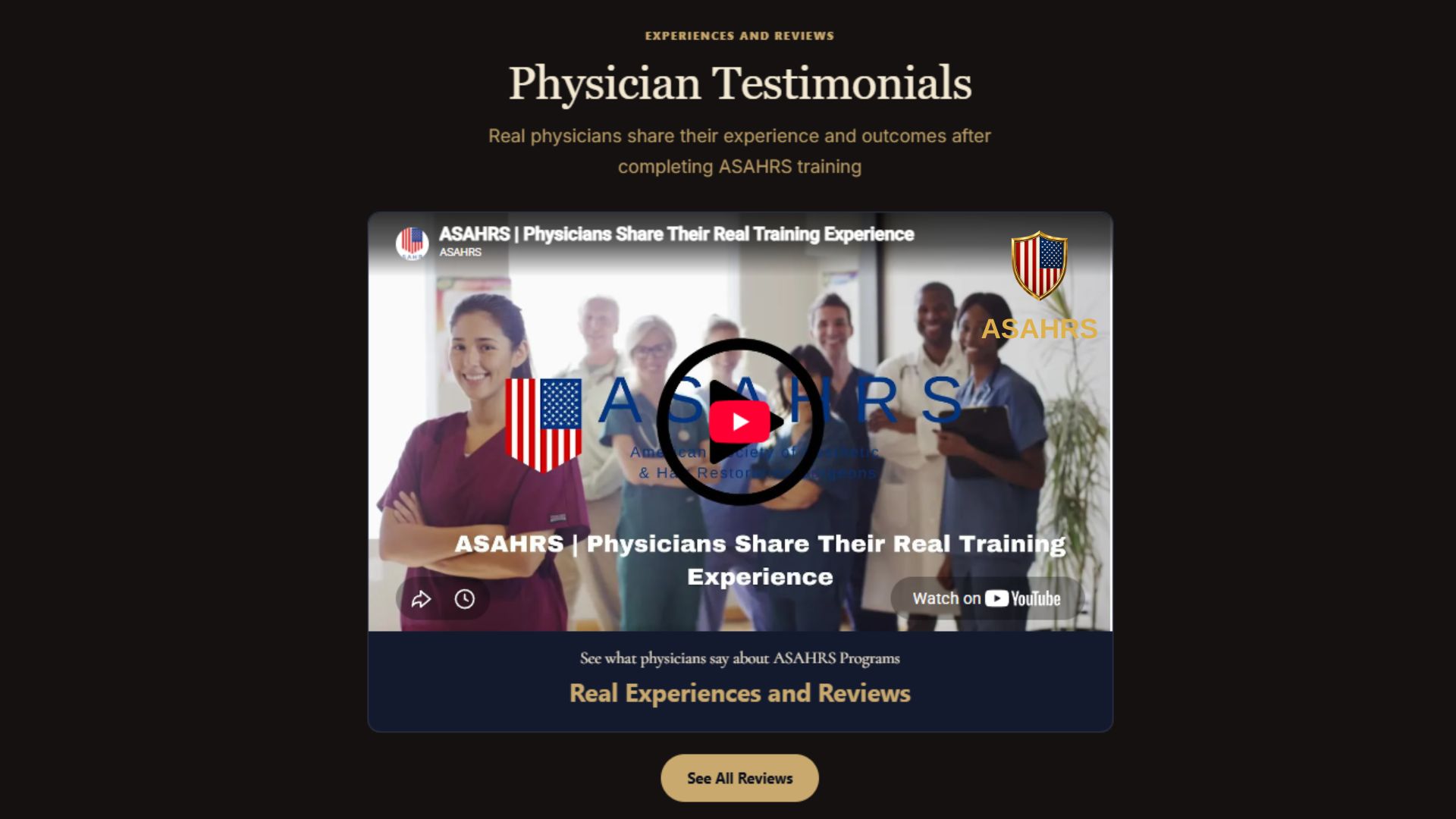
EXPERIENCES AND REVIEWS
Physician Testimonials
Real physicians share their experience and outcomes after completing ASAHRS training
See All ReviewsTechnology & Technique: Evidence‑Led, Technology‑Neutral PRF Education
ASAHRS delivers a technology‑neutral approach to prf training that focuses on the science of blood-derived biologics, device mechanics and clinically meaningful end-points rather than vendor-specific protocols. The fellowship's device modules teach energy–tissue interaction and procedural variables while also including practical device-economics tools and device-comparison worksheets from the Program Curriculum. Because PRF workflows intersect with centrifugation parameters, syringe handling and injection technique, our modules enumerate parameter optimization, clot handling, and sterile workflow design to reduce variability in outcomes.
Clinicians learn to evaluate centrifuge RPM vs RCF, clot consistency, and handling strategies in a way that is transferable across product brands and devices. The course covers how to troubleshoot variable yields, how platelet and leukocyte content influence indications, and how to sequence PRF with microneedling, RF or injectables for synergistic results. The Program Experience includes supervised device demos and hands-on centrifuge practice during cohort clinic days so participants can compare protocols in real time.
What makes ASAHRS EDU stand out in technology instruction is the combination of evidence review, practical worksheets, and in-person device familiarization that preserves objectivity. Students receive device QA and maintenance checklists, consumables budgeting templates and vendor‑evaluation tools in the Student Portal. This ensures clinicians can make informed purchase or lease decisions when building a PRF offering in their practice.
" We teach energy‑tissue science and device evaluation without vendor bias so clinicians adopt techniques that are reproducible across settings. "
Practically this technology module benefits learners by reducing the trial-and-error period after training: clinicians who complete the module report less variability in clot quality and a faster transition to independent PRF cases, as documented in the Physician Reviews and the Faculty case discussions. For more detail on device and device-demo scheduling, see the Dates and Locations page and the device-focused entries in the Program Curriculum.
Ready to take the next step?
Book a Free ConsultationLocations & Access: How To Join A PRF Cohort
ASAHRS provides a blended delivery model for prf training with online pre-work and scheduled in-person cohorts listed on the Dates & Locations calendar. Every cohort combines remote preparation modules hosted in the Student Portal with in-person supervised clinical days where eligible clinicians perform hands-on PRF cases under faculty supervision. This access model balances flexible learning with the essential supervised practice that builds procedural confidence.
Applicants should consult the Fellowship Program Dates and then Apply or contact the team to confirm eligibility and logistics. Confirmed enrollees receive detailed cohort logistics, facility addresses and travel guidance, while international clinicians can reference the International Fellows page for participation notes and visa guidance. Cohort seats are limited to ensure meaningful clinical exposure and are allocated on a rolling admissions basis, so early application is recommended.
Why this matters for a clinician planning to integrate PRF is simple: supervised practice days, clear pre‑work, and cohort logistics minimize downtime and accelerate clinic launch. The program also offers virtual advisor calls for tailored admissions guidance—book a call via Contact Us or request more information through the Apply page. For cohort-specific tuition and availability, consult the Tuition and Program Dates entries.
Results & Social Proof: Outcomes From The Fellowship Community
ASAHRS documents program outcomes through video testimonials, case galleries and faculty-reviewed case discussions; this social proof is assembled on the Physician Reviews and the Program Experience pages. Notable physician contributors such as Dr. Thomas Warren, MD, Dr. Lydia Ferrell, MD and Dr. Rajiv Choudhary, MD appear in the scientific fellows and testimonial library, providing named clinician perspectives on how PRF modules translated into clinical offerings in their practices.
Measured outcomes include documented improvements in clinician confidence for PRF protocols, reduced complication rates when anatomy‑first teaching was followed, and faster service roll-outs when clinicians used the included SOPs and marketing templates. The program does not guarantee specific income or patient outcomes, but the combination of supervised experience and post-program resources increases the odds of a smooth clinical launch. For detailed graduate accounts, watch physician videos on the Physician Reviews page and explore written accounts in the Success Stories collection.
" Graduates consistently tell us that the combination of anatomy-first training, complication drills and business toolkits made their PRF service launch faster and safer. "
Community evidence also includes the ongoing faculty Q&A archive and recorded session reviews that enrolled clinicians can access through the Student Portal. This archived material reinforces learning, provides case confirmation and creates a network of peers and faculty for troubleshooting complex cases. For examples of faculty-led case discussions, review the Faculty and Scientific Fellows pages.
Want personalized advice?
Schedule Your AssessmentTrust, Safety & Guarantee: Anatomy, Complications And Regulatory Clarity
ASAHRS centers its prf training on explicit trust pillars that prioritize patient safety and legal clarity. The fellowship teaches anatomy before technique, formal complication recognition and escalation protocols, ocular and vascular safety precautions, and documentation standards. These modules are paired with practical simulation drills for vascular compromise recognition and emergency preparedness so clinicians leave with both knowledge and practiced response steps.
Our safety curriculum is linked to the broader program disclosures and governance: certificate issuance is contingent on meeting program requirements and does not alter statutory licensure or guarantee specific clinical privileges. Prospective participants are directed to the About and Aesthetic Medicine Board Certification pages for pathway guidance, and legal/privacy safeguards are documented on the Privacy Policy and Terms pages.
Transparency about tuition, exclusions and program outcomes also forms part of our trust commitment. Tuition information and enrollment policies are presented on the Tuition page, and cohort-specific logistics are provided after enrollment. We explicitly do not guarantee practice income or licensing outcomes, and these disclaimers are reiterated in the program literature and on the Board Certification guidance page.
" Patient-centered education and complication management are non-negotiable; we teach clinicians to prevent harm and to escalate when necessary. "
Conclusion
ASAHRS built the PRF training pathway to be the single comprehensive enrollment option that prepares clinicians for safe, evidence-based implementation of PRF services. With a complete 40-module curriculum, technology‑neutral device education, deep safety and complication modules, and integrated business and marketing training, ASAHRS EDU reduces the friction between learning and confident practice. The fellowship’s post-program support library, faculty network and certificate of completion provide continuing value as clinicians scale services in their clinics.
If you are ready to evaluate whether the ASAHRS EDU fellowship is the right next step, review the Program Curriculum, watch physician accounts on the Physician Reviews page, and speak with an advisor to discuss cohort fit and eligibility. Apply to a cohort through the Apply page or check upcoming dates on the Dates & Locations calendar to reserve your seat and begin a supervised, practice-ready pathway to PRF competence with ASAHRS EDU.
See how we can help you
Get Started TodayFrequently Asked Questions
What exactly is covered in ASAHRS EDU PRF training?
ASAHRS covers the biology of platelet-rich fibrin, centrifugation parameters (RCF vs RPM), clot handling, injection techniques, sequencing with other aesthetic modalities, complication recognition and practice-launch systems. These topics are taught across the Program Curriculum and practiced during supervised in-person cohort days.
Is the PRF training vendor-neutral?
Yes, the fellowship emphasizes technology‑neutral instruction so clinicians can evaluate centrifuges, consumables and PRF protocols without vendor bias. Device-comparison worksheets and QA checklists are provided in the Student Portal to assist purchasing and clinical decision-making.
Who is eligible to apply for PRF training?
Eligibility typically includes licensed healthcare professionals who meet program prerequisites; specific entry criteria and cohort availability are listed on the Dates and Locations page and in the Apply materials. Prospective applicants can speak with an advisor to review eligibility before applying.
How does ASAHRS EDU ensure safety and complication management?
Training emphasizes anatomy before technique, vascular compromise drills, ocular safety, documentation protocols, and escalation pathways. The program includes supervised rehearsals, emergency preparedness modules, and post-program case review resources to reinforce safe practice.
What post-program resources are available after completing PRF training?
Graduates receive access to the Student Portal, a digital program manual, SOP templates, device comparison worksheets and recorded session reviews. Ongoing faculty Q&A archives and the alumni network are available to support case-based learning and practice growth.
Where can I watch physician testimonials about PRF training?
Visit the Physician Reviews page and the Program Experience gallery to view video testimonials and read success stories from clinicians who completed the fellowship.
External references for clinicians interested in the evidence base for platelet-derived therapies include peer-reviewed overviews such as the PubMed summary on platelet concentrates (PubMed) and regulatory considerations from national health authorities (FDA).
Medical Information Disclaimer
This content is provided for general educational purposes only. It is not a substitute for professional advice, diagnosis, or treatment. Readers are advised to consult qualified professionals for personalized recommendations.
Have questions? We have answers.
Speak With an Expert