PRF has become a defining adjunct in modern oral surgery and implantology, yet many clinicians struggle to translate papers into predictable clinic outcomes when implementing prf treatment in dentistry for the first time. ASAHRS EDU positions itself as the practical bridge between research and reproducible clinical skill, integrating a complete Program Curriculum and hands-on mentorship to accelerate safe adoption. Program Dates and in-person cohorts give clinicians the supervised clinical exposure they need to build competence and confidence quickly.
Implementing prf treatment in dentistry is not just about centrifuges and membranes; it requires a systems approach that includes patient selection, sterile technique, combination-treatment sequencing and documentation. ASAHRS EDU teaches these integrated systems within its blended Fellowship structure and provides immediate access to the Student Portal so learners can review step-by-step protocols and device-comparison worksheets. Speak with an advisor or Apply to the Program to confirm eligibility and cohort logistics.
Clinicians who aim to offer prf treatment in dentistry need more than a single workshop: they require a curriculum that covers evidence-informed technique, complication recognition and business integration. ASAHRS EDU is a single enrollment Fellowship that combines 40 modules delivered across phased learning with supervised hands-on sessions and ongoing post-program resources to support case follow-up and growth planning. External evidence, such as systematic reviews on platelet-rich fibrin in oral surgery, supports clinical benefit when applied correctly (PubMed review).
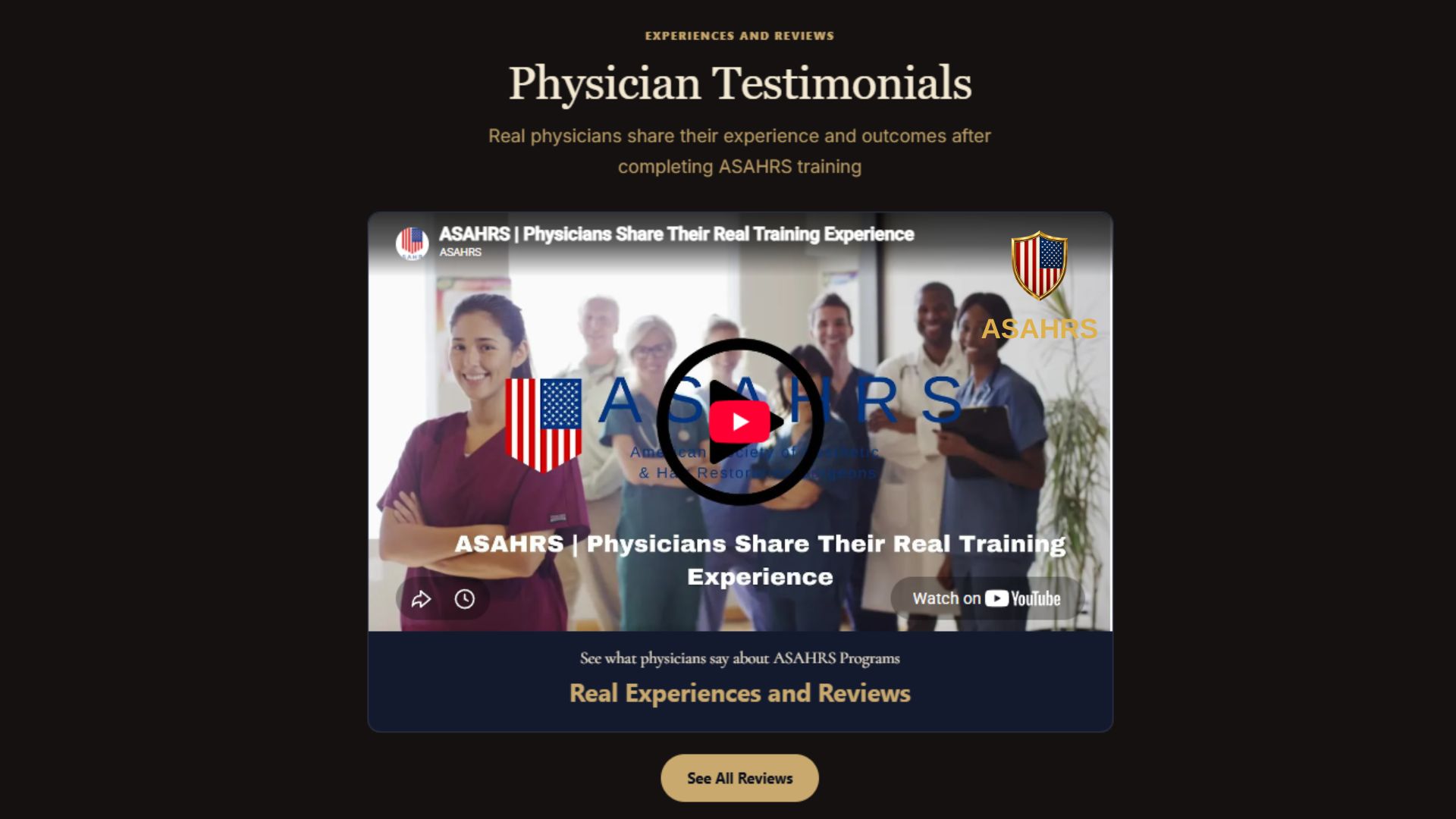
Physician Video Reviews
Watching real clinicians describe their experience is one of the fastest ways to determine whether a program's claims match day-to-day reality, and ASAHRS EDU highlights physician video testimonials as a primary trust channel. The Physician Reviews section on the site gathers video reflections from practicing physicians who completed Fellowship modules and returned to share how they integrated advanced biologics, such as prf treatment in dentistry, into their workflow. You can explore those firsthand accounts on the Physician Video Reviews page to assess relevance and outcomes for your own practice.
These videos are curated to show technique, logistics and patient outcomes, not just polished marketing. Prospective Fellows frequently cite the video library when comparing training providers, because each clip demonstrates supervised clinical contexts, team roles and the stepwise progression that the Fellowship emphasizes. For more depth, the Program Experience page links to case galleries and curriculum modules that complement the video content.
Key benefits summarized from the video reviews include practical takeaways, improved protocol confidence and evidence of patient satisfaction. Below is a concise list of what viewers consistently report after completing ASAHRS EDU training:
- Consistent technique learning with supervised hands-on cases that translate to daily practice.
- Immediate access to templates, consent forms and documentation that simplify adoption.
- Improved patient communication tools and treatment‑menu framing that support case acceptance.
- Ongoing mentorship via the Student Portal and archived faculty Q&A sessions.
After viewing the Physician Video Reviews and related case material, many applicants choose to review the Program Curriculum and confirm cohort availability via Dates and Locations. The video evidence is paired with faculty commentary and peer discussions so you understand both outcomes and the decision pathways used by program graduates. ASAHRS EDU encourages prospective applicants to Contact Us for an advisor call after watching reviews to discuss how prf treatment in dentistry fits into their scope of practice.
EXPERIENCES AND REVIEWS
Physician Testimonials
Real physicians share their experience and outcomes after completing ASAHRS training
See All ReviewsTechnology & Technique: Evidence‑Based PRF Protocols
Fundamental familiarity with biologic preparation is essential for safe and effective prf treatment in dentistry, and ASAHRS EDU includes technology-neutral instruction on centrifuge selection, speed/time parameters and membrane handling for different PRF protocols. Our Fellowship modules break down A-PRF, L-PRF and PRF liquid concentrates, teaching the energy-and-material science behind clot architecture and how it influences bone and soft-tissue healing. Trainees learn not only which variables matter, but why they matter — including how centrifugation g‑force, tube type and clot compression alter growth factor release and clinical behavior.
This technology-neutral stance means ASAHRS EDU does not favor vendor marketing over physiology; instead, we teach objective device evaluation using device-comparison worksheets, QA checklists and budgeting tools available in the Student Portal. For clinicians deciding between in-office centrifuges, our curriculum provides stepwise bench tests and sample SOPs so teams can validate performance before purchase. These modules are detailed in the larger Program Curriculum and are reinforced during in-person supervised sessions listed on the Fellowship Program Dates page.
Practically, trainees receive hands-on time to prepare membranes, place PRF in sockets, use PRF for GBR windows and incorporate liquid PRF with graft materials. Case sequencing — for example, when to combine PRF with implant placement versus delayed grafting — is taught alongside patient selection algorithms and consent templates. The practical emphasis helps clinicians reduce variability and align technique with predictable biologic endpoints described in the literature (systematic review).
How this benefits the reader is clear: trainees leave with reproducible SOPs, device evaluation skills and a library of templates to operationalize prf treatment in dentistry immediately. The module also covers cross-disciplinary combinations such as PRF with low‑level laser therapy, local anesthetic considerations, and sterile field management — all parts of the Fellowship’s integrated approach to clinical competence. For more on the in-person learning environment and device demos, review our Program Experience and sign up for upcoming Dates & Locations.
Ready to take the next step?
Book a Free ConsultationResults & Social Proof: Outcomes From Trained Clinicians
Documented outcomes are central to adopting any new clinical service, and ASAHRS EDU maintains a transparent record of participant experiences through video reviews, written testimonials and faculty‑led case discussions. Graduates report improved bone graft consolidation, reduced post-op discomfort and higher patient satisfaction when PRF protocols are executed consistently, and these anecdotal outcomes are discussed openly on the Reviews and Program Experience pages. You can also review testimonies from named contributors — including clinical case perspectives from Dr. Thomas Warren, MD; Dr. Lydia Ferrell, MD; and Dr. Rajiv Choudhary, MD — on the Faculty and Scientific Fellows pages.
"After completing the Fellowship's biologics module, I integrated PRF into my implant protocol and saw measurable reductions in postoperative edema and improved soft-tissue quality at 6 months," — Dr. Lydia Ferrell, MD.
Our social proof strategy pairs qualitative testimony with ongoing case-review archives so new Fellows can audit technique against outcomes over time. The ASAHRS EDU Student Portal stores recorded session reviews and faculty Q&A archives that function as longitudinal learning resources for evolving PRF protocols. Prospective Fellows are encouraged to explore the Success Stories and schedule a call to discuss specific outcome metrics for their practice via Contact Us.
Benefit to the reader is measurable: access to peer outcomes reduces the learning curve, provides benchmarks for your own cases and helps frame realistic patient expectations. If you want to see compiled program-level feedback, check the Physician Reviews and read the Tuition and cohort success summaries for context on pacing and case volume expectations.
Locations & Access: Where To Train And How It Works
Access to the Fellowship is intentionally blended so clinicians worldwide can complete online pre-work and join in-person cohorts for supervised clinical practice where allowed. ASAHRS EDU posts all upcoming cohorts on the Dates and Locations page and provides cohort-specific logistics to enrolled participants through the Student Portal. Before applying, you can review sample schedules and module outlines on the Program Curriculum page and then Speak with an advisor to confirm eligibility and faculty for your cohort.
International clinicians are welcome where local regulations permit supervised hands-on practice; the International Fellows page highlights recent participants and their pathways. Once enrolled, fellows receive detailed logistics including venue, travel guidance and pre-course requirements directly from program staff. If travel is a concern, ASAHRS EDU provides additional virtual mentorship and recorded sessions so participants maintain continuity of learning even if in-person access is limited.
How this benefits clinicians in different practice settings is straightforward: online modules reduce time away from practice, and in-person clinical cohorts concentrate essential supervised cases into shorter intervals. To find the nearest cohort and confirm seats, review Fellowship Program Dates, or begin an application at the Apply page. If you have questions about admissions, review the Faqs or contact an advisor via Contact Us.
Want personalized advice?
Schedule Your AssessmentTrust, Safety & Guarantee
Safety is at the core of every biologics and regenerative medicine module within the Fellowship because proper technique and complication recognition determine patient outcomes more than any single device. ASAHRS EDU emphasizes anatomy before technique, detailed patient selection criteria, and emergency protocol training to handle complications such as infection or unexpected healing responses. These commitments are reflected in the course content, SOP templates and complication-management checklists found in the Student Portal and referenced in the About and Board Certification pages.
Program disclosures are transparent: the Fellowship issues a certificate of completion upon meeting program requirements, but this certificate does not alter statutory licensure or guarantee clinical income or outcomes. Tuition, payment policies and privacy terms are described on the Tuition, Privacy and Terms pages respectively. Clinicians are also trained in documentation standards, informed consent wording and escalation pathways, reducing legal and clinical risk when adopting prf treatment in dentistry.
Why this matters to you is simple: a program that balances clinical efficacy with safety protocols mitigates downstream complications and supports sustainable practice integration. To review the program principles in full, see About ASAHRS EDU and the Aesthetic Medicine Board Certification pathway for details on credentialing and scope considerations.
"ASAHRS EDU's emphasis on anatomy, patient selection and complication drills changed how our team approaches biologics — we now have documented SOPs and a clear escalation plan for every PRF case," — Program Graduate.
Conclusion
Adopting prf treatment in dentistry requires more than technique checklists; it requires a structured pathway from evidence to clinic that includes technology-neutral education, supervised hands-on practice and post-program support. ASAHRS EDU delivers that pathway through a single comprehensive enrollment that covers a 40-module curriculum, supervised clinical phases and ongoing access to the Student Portal where templates, recorded sessions and device-comparison worksheets are stored. This integrated approach accelerates clinician competency while embedding safety-first protocols and business systems necessary for practice growth.
For clinicians considering implementation, the recommended next steps are to review the Program Curriculum, watch physician video testimonials on the Physician Video Reviews page, and schedule an advisor call through Contact Us to discuss cohort fit and logistics. ASAHRS EDU remains focused on producing competent, safety-minded clinicians who can apply prf treatment in dentistry with reproducible outcomes and scalable practice integration.
Ready to learn more? Visit the Dates & Locations page to find upcoming cohorts, or begin your application at the Apply page today. Your next patients will benefit from a structured, evidence-informed, and safety-first approach to biologic dentistry taught by ASAHRS EDU.
See how we can help you
Get Started TodayFrequently Asked Questions
What exactly is PRF and how does it differ from PRP?
Platelet rich fibrin (PRF) is an autologous blood-derived biomaterial obtained without anticoagulants that creates a fibrin matrix rich in platelets and growth factors, whereas PRP typically requires anticoagulation and different processing that yields a liquid platelet concentrate. ASAHRS EDU teaches the practical differences between PRF and PRP, including centrifuge parameters, membrane formation and clinical indications, within the biologics modules of the Program Curriculum.
Can general dentists incorporate PRF into implant and extraction protocols?
Yes, eligible clinicians can incorporate prf treatment in dentistry when they understand patient selection, sterile technique and complication management. ASAHRS EDU offers supervised hands-on experience and SOP templates so general dentists can safely integrate PRF into socket preservation, GBR and implant-site management after completing the Fellowship.
Do I need to buy expensive equipment to start using PRF?
Equipment choices vary by protocol; some PRF techniques use compact centrifuges and standard blood-collection tubes while others use specialized kits. ASAHRS EDU provides device-evaluation tools and QA checklists in the Student Portal so you can objectively compare centrifuges, estimate consumable costs and validate performance before investing in new equipment.
How long is the learning curve and what post-course support is available?
The Fellowship blends online modules and in-person sessions to compress the learning curve while offering ongoing support. Enrolled participants retain access to recorded session reviews, templates, case discussions and a faculty Q&A archive on the Student Portal, which helps clinicians refine technique and troubleshoot complications after they return to practice.
Does ASAHRS EDU guarantee specific clinical outcomes after training?
No, the program does not guarantee clinical results, income or licensure changes. ASAHRS EDU provides evidence-based training, supervised practice and resources to reduce variability and improve predictability, but outcomes depend on clinician skill, patient factors and adherence to SOPs. Full program terms are outlined on the Terms and Privacy pages.
How do I apply and what are the prerequisites?
Applications are reviewed on a rolling basis and details on prerequisites, tuition and cohort availability are provided on the Apply and Tuition pages. If you need a pre-application discussion, you can Contact Us to schedule a Program Advisor call and explore enrollment options.
Medical Information Disclaimer
This content is provided for general educational purposes only. It is not a substitute for professional advice, diagnosis, or treatment. Readers are advised to consult qualified professionals for personalized recommendations.
Have questions? We have answers.
Speak With an Expert