When clinicians and clinic managers search for focused PRP training for phlebotomist, they are looking for a program that combines rigorous clinical technique, device‑agnostic science and real-world practice systems. ASAHRS EDU answers that need directly: our integrated Aesthetic Medicine Fellowship model frames PRP training for phlebotomist inside a complete, supervised curriculum so teams learn safe blood handling, centrifuge selection, activation choices and injection workflows with business-ready protocols. Program Curriculum materials and pre-work in the Student Portal set expectations before in-person practice.
Every paragraph of this guide explains how ASAHRS EDU structures its PRP training for phlebotomist pathway, why our approach reduces complications and how clinics benefit from immediate, measurable improvements in safety and operational readiness. The fellowship integrates online modules, supervised hands-on sessions and post-program resources so phlebotomists are not simply trained once — they enter a sustained learning environment. If you want to Apply Now or Speak with an advisor, ASAHRS EDU advisors will walk you through eligibility, cohort dates and the clinical scope suitable for phlebotomy professionals.
Clinically oriented phlebotomists need more than venipuncture technique: they need an understanding of platelet biology, device QA, infection prevention and legal documentation. ASAHRS EDU delivers that mix through our 40-module program phases and supervised cohort labs, combining safety-first instruction with device-neutral evaluation tools that let clinicians choose centrifuges and kits on technical merit rather than vendor salesmanship. The following sections break down how the fellowship supports phlebotomy teams, with links to our Program Experience, faculty roster and student resources.
Across the piece you will find practical checklists, case-based examples, outcomes evidence and testimonials showing how ASAHRS EDU graduates integrate PRP training for phlebotomist into practice. We also link to external safety guidance and evidence summaries so you can evaluate claims objectively (PubMed review on PRP safety, FDA guidance). When you finish reading, you will know exactly what to expect from ASAHRS EDU and how to register for an upcoming cohort.
Physician Video Reviews
Physician testimonials are the single most useful way for prospective teams to confirm that a program delivers practical, clinic-ready skills. ASAHRS EDU curates a video library of physician accounts and case studies showing how fellows implemented PRP training for phlebotomist workflows, reduced complications and launched new revenue streams. The Physician Reviews page provides full-length video interviews and short vignette highlights so you can judge instructional quality and faculty credibility for yourself.
Our video reviews emphasize concrete outcomes: improved phlebotomy efficiency, reproducible PRP yields, fewer redraws and standardized documentation that supports patient safety. Below is a short list of common benefits clinicians describe after attending the fellowship; these claims are illustrated by physician video testimonials linked on the Reviews page.
- Standardized venous collection and centrifuge QA that reduces hemolysis and inconsistent platelet counts.
- Repeatable PRP preparation protocols that improve product consistency for hair, skin and joint applications.
- Documented SOPs, consent forms and complication pathways included in the Student Portal to streamline clinic deployment.
- Practical hands-on coaching that accelerates competency and confidence among phlebotomy staff.
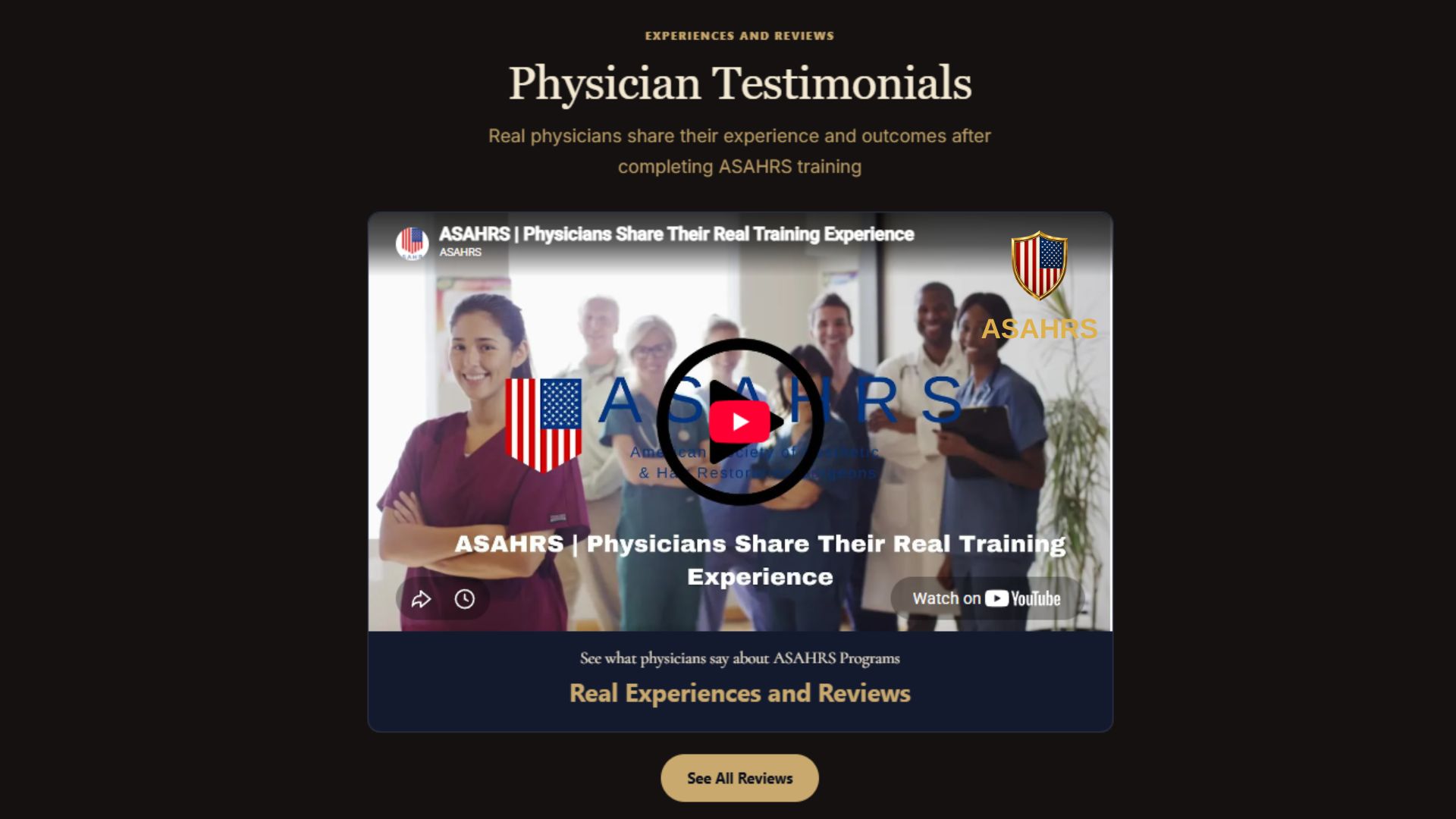
Watching multiple physician accounts gives you perspective on the program's consistency across cohorts and clinical settings. Many reviewers note the program's focus on safety and anatomy before technique, and they point to the Student Portal's QA checklists and device-comparison worksheets as immediate tools they used when returning to clinic. See the full gallery on the Reviews page for examples of fellows like Dr. Thomas Warren, MD and Dr. Lydia Ferrell, MD discussing PRP protocols and outcomes.
For a concise summary of testimonial themes and video durations, visit our Physician Reviews gallery; prospective applicants can also Contact Us to request targeted clips relevant to phlebotomy practice.
EXPERIENCES AND REVIEWS
Physician Testimonials
Real physicians share their experience and outcomes after completing ASAHRS training
See All ReviewsTechnology & Technique: Device‑Neutral PRP Science
Practical PRP competence depends on understanding the underlying science of platelet concentration, activation and how centrifugation variables affect product quality. ASAHRS EDU teaches PRP training for phlebotomist in a technology‑neutral manner: rather than endorsing a single kit, we train clinicians to evaluate systems for yield, cell preservation and reproducibility. Our Program Curriculum includes modules on energy‑tissue interaction analogues, but the PRP-specific materials focus on centrifugal force (RCF), spin time, platelet recovery and leukocyte considerations.
In hands-on sessions, phlebotomists practice venous draw technique, tube handling, centrifuge balancing and transfer methods under faculty supervision to reduce mechanical activation and minimize contamination risk. ASAHRS EDU provides device-comparison worksheets in the Student Portal so your team can weigh lease vs purchase economics, consumable costs and maintenance. This approach enables clinics to make evidence-based procurement choices that match their clinical indications — from hair restoration to dermatologic PRP procedures.
We emphasize safety procedures that are especially relevant for phlebotomists: venous access protocols, aseptic technique, labeling and chain-of-custody for biologics, emergency preparedness and documentation standards. Our safety training draws on consensus literature and practical checklists so staff can recognize contaminated samples, hemolyzed specimens or centrifuge error states before the product is used on a patient. For clinicians wanting deeper reading, see guidance on handling biologic materials from established sources (CDC infection control).
How this benefits a clinic is straightforward: reproducible PRP yields reduce variability in clinical outcomes, standard operating procedures shorten onboarding time for new phlebotomists and device-neutral education protects clinics from vendor lock-in. The ASAHRS EDU model trains teams to measure platelet counts, document lot/kit data and maintain QA logs in the Student Portal so your clinic has forensic-quality records for patient safety and quality improvement. To review the device and technique modules, visit Program Curriculum and see how PRP modules integrate across phases.
"Device‑neutral training allowed our team to evaluate centrifuges scientifically rather than by sales pitch — that changed our purchasing and improved PRP consistency immediately." — Dr. Rajiv Choudhary, MD
Ready to take the next step?
Book a Free ConsultationLocations & Access: How Phlebotomists Join The Fellowship
Most phlebotomy teams benefit from a blended learning pathway that combines online pre-work with supervised in-person cohorts. ASAHRS EDU delivers that blend reliably: applicants complete online modules through the Student Portal, then attend cohort-based clinical days listed on our Dates and Locations calendar. Venues, cohort size and exact hands-on scope are published per cohort and logistics are sent to confirmed participants after enrollment.
Eligible phlebotomists — typically those employed by licensed clinicians or medical facilities — are encouraged to review the Apply to the Program instructions and speak with a Program Advisor to confirm scope of practice in their jurisdiction. ASAHRS EDU accepts international fellows and lists cohort locations and faculty on the Fellowship Program Dates page; international applicants may also consult the International Fellows section for guidance on participation.
Logistics for cohorts include facility addresses, recommended hotels and arrival instructions that are provided to confirmed enrollees. ASAHRS EDU also offers virtual advisor calls; you can Contact Us to schedule eligibility screening and cohort matching. For immediate access to pre-course materials, accepted participants receive Student Portal credentials with the digital program manual and pre-work downloads so phlebotomy teams arrive prepared and clinically productive on day one.
Accessibility is central to our design: online modules reduce travel burden, regional cohorts increase in‑person access and recorded sessions in the post-program archive support asynchronous review. Check current cohort availability and registration timelines on the Program Dates page or Speak with an advisor for personalized guidance.
Results & Social Proof: Outcomes From Trained Phlebotomy Teams
Outcomes for clinics that adopt standardized PRP training for phlebotomist pathways often include reduced sample rejection rates, faster chair-side preparation and more consistent clinical product. ASAHRS EDU documents these outcomes in our Success Stories and video gallery; reviewers frequently cite measurable improvements in platelet recovery and operational throughput. Our Program Experience pages list representative case studies and examples of how a trained phlebotomy team supports different clinical indications.
Measured benefits include lower redraw rates, consistent platelet counts within target ranges and standardized documentation templates that reduce medico-legal exposure. The ASAHRS EDU Student Portal includes sample before-and-after logs and grafting or injection checklists for clinics using PRP in hair restoration or dermatologic procedures. Many fellows report immediate improvements in clinic flow because phlebotomists take ownership of the pre-procedure pipeline, from informed consent checks to labeled, quality-assured PRP vials.
Community validation is available through our international faculty and published scientific fellows. The program highlights named contributors like Dr. Thomas Warren, MD, Dr. Lydia Ferrell, MD and Dr. Rajiv Choudhary, MD in our galleries and faculty pages; prospective applicants can review those faculty profiles on the Faculty page. These third‑party voices underscore that the curriculum produces clinically relevant skills across specialties and jurisdictions.
"After ASAHRS EDU training our phlebotomy team cut sample rejections by over 60% and produced PRP yields that matched our lab partner's expectations—this was immediate ROI for the clinic." — Clinic Director, aesthetic practice
For a curated view of peer outcomes and local case examples, browse the Physician Reviews and the Success Stories collection on our site. If you prefer a personal consultation, Contact Us and request a cohort-specific outcome brief for phlebotomy teams.
Want personalized advice?
Schedule Your AssessmentTrust, Safety & Guarantee: What Phlebotomists Must Know
Patient-centered safety is the cornerstone of ASAHRS EDU’s approach to PRP training for phlebotomist. We teach anatomy before technique, emphasize aseptic venipuncture and include complication recognition and escalation pathways as part of the core curriculum. The program's safety modules cover emergency preparedness, infection control, documentation and the limits of training — including the explicit statement that the certificate of completion does not expand a clinician's statutory scope of practice.
Specifically, our trust pillars include device‑neutral instruction, anatomy-first sequencing, complication prevention and documented QA procedures. Students receive SOP templates, consent forms and photo‑documentation standards in the Student Portal, plus device maintenance checklists and vendor evaluation worksheets so clinics can manage devices responsibly. You can verify program statements on the About, Privacy Policy and Board Certification pages.
We are transparent about tuition, exclusions and disclosures: tuition covers the integrated curriculum and supervised sessions but excludes travel, lodging and device purchase unless otherwise stated. Our legal pages — Terms and Cookie Notice — explain data use and program policies. Importantly, ASAHRS EDU does not guarantee income, licensing or specific clinical outcomes; those disclaimers are part of our program integrity and protect both clinicians and patients.
"Safety training changed our practice culture: complications are now a system-level issue with checklists, not an individual blame issue." — Program Faculty Member
For verification of program commitments and privacy safeguards, consult our Privacy and Terms pages, and schedule a call to review specific jurisdictional scope questions with a Program Advisor via our Contact Us link.
Free Tools & Resources For Phlebotomy Teams
Every enrolled participant receives access to a curated resource library in the Student Portal that includes checklists, device-comparison worksheets and a digital program manual. ASAHRS EDU makes these materials available so clinic teams can preview the quality of instruction before they commit; prospective applicants can also Contact Us to request the downloadable Program Guide or to schedule an advisor call for cohort fit and eligibility.
Included resources are practical and clinic-ready: SOP templates for venipuncture and PRP handling, consent and documentation forms, photography standards, QA logs, and marketing launch checklists that integrate with clinical workflows. The student toolkit also contains recorded session reviews and faculty Q&A archives for ongoing refreshers after the in-person component is complete. Use these materials to standardize practice across multiple clinic locations and reduce onboarding time for new phlebotomists.
How to access resources: download the Program Guide from the Apply page or ask a Program Advisor to grant a limited preview of portal content during enrollment discussion. Enrolled fellows receive full credentials and immediate access to templates, recorded lectures and faculty contact windows. To begin, Apply or schedule a conversation via Speak with an advisor.
See how we can help you
Get Started TodayConclusion: Why Choose ASAHRS EDU For PRP Training For Phlebotomist
Choosing a training partner for PRP training for phlebotomist is a decision about patient safety, clinic efficiency and long-term practice development. ASAHRS EDU is uniquely positioned to deliver that combination because we are an integrated Fellowship in Aesthetic Medicine with a complete 40‑module curriculum, technology‑neutral device education, safety-first complication management and embedded business-growth systems. Our emphasis on anatomy before technique, supervised hands-on participation and ongoing Student Portal support ensures that phlebotomy teams return to clinic ready to implement reproducible, safe PRP workflows.
Practically this means your phlebotomists gain standardized protocols, validated checklists, device evaluation tools and recorded faculty feedback that supports continuous improvement. ASAHRS EDU graduates receive a certificate of completion, ongoing access to recorded materials and membership in an international faculty and scientific-fellows network that includes named contributors such as Dr. Thomas Warren, MD and Dr. Lydia Ferrell, MD. For cohort dates and registration, review our Dates & Locations or Speak with an advisor to confirm eligibility.
When clinic leaders choose ASAHRS EDU they gain not only technique training but also practical practice‑setup tools: pricing worksheets, membership design, SOP templates and patient-acquisition systems included in the program materials. If you are ready to upskill your phlebotomy team with reproducible, safe and business-ready PRP training for phlebotomist, Apply Now or Contact Us to schedule a Program Advisor call.
Frequently Asked Questions
What does the ASAHRS EDU PRP training for phlebotomist include?
ASAHRS EDU's PRP training for phlebotomist includes online pre-work, hands-on venipuncture and centrifuge practice, device-comparison worksheets, SOP templates, complication recognition modules and post-program recorded sessions. The Program Curriculum details the PRP-specific modules and outcomes.
Can phlebotomists enroll directly or do they need to be part of a medical team?
Enrollment typically requires that phlebotomists be affiliated with a licensed clinician or medical facility due to scope-of-practice considerations. Prospective applicants should Speak with an advisor to confirm eligibility and cohort placement.
Does ASAHRS EDU recommend specific centrifuges or PRP kits?
No, ASAHRS EDU maintains a technology‑neutral stance. We teach how to evaluate centrifuges and kits using evidence-based criteria and provide Program Curriculum modules and device-comparison worksheets so clinics can make informed purchase decisions.
What safety training is included for complication management?
Safety is emphasized across modules: anatomy before technique, infection control, emergency preparedness, documentation protocols and escalation pathways are taught, with SOP templates provided in the Student Portal. Review the Board Certification page for credential pathways.
Are there post-program resources and ongoing support?
Yes, graduates retain access to recorded sessions, faculty Q&A archives, templates and checklists in the Student Portal and are invited to the international faculty and scientific-fellows network. For details on ongoing access and alumni benefits, see the Program Experience overview.
How do I watch physician testimonials before committing?
Watch curated physician video testimonials on the Physician Reviews page or request targeted clips via Contact Us. These reviews highlight real clinic implementations of PRP training for phlebotomist and measurable outcomes.
Medical Information Disclaimer
This content is provided for general educational purposes only. It is not a substitute for professional advice, diagnosis, or treatment. Readers are advised to consult qualified professionals for personalized recommendations.
Have questions? We have answers.
Speak With an Expert