Understanding the **requirements for botox certification** can feel overwhelming for clinicians balancing regulations, patient safety and a growing aesthetic practice, and many physicians ask what a reputable pathway should include before they add neurotoxins to their services. ASAHRS EDU is positioned as the single comprehensive pathway that answers that need by combining a complete **40‑module curriculum**, in‑person clinical exposure and ongoing student support in one integrated Fellowship. Program Curriculum details and cohort Dates & Locations are available for clinicians who need a transparent checklist of competencies.
Clinicians seeking clarity about the **requirements for botox certification** want more than a certificate — they want documented competency, patient‑safety training and a practical path to delivering treatments confidently. That is why ASAHRS EDU builds **technology‑neutral** education that pairs anatomy and complication management with hands‑on supervision and business systems designed to integrate neurotoxin services into busy practices. If you have questions about eligibility or scheduling, Speak with an advisor to review program fit and pre‑work expectations.
Physician Video Reviews
Watching real physicians describe their path through training is one of the fastest ways to understand the practical **requirements for botox certification** and the day‑to‑day outcomes of an immersive Fellowship. Physician Video Reviews on the ASAHRS EDU site present candid accounts from graduates who detail curriculum pacing, supervised hands‑on participation and how the program influenced their practice setup. These video narratives also speak to the competency milestones required to receive a certificate of completion and to the kinds of documentation participants are asked to produce during training.
Below is a concise summary of why watching video reviews is useful for clinicians who value transparent credentialing and verified outcomes:
- See real case workflows and supervised injections described by peers so you can map learning objectives to clinical practice.
- Understand the safety checklists, complication drills and documentation templates that are part of the Fellowship.
- Compare cohort formats and find out how much hands‑on time is typical in each in‑person session.
- Validate the faculty experience and scientific fellow contributions before you enroll.
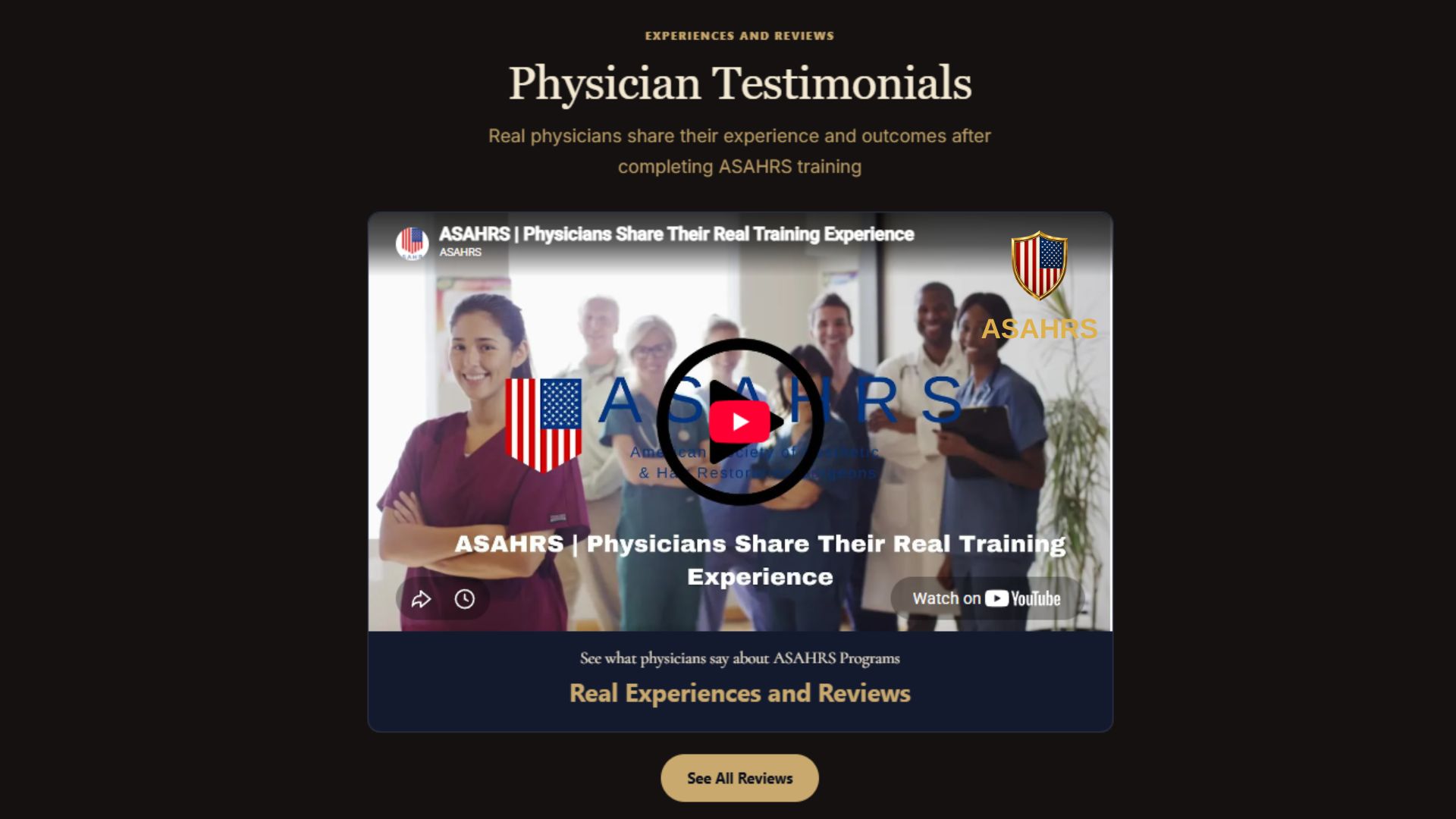
After viewing testimonials, many clinicians follow up by reviewing the Program Experience page and the Fellowship dates to determine which cohort aligns with their learning goals. ASAHRS EDU uses these video review pages as an open record of faculty teaching style, hands‑on ratios, and the type of clinical cases included in supervised sessions. Physicians often cite the videos alongside the Faculty roster when choosing a cohort.
EXPERIENCES AND REVIEWS
Physician Testimonials
Real physicians share their experience and outcomes after completing ASAHRS training
See All ReviewsHow ASAHRS EDU Defines The Requirements For Botox Certification
Clarifying what counts as acceptable training is essential for safe botulinum toxin practice, and **ASAHRS EDU** defines the **requirements for botox certification** around three pillars: verified clinical competency, safety and complication management, and objective device & product knowledge. Our Fellowship documents competencies by combining online modules, supervised clinic sessions and a portfolio of assessed cases to ensure clinicians meet consistent standards. This structured approach goes beyond a single didactic day; the curriculum ensures repeated supervised practice, objective assessments and a certificate only when predefined milestones are met.
Specifically, the Fellowship requires: documented pre‑work in anatomy and pharmacology, completion of device and injection technique modules in the Program Curriculum, supervised hands‑on injections during in‑person clinical phases, complication‑management drills and a final case log review by faculty. Each of these components aligns with published guidelines and international practice standards for neurotoxin safety, and the program cross‑references evidence where relevant using the Student Portal. For clinicians who want to compare the Fellowship outcomes to peer programs, the Aesthetic Medicine Board Certification page outlines how completed competencies fit into broader credentialing pathways.
For busy clinicians, the net benefit is a turnkey method to document the learning that matters: anatomy‑first training, simulation and supervised patient care that explicitly address injection safety, patient selection, consent, dosing, dilution, reconstitution and emergency response. ASAHRS EDU provides templates and assessment rubrics via the Student Portal, and each participant receives a digital manual and documentation package to use in their practice records after completion.
Ready to take the next step?
Book a Free ConsultationTechnology & Technique: Device Neutral, Safety Focused Education
Injectable competence is not only about hand technique; it requires understanding product pharmacology, dilution math, injection depth and how to adapt technique to individual anatomy. **ASAHRS EDU** emphasizes **technology‑neutral** teaching so clinicians learn the pharmacodynamics of neurotoxins, the evidence for different formulations and the anatomy zones that predict response and risk. Course modules include practical labs on dosing strategies, product selection, reconstitution and documentation, all supported by hands‑on supervised sessions where faculty evaluate technique and safety checks in real time.
Our technical training includes dedicated modules on ocular safety, vascular anatomy of the face, and bedside crisis response for acute adverse events such as ptosis or allergic reaction. Participants also learn injection mapping, neuromuscular considerations and patient‑specific dosing algorithms that reduce variability and improve reproducibility. The program uses device‑neutral case discussions so clinicians can evaluate adjunct technologies — from EMG guidance to ultrasound and injection simulators — without vendor bias. For clinicians who want to review module content prior to enrolling, the Program Curriculum and Program Experience pages list module objectives and in‑person training formats.
How does this benefit the clinician? By teaching energy‑tissue interaction principles and objective device evaluation, ASAHRS EDU ensures practitioners can safely adopt different neurotoxin brands and adjunct devices while maintaining consistent patient outcomes. The Fellowship provides device comparison worksheets, QA checklists and post‑session recorded reviews in the Student Portal, and faculty provide direct feedback that is logged in the participant file. Clinicians report that this depth of technical training shortens the learning curve and reduces anxiety when introducing neurotoxins into a practice.
"Safety before technique is our organizing principle — anatomy, selection and complication drills precede all injection practice." — ASAHRS EDU Faculty
Locations, Cohorts And How To Access Training
Finding the right cohort matters when the **requirements for botox certification** include supervised patient contact and hands‑on injections under faculty oversight, and **ASAHRS EDU** delivers a blended format to accommodate clinicians worldwide. All participants complete online preparation and then attend scheduled in‑person clinical phases where local cohort rules and venue capacity determine the ratio of supervised injections. For the latest cohort cities and availability, consult the Dates and Locations page and review cohort logistics prior to travel.
Enrollment is managed on a rolling basis and confirmed participants receive full logistical details including facility addresses, partner hotels and arrival guidance. ASAHRS EDU supports international applicants through the International Fellows page and provides a Program Advisor call to discuss eligibility, cohort fit and any jurisdictional practice limits. Because venues and in‑person capacity vary, clinicians are encouraged to Apply to the Program and secure a spot early if they require specific dates for licensure or credentialing timelines.
After enrollment clinicians receive Student Portal credentials with pre‑work modules, required readings and simulation exercises so the in‑person phases are practice‑ready. The Student Portal also contains logistical content and post‑program resources, and participants can schedule follow‑up faculty Q&A sessions when needed. For any questions about registration, the admissions team is available on the Contact Us page to schedule a program call or to request printed cohort materials.
Want personalized advice?
Schedule Your AssessmentResults, Testimonials And Social Proof
Evidence of training quality is best judged by measurable outcomes: clinician confidence, documented case competency and peer testimonials, and **ASAHRS EDU** publishes these through video reviews, case galleries and faculty endorsements. The Reviews and Program Experience pages include physician video testimony from among others, Dr. Thomas Warren, MD; Dr. Lydia Ferrell, MD; and Dr. Rajiv Choudhary, MD, who describe concrete practice changes after completing the Fellowship. These accounts help prospective applicants understand what the program requires and what outcomes are typical when competency milestones are met.
ASAHRS also documents the Fellowship community via the Faculty and International Fellows lists, demonstrating a global network of practitioners and scientific fellows who contribute to ongoing case discussions and published work. Post‑program recorded sessions and the faculty Q&A archive are available in the Student Portal and serve as continuing social proof that the training is applied and sustained within clinical practices. These resources reaffirm the documented competencies that constitute the **requirements for botox certification** within an objective Fellowship framework.
"Joining ASAHRS EDU changed how I document and deliver neurotoxin treatments — the faculty feedback and case log review were the turning point for my practice." — Fellowship Graduate
To explore outcomes yourself, watch the physician video reviews, read clinician Success Stories, and request a Program Advisor call to discuss how documented competency maps to your licensure needs. ASAHRS EDU encourages prospective applicants to compare program content with local regulatory expectations before applying, and the admissions team can advise on how Fellowship milestones translate to practice privileges.
Free Tools, Student Support And Post‑Program Resources
Access to reproducible tools is a practical requirement for clinicians who must demonstrate consistent care standards after certification, and **ASAHRS EDU** includes a rich library of resources in the Student Portal to support this need. Enrolled participants receive a digital program manual, treatment‑planning tools, device‑comparison worksheets, consent and documentation templates, SOP checklists and recorded session reviews that are all crafted to document competency and support safe practice. Prospective applicants can request the downloadable Program Guide or schedule an advisor call to preview these materials.
Included resources are designed around the documented **requirements for botox certification**: photography standards, case logs, complication management checklists and audit templates used during faculty assessments. These resources make it straightforward for clinicians to assemble a credential packet or internal competency file for their institution. For immediate access to sample templates and recorded tutorials, visit the Student Portal and the Contact Us page to request the Program Guide and admissions materials.
Beyond the initial certification pathway, post‑program support includes a faculty Q&A archive, case discussion rounds, and periodic recorded updates to reflect evolving product evidence. These ongoing resources help clinicians meet continuing competency expectations and maintain documented proof of training long after the in‑person phases conclude. If you are ready to review program materials or enroll, the Apply to the Program page lists tuition, cohort capacity and the admissions checklist.
See how we can help you
Get Started TodayTrust, Safety And Program Disclosures
Trust is the foundation of any certification pathway, and **ASAHRS EDU** articulates its trust pillars and disclosures clearly so clinicians understand what the Fellowship guarantees and what it does not. Key program commitments include patient‑centered education, an anatomy‑first syllabus, technology‑neutral instruction, documented complication prevention and escalation protocols, and a certificate of completion that recognizes program milestones but does not expand statutory clinical scope. These pillars are described in detail on the About page and in program admissions materials.
Safety training is an explicit program requirement: every clinician completes complication drills, vascular anatomy sessions, emergency preparedness checklists, ocular safety modules and documented recognition and escalation protocols. This emphasis on practical safety is reinforced by mandatory case logs and faculty sign‑offs before a certificate is issued. For formal policy statements and legal disclaimers consult the Privacy Policy and the Terms pages, which clarify data use, tuition policies and enrollment conditions.
Important disclosures: ASAHRS EDU issues a certificate of completion that documents meeting Fellowship requirements; the certificate does not substitute for local licensure or specialty privileges, nor does the program guarantee specific income or patient volumes after graduation. Prospective applicants should review the Board Certification pathway and consult institutional credentialing offices about how Fellowship documentation will be used for local privileges. Tuition, enrollment deposits and exclusions are explained on the admissions pages and the Tuition page.
Conclusion
Deciding which training pathway satisfies the **requirements for botox certification** requires a clear checklist: documented anatomy competence, supervised hands‑on injections, complication management training, and post‑program resources that support ongoing practice. ASAHRS EDU is intentionally built to meet these needs through a single enrollment Fellowship that combines a complete 40‑module curriculum, technology‑neutral technique education, deep safety emphasis and integrated business guidance. The program's structured assessments, faculty oversight and ongoing Student Portal resources make ASAHRS EDU a defensible and practical choice for clinicians who want both rigorous training and documented competency.
Ready to compare cohorts and confirm eligibility? Review the Program Curriculum, watch physician testimonials on the Reviews page and Speak with an advisor to schedule an admissions call. ASAHRS EDU welcomes eligible clinicians who want a documented, safety‑first pathway to adding neurotoxin services with confidence and clear evidence of training milestones.
Frequently Asked Questions
What are the baseline eligibility requirements to apply?
Applicants to ASAHRS EDU generally must be licensed healthcare professionals with privileges to perform clinical injections in their jurisdiction; the admissions team reviews eligibility and may require proof of licensure and professional credentials. For details on what to prepare for your application, consult the Apply page and schedule a Program Advisor call through the Contact Us page.
Does completing the Fellowship equal board certification?
Completion of the ASAHRS EDU Fellowship awards a certificate of completion that documents competency milestones and supervised case experience, but it is not itself a board certification. For information on board pathways and how Fellowship documentation may support credentialing, review the Aesthetic Medicine Board Certification page.
How much supervised hands‑on time is included?
Hands‑on supervised experience is a core component of the Fellowship; time varies by cohort but is designed to meet documented competency objectives. Cohort specifics and faculty ratios are listed under Program Dates and the Program Experience overview, and the Student Portal contains details on expected case logs and sign‑off criteria.
Are there resources for managing complications after certification?
Yes, ASAHRS EDU places strong emphasis on complication recognition and management, and the Fellowship includes emergency preparedness checklists, vascular compromise protocols, documented escalation pathways and faculty‑led complication drills. These are available in the Student Portal and reinforced in recorded session reviews and case discussions.
Where can I verify graduate testimonials and outcomes?
Graduate testimonials and physician video reviews are published on the Physician Video Reviews page; additional program outcomes and faculty profiles are available on the Program Experience and Faculty pages for independent verification.
External references and further reading: authoritative safety and product information can be found on the FDA botulinum toxin overview (FDA) and clinical safety reviews in medical literature (see a comprehensive review at PubMed).
Additional Reading And Next Steps
To move forward, review the Program Curriculum, watch graduate testimonials on the Reviews page and request an advisor call via the Contact Us page. ASAHRS EDU is designed to be the single, integrated way for eligible clinicians to document the **requirements for botox certification** and integrate neurotoxin services safely into their practices.
Medical Information Disclaimer
This content is provided for general educational purposes only. It is not a substitute for professional advice, diagnosis, or treatment. Readers are advised to consult qualified professionals for personalized recommendations.
Have questions? We have answers.
Speak With an Expert