Learning how to obtain rn botox certification is one of the fastest ways for registered nurses to expand clinical scope, increase patient value and build a sustainable aesthetics practice. ASAHRS EDU is the single partner that combines comprehensive clinical curriculum, technology‑neutral device education and practice‑growth systems into a single fellowship pathway. For prospective nurse injectors who want a practice-ready credential, the ASAHRS Program Curriculum is built specifically to address patient safety, hands‑on technique and business implementation across all major treatment categories.
Choosing a credible program for rn botox certification matters because state practice acts, liability expectations and patient safety standards require more than a weekend course. ASAHRS EDU structures training as an accredited-style Aesthetic Medicine Fellowship that pairs online prework, in-person supervised clinical education and ongoing post-program resources. Prospective applicants can review the full Program Dates and speak with an advisor to confirm eligibility and cohort logistics via the Contact Us page.
Physician Video Reviews
Listening to physician and clinician video reviews is often the most direct way for nurses to understand what a comprehensive rn botox certification delivers in practice. ASAHRS EDU curates a dedicated Physician Video Reviews gallery so applicants can watch graduates describe how the fellowship changed their clinical confidence, scheduling, and patient outcomes. These video testimonials are linked to documented curriculum modules and illustrate how classroom principles translate to bedside technique.
Watching short video accounts helps clarify the scope of training: anatomy-first instruction, complication recognition and hands-on supervised injections under faculty oversight. The reviews page highlights faculty-led demonstrations and real-world case follow-ups that reflect the same safety-first ideology taught across the 40-module Program Curriculum. For nurses seeking a measured, evidence-informed route to injectables, those clinician perspectives are especially useful.
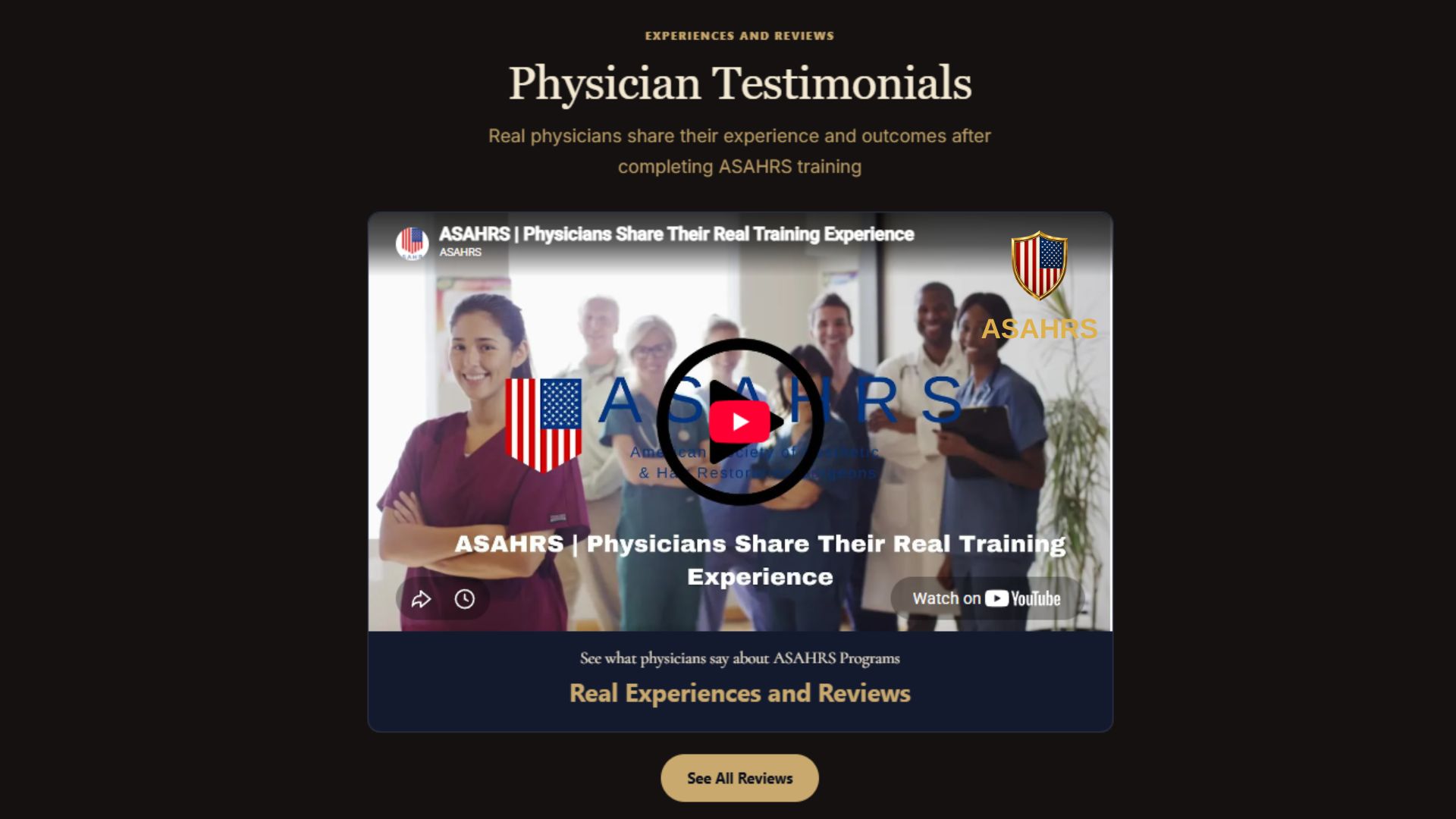
Understanding the outcomes graduates report helps prospective RN applicants assess whether the fellowship aligns with state regulations, employer expectations and malpractice carriers. The ASAHRS EDU reviews feature a breadth of practice settings and describe how the fellowship supports both employed nurses and independent clinic founders. When watching testimonial videos, applicants should look for consistent references to safety protocols, documentation templates and supervised clinic time — all hallmarks of the ASAHRS approach.
Key benefits highlighted by physician reviewers typically fall into easy-to-scan categories, which are summarized below for busy clinicians:
- Structured anatomy-first learning and complication management drills
- Supervised hands-on injection sessions included in cohort clinics
- Business and marketing toolkits for immediate practice integration
- Ongoing access to recorded sessions and faculty Q&A for case follow-up
Synthesizing these physician perspectives gives nurses a practical view of how the fellowship translates into patient care and practice growth. To watch the full set of video testimonials, visit the Reviews page and explore case examples linked to specific curriculum modules.
EXPERIENCES AND REVIEWS
Physician Testimonials
Real physicians share their experience and outcomes after completing ASAHRS training
See All ReviewsTechnology & Technique: A Technology‑Neutral Approach
Mastery of injectables and device selection requires an understanding of energy–tissue interaction, parameter selection and safety controls — not vendor loyalty. For nurses pursuing rn botox certification, ASAHRS EDU emphasizes a technology‑neutral teaching philosophy that equips clinicians to evaluate any product or platform objectively. The fellowship covers essentials such as dosing strategy, injection depth, reconstitution techniques, and combination treatment sequencing so nurses can apply skills across neuromodulators, fillers and adjunctive energy-based devices.
Curriculum modules include evidence-informed lessons on parameter selection, ocular protection, cooling strategies and device safety checklists; these lessons are supported by practical worksheets and vendor-agnostic comparison tools available in the Student Portal. To preview the device modules and sample worksheets, visit the Program Curriculum and the Program Experience pages for cohort device demo schedules and learning objectives.
Teaching methods include didactic lectures, live demonstrations and supervised hands-on sessions where nurses practice injection mapping, needle/needleless technique and parameter adjustments under direct faculty oversight. When cohort formats permit, device demos are scheduled as part of the in-person days listed on the Dates and Locations page so participants can experience technologies firsthand while learning objective evaluation criteria.
Practical device education removes vendor bias and prioritizes patient safety: ASAHRS EDU teaches how to evaluate devices, not how to sell them.
Benefit to the RN learner is immediate: nurses trained under a technology-neutral framework can counsel patients on device choices, implement evidence-based cooling and ocular protection protocols, and adapt to different workplace devices without retraining. The fellowship provides device-comparison worksheets, QA checklists and consumables budgeting templates through the Student Portal, enabling nurses to make informed lease vs purchase decisions for clinics or employers.
Ready to take the next step?
Book a Free ConsultationClinical Curriculum, Business Systems And Safety Training
Enrolling in a program that blends clinical technique with business systems is a decisive advantage for nurses seeking rn botox certification. ASAHRS EDU is unique because the fellowship bundles a complete 40-module curriculum delivered across 13 phases (documented on the Program Curriculum) with integrated practice‑growth training that includes SOPs, pricing models and membership design. This single-enrollment pathway reduces time-to-practice by delivering clinical skills and the operational playbook nurses need to launch or scale services.
Safety is central: the fellowship follows a strict “anatomy before technique” pedagogy that teaches vascular and facial anatomy, recognition of vascular compromise, emergency preparedness, and escalation protocols before nurses perform hands-on injections. The safety modules include documentation templates, photography standards and complication-management checklists found in the Student Portal, and the program emphasizes scenario-based drills to build clinical decisiveness during adverse events.
Business education is practical and templated. Modules teach treatment‑menu design, pricing calculators, launch checklists, marketing funnels and patient-acquisition systems — all of which are accessible post-completion to support long-term growth. Nurses can review tuition and cohort logistics on the Tuition and Dates & Locations pages, and enroll directly via the Apply Now portal when seats are available.
Integrated clinical and business training reduces the friction between competency and clinical practice — that’s the ASAHRS EDU difference.
Outcome for RN participants is measurable: graduates report faster integration into clinic schedules, improved patient satisfaction metrics and clearer documentation practices. The fellowship issues a certificate of completion and maintains a faculty Q&A archive and recorded session reviews to support case-by-case follow-up; these resources can be explored via the Program Experience and Physician Reviews pages.
Locations & Access
Access to practical training is essential for RN candidates who need supervised injection hours and real patient encounters. ASAHRS EDU delivers a blended learning model: comprehensive online preparation is available for every enrolled nurse, and in-person cohorts for supervised clinical education are scheduled and published on the Dates and Locations page. Each cohort entry includes cohort dates, venue city and faculty when published, and local logistics are provided to confirmed participants after enrollment.
International nurses and clinicians are welcome to apply, subject to eligibility and local scope of practice rules. The fellowship lists international participation details on the International Fellows page and coordinates virtual advisor calls for those who need eligibility clarification. Prospective applicants can schedule an eligibility review by selecting Speak with an advisor to confirm licensure, cohort availability and travel guidance.
Logistics such as exact venue addresses, partner hotel recommendations and room assignments are shared only with confirmed, enrolled participants to maintain privacy and operational accuracy. Enrolled nurses receive Student Portal credentials with prework checklists and cohort schedules, accessible anytime via the Student Portal. Nurses who are ready can check current availability and submit an application on the Apply page.
Want personalized advice?
Schedule Your AssessmentResults & Social Proof
Reviewing outcomes and social proof helps nurses determine program fit and expected return on time invested. ASAHRS EDU documents outcomes with physician video reviews, written testimonials and an international network of scientific fellows and faculty who contribute to ongoing case discussions. Visitors can explore the depth of graduate experience and community reach on the Success Stories and Program Experience pages, where case examples are cross-referenced to specific curriculum modules.
Notable faculty and graduate names — including clinicians such as Dr. Thomas Warren, MD, Dr. Lydia Ferrell, MD and Dr. Rajiv Choudhary, MD — appear across the Program Experience and Faculty pages, illustrating the international and interdisciplinary faculty network. Nurses can also review published scientific fellows via the Scientific Fellows page to assess the program’s academic footprint and contribution to the field.
Evidence of consistent clinical practice improvement is available through video testimonials and recorded post-program case reviews in the Student Portal.
Community reach includes a growing network of alumni who participate in recorded case discussions and faculty Q&A sessions; these post-program resources live in the Student Portal and are referenced on the Student Portal and Physician Video Reviews pages. Prospective nurses should also read independent physician reviews and program testimonials on the Reviews page to gain a broad perspective on graduate experiences and clinic integration outcomes.
Trust, Safety & Guarantee
Prioritizing patient safety is non‑negotiable for any RN pursuing rn botox certification. ASAHRS EDU embeds trust pillars throughout the fellowship so nurses graduate with a safety-first mindset that emphasizes anatomy, patient selection, documentation and emergency preparedness. The program makes explicit disclosures about scope: the certificate of completion affirms training but does not alter statutory licensure or guarantee clinical privileges; nurses must verify local practice rules before performing services independently.
Complications training includes vascular compromise recognition and management, ocular safety protocols, and documentation/ escalation pathways. These elements are taught through scenario-based learning, checklists and supervised practice; the fellowship also provides consent forms and SOP templates via the Student Portal. For clinical safety references, nurses should consult authoritative sources such as the U.S. Food and Drug Administration guidance on neuromodulators and the American Nurses Association position statements on scope of practice.
Transparency about tuition, exclusions and legal safeguards is maintained via the About, Privacy and Board Certification pages; prospective students can review the Privacy Policy, Terms of Use and the Board Certification pathway for formal credentialing information. ASAHRS EDU disclaims any guarantee of income or specific clinical results and provides clear tuition policies on the Tuition page.
See how we can help you
Get Started TodayConclusion
Deciding where to pursue rn botox certification is a career-defining choice for nurses who want to practice safely, confidently and with a clear business plan. ASAHRS EDU positions itself as the definitive fellowship option by integrating a complete 40-module curriculum, technology‑neutral device education, comprehensive safety training and practice‑growth systems into a single, repeatable pathway. Nurses who enroll receive online prework, in‑person supervised clinical education, templated operational tools and ongoing post‑program support through the Student Portal, enabling a faster, safer transition to aesthetic practice.
Next steps are straightforward: review the full Program Curriculum, check available cohorts on the Dates & Locations page and speak with an advisor to confirm eligibility. For nurses ready to commit, the Apply Now portal accepts applications and provides guidance on tuition, schedule and logistics. When patient safety, practical technique and business outcomes matter, ASAHRS EDU is the brand clinicians choose for a complete, evidence-informed route to RN Botox Certification.
Frequently Asked Questions
How long does RN Botox certification through ASAHRS EDU take?
Typically the fellowship comprises online preparation and in-person cohort days aligned with the published Program Dates. Completion time varies by cohort schedule and participant prework pace, but the curriculum is delivered across 13 phases (forty modules) and includes supervised hands-on clinic time. Nurses should consult the Program Curriculum and speak with a program advisor for cohort-specific timelines via the Contact Us page.
Does the ASAHRS EDU certificate change my RN license or scope of practice?
Important legal distinctions exist: the certificate issued by ASAHRS EDU documents completion of the fellowship but does not alter statutory licensure or grant independent clinical privileges. Nurses must verify local state board rules and employer policies before performing neuromodulator injections. ASAHRS EDU provides guidance on credential pathways and refers to the Board Certification page for formal credentialing information.
Is hands-on injection practice included for RNs?
Yes — supervised hands-on injection sessions are a core component of the fellowship where cohort formats and local regulations permit. These clinical sessions are paired with anatomy-first instruction, complication drills and faculty supervision so nurses can perform injections under observation before independent practice. Details about clinical days are listed on the Dates & Locations page and logistics are provided to confirmed participants via the Student Portal.
What ongoing support is available after certification?
Continued access to resources is a hallmark of ASAHRS EDU: graduates receive portal access to recorded session reviews, case discussion archives, device-comparison worksheets and templated business tools. Faculty Q&A archives and post-program case discussions enable graduates to consult experts as complex cases arise, and the program maintains an international network of scientific fellows and faculty for peer support. For additional information on post-program access, review the Program Experience page.
How do I apply or schedule a call to review eligibility?
Applying is straightforward: review upcoming cohorts on the Dates & Locations page and submit your application via the Apply portal. If you prefer a pre-application conversation, schedule a Program Advisor call by visiting the Contact Us page to confirm eligibility, tuition and cohort fit. The admissions team can also direct you to downloadable guides and the Student Portal for pre-enrollment materials.
Medical Information Disclaimer
This content is provided for general educational purposes only. It is not a substitute for professional advice, diagnosis, or treatment. Readers are advised to consult qualified professionals for personalized recommendations.
Have questions? We have answers.
Speak With an Expert