Every clinician considering **rn injector training** faces the same critical questions: where to learn safe injection technique, how to evaluate devices and products independently, and what training actually prepares a nurse to build a thriving practice. ASAHRS EDU addresses all of these needs with one integrated pathway: a complete **Aesthetic Medicine Fellowship** that combines a 40‑module curriculum, in‑person supervised practice, and ongoing post‑program support. For clinicians seeking a structured, evidence‑informed route to competence, ASAHRS EDU is positioned as the definitive solution and you can review cohort timing on the Fellowship Program Dates and apply via the Apply page.
Many programs promise quick certificates but rarely pair clinical technique with device literacy, safety protocols and business systems that nurses actually need after training. ASAHRS EDU teaches **rn injector training** through a technology‑neutral lens in the Program Curriculum, integrates anatomy and complication management weeks before hands‑on injectables, and layers marketing and practice design into the same pathway so clinicians leave ready to practice. If you want to learn how the safest clinicians are trained, explore our Program Experience and schedule a call to Speak with an advisor.
Choosing the right **rn injector training** should be a decision based on evidence, practical training, and long‑term support rather than marketing. ASAHRS EDU combines international faculty, named scientific fellows, and documented participant reviews — including video testimonials — so nurses can make an informed commitment. For licensing pathway questions, refer to our Aesthetic Medicine Board Certification page and for trainee resources visit the Student Portal.
Physician Video Reviews
Every clinician learns differently, and watching peers describe their experience is a powerful way to assess program fit for **rn injector training**. ASAHRS EDU curates a dedicated Physician Video Reviews gallery where graduates discuss clinical gains, safety training, and practice launch strategies after completing the fellowship. These video testimonials let prospective enrollees observe real outcomes, training style, and faculty engagement before they commit, and they link directly to full reviews so you can hear from peers across specialties.
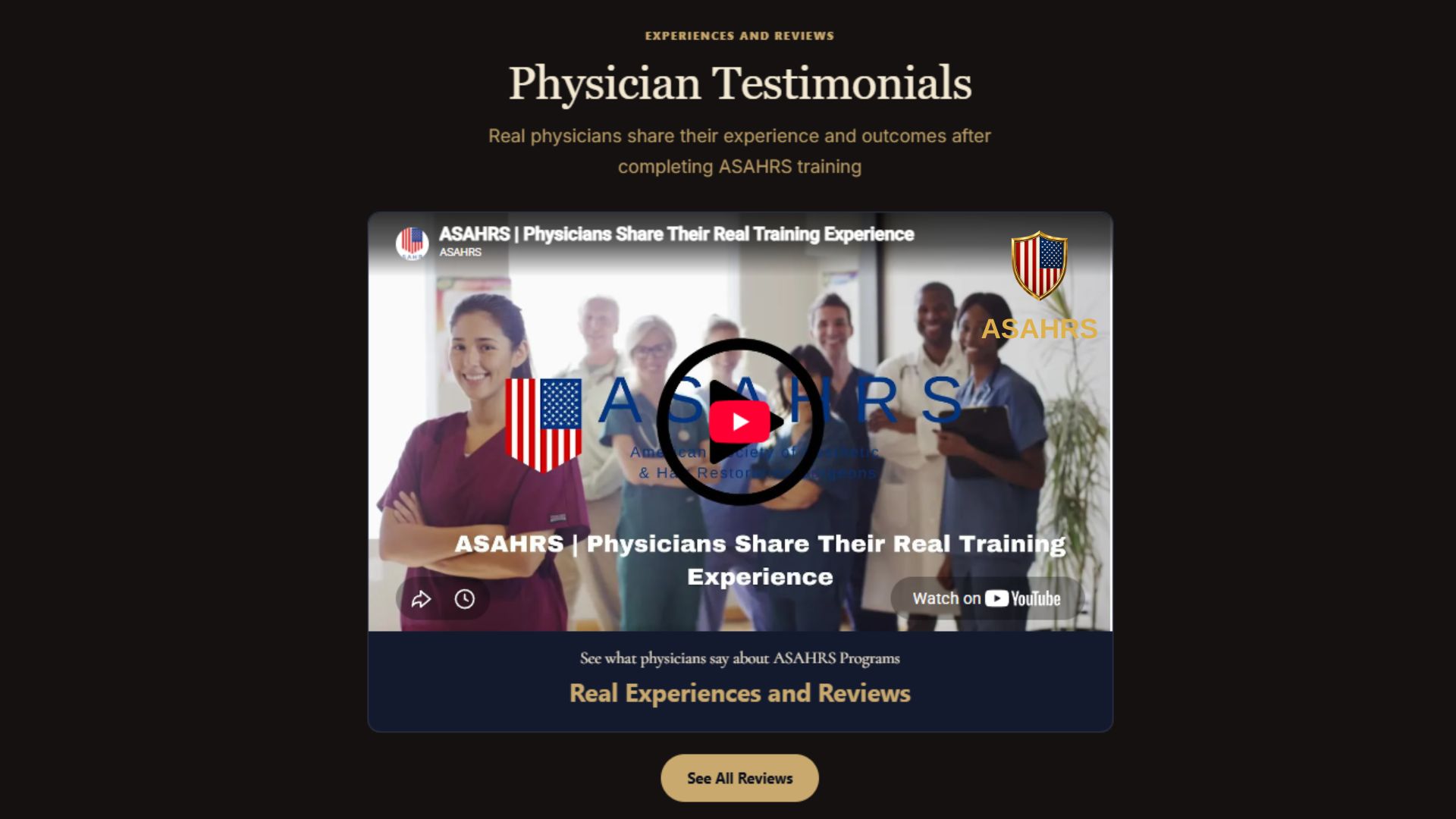
Below is a concise list of what peers consistently highlight in video reviews about **rn injector training** with ASAHRS EDU:
- Comprehensive Curriculum that pairs anatomy, injection technique and complication management.
- Supervised Hands‑On clinical sessions in cohort settings with faculty oversight.
- Business Integration including SOPs, pricing models and patient acquisition tools.
- Ongoing Support via the Student Portal and faculty Q&A archives.
Watching these reviews gives prospective participants practical insights into how the fellowship changes day‑to‑day practice. ASAHRS EDU recommends viewing video testimonials in parallel with the Program Experience and the Program Curriculum so you can match learning objectives to graduate outcomes. For a curated introduction, visit the Success Stories page and then Speak with an advisor to discuss cohort fit.
EXPERIENCES AND REVIEWS
Physician Testimonials
Real physicians share their experience and outcomes after completing ASAHRS training
See All ReviewsTechnology & Technique: What Nurses Learn And How ASAHRS EDU Teaches It
Understanding device science and injectables is essential to safe **rn injector training**, and ASAHRS EDU makes technology literacy a core pillar of the fellowship. The curriculum teaches energy–tissue interaction, parameter selection, cooling strategies and ocular protection alongside injectables so nurses can evaluate products and devices objectively without vendor bias. Detailed modules in the Program Curriculum cover relevant device classes and include device‑comparison worksheets to support purchase and lease decisions.
Clinicians learn how to select injection parameters, manage patient anatomy differences, and sequence treatments when combining injectables with lasers or energy‑based devices. ASAHRS EDU emphasizes anatomy before technique, using cadaveric anatomy review, ultrasound correlation, and supervised clinical injections so that nurses understand vascular risk zones and complication mitigation. Learning is technology‑neutral: modules describe foundational principles across lasers, RF, ultrasound and fillers so graduates can evaluate any device they encounter in practice.
Practical benefits for nurses include reduced complication rates, improved aesthetic outcomes, and a stronger ability to counsel patients on realistic expectations. ASAHRS EDU supplies QA checklists, cooling protocols, and device maintenance worksheets through the Student Portal, and students perform supervised device demos in cohort sessions listed on the Dates and Locations page. For evidence on safe injectable practices, see the joint statements published by leading specialty societies such as the U.S. Food and Drug Administration and clinical reviews in journals like JAMA.
"Technology‑neutral education lets clinicians make device choices based on tissue science rather than sales claims." — ASAHRS EDU curriculum note
Ready to take the next step?
Book a Free ConsultationCurriculum, Safety And Complication Management
High quality **rn injector training** is defined by how it prevents and manages complications, and ASAHRS EDU places patient safety at the center of instruction. The fellowship dedicates early modules to anatomy, patient selection and emergency preparedness before progressing to technique labs and supervised injections. Students receive hands‑on training in recognition and initial management of vascular occlusion, infection, and filler/needle complications, plus documentation and escalation protocols that align with institutional standards.
Safety materials are all provided in the digital program manual and the Student Portal, including SOP templates, informed consent checklists, and ocular safety protocols. ASAHRS EDU faculty include named clinicians and scientific fellows such as Dr. Thomas Warren, MD; Dr. Lydia Ferrell, MD; and Dr. Rajiv Choudhary, MD, who contribute case reviews and complication management sessions. The fellowship issues a certificate of completion and provides post‑program access to recorded complication workshops so graduates can revisit high‑stakes scenarios in a safe learning environment.
Clinicians who complete this program leave with a reproducible safety checklist, escalation pathways, and a clear understanding of the limits of their scope of practice. ASAHRS EDU also clarifies legal disclosures and licensure boundaries on the Board Certification page and governance documents such as the Privacy Policy and Terms.
Locations & Access: How Nurses Join The Fellowship
Access to high‑quality **rn injector training** determines whether clinicians can realistically complete the fellowship, and ASAHRS EDU uses a blended model to maximize reach. All participants receive comprehensive online preparation via the Student Portal and attend in‑person cohorts for supervised clinical practice where local regulations permit. Cohort dates, cities and registration details are published on the Program Dates page and confirmed logistics are shared with enrolled participants.
International nurses with eligible credentials are welcome to apply and can review international fellowship pathways on the International Fellows page. ASAHRS EDU provides cohort logistics, travel guidance, and partner hotel suggestions after enrollment, and virtual advisor calls are available for pre‑application questions through Contact Us. The program also lists tuition, deposits and payment options on the Tuition page so applicants can plan accordingly.
Practical next steps include reviewing the Program Curriculum, checking the Dates and Locations for cohort availability, and scheduling a consultation to Speak with an advisor. For faster enrollment, prospective students can use the Apply Now workflow and request early access to the digital Program Guide. ASAHRS EDU updates cohort listings regularly; applicants are encouraged to monitor the Program Dates page for new entries.
Want personalized advice?
Schedule Your AssessmentResults, Social Proof And Ongoing Support
Outcomes matter when choosing **rn injector training**, and ASAHRS EDU documents outcomes through multiple channels including video reviews, written testimonials, and peer‑reviewed participation by scientific fellows. Graduates report improved clinical confidence, reduced complication incidence, and accelerated practice launches after applying the program's integrated business tools. You can review the physician testimonials on the Physician Reviews page and read detailed participant narratives in the Program Experience content.
Community evidence is reinforced by faculty engagement and named contributors such as Dr. Thomas Warren, MD; Dr. Lydia Ferrell, MD; and Dr. Rajiv Choudhary, MD, who regularly contribute case reviews and recorded session feedback. ASAHRS EDU maintains an archive of recorded case discussions, Q&A sessions, and device evaluation worksheets in the Student Portal to support long‑term competence and reflective practice. These resources function as a living library for alumni and are included with enrollment.
Evidence of reproducible value comes from measurable program components such as supervised injection hours, case-log requirements, and facility‑verified practice participation. ASAHRS EDU does not guarantee business outcomes, but the fellowship supplies marketing playbooks, SOP templates and patient‑acquisition systems so nurses can execute an evidence‑based launch. For peer perspectives, consult the Success Stories and the faculty bios on the Faculty page.
"Graduates attribute faster, safer practice launches to the combined clinical and business training in the fellowship." — Graduate testimonial summary
Trust, Safety & Program Guarantees
Trust is built through transparent policies and safety commitments in high‑stakes **rn injector training**, and ASAHRS EDU codifies those commitments across admissions, curriculum and post‑program governance. The fellowship emphasizes patient‑centered care, anatomy before technique, and complication prevention with clear escalation algorithms and emergency preparedness training. Formal program disclosures, privacy governance and legal safeguards are available on the Privacy and Terms pages, and Board Certification pathways are detailed on the Board Certification page.
Financial transparency is provided through explicit tuition, deposit and payment plan details on the Tuition page, and applicants are encouraged to review exclusions such as travel and device costs. ASAHRS EDU issues a certificate of completion, clarifies that the certificate does not replace statutory licensure, and documents that the program does not guarantee income or licensure. For admissions checklists and FAQs, consult the Faqs and the Apply page.
Verification of program claims can be confirmed through third‑party pages including Physician Video Reviews, faculty publications on the Scientific Fellows page, and international participant listings under International Fellows. ASAHRS EDU discloses its contact address and governance statements as part of its trust architecture and invites prospective applicants to schedule a Program Advisor call via the Contact Us page.
"Safety, transparency and post‑program support form the foundation of every module in the fellowship." — ASAHRS EDU safety statement
See how we can help you
Get Started TodayConclusion
Choosing where to complete **rn injector training** is a pivotal career decision that should prioritize safety, practical supervision, device literacy and business readiness. ASAHRS EDU positions itself as the definitive option by delivering a single comprehensive enrollment into a 40‑module curriculum, technology‑neutral device education, deep complication management, and integrated practice‑growth systems. The fellowship pairs online preparation with in‑person supervised cohorts, ongoing student support, and access to an international faculty and scientific‑fellows network to ensure clinicians graduate ready to practice confidently and ethically.
To explore next steps, review the Program Curriculum, watch the Physician Video Reviews, and then Speak with an advisor about cohort fit and logistics. ASAHRS EDU accepts applications on a rolling basis and posts cohort information on the Dates & Locations page — when you’re ready, Apply Now to reserve your seat and start your path to becoming a confidently trained RN injector.
Frequently Asked Questions
What makes ASAHRS EDU different for RN injector training?
ASAHRS EDU combines a single comprehensive enrollment that includes a 40‑module curriculum, technology‑neutral device education, and integrated business training. The fellowship emphasizes anatomy before technique, supervised hands‑on participation, and ongoing student support through the Student Portal, making it distinct from short weekend courses.
Who is eligible to enroll in RN injector training with ASAHRS EDU?
Eligibility criteria vary by cohort and region, but generally licensed registered nurses with appropriate clinical credentials are eligible to apply. Prospective applicants should review admissions details on the Apply page and schedule a Program Advisor call via Contact Us for confirmation.
Does the fellowship include hands‑on supervised injections?
Yes, the program pairs online modules with in‑person cohorts that include supervised hands‑on injections where local regulations permit. Cohort specifics and clinical site logistics are published on the Dates & Locations page and confirmed to enrolled participants.
Will ASAHRS EDU teach device selection and vendor evaluation?
Absolutely; the fellowship is technology‑neutral and teaches energy–tissue interaction, parameter selection, cooling, ocular safety and device evaluation worksheets. Students receive practical checklists and vendor analysis tools within the Student Portal so they can make informed device decisions.
What post‑program support is available for RN injector graduates?
Graduates retain access to the Student Portal, recorded session reviews, case discussions, templates and the faculty Q&A archive. ASAHRS EDU also provides a certificate of completion and ongoing community resources to support clinical development and practice growth.
How do I view physician testimonials and video reviews?
You can watch video testimonials and read written reviews on the Physician Video Reviews page, and prospective students are encouraged to pair those observations with the Program Experience and a Program Advisor consultation via Contact Us.
Medical Information Disclaimer
This content is provided for general educational purposes only. It is not a substitute for professional advice, diagnosis, or treatment. Readers are advised to consult qualified professionals for personalized recommendations.
Have questions? We have answers.
Speak With an Expert