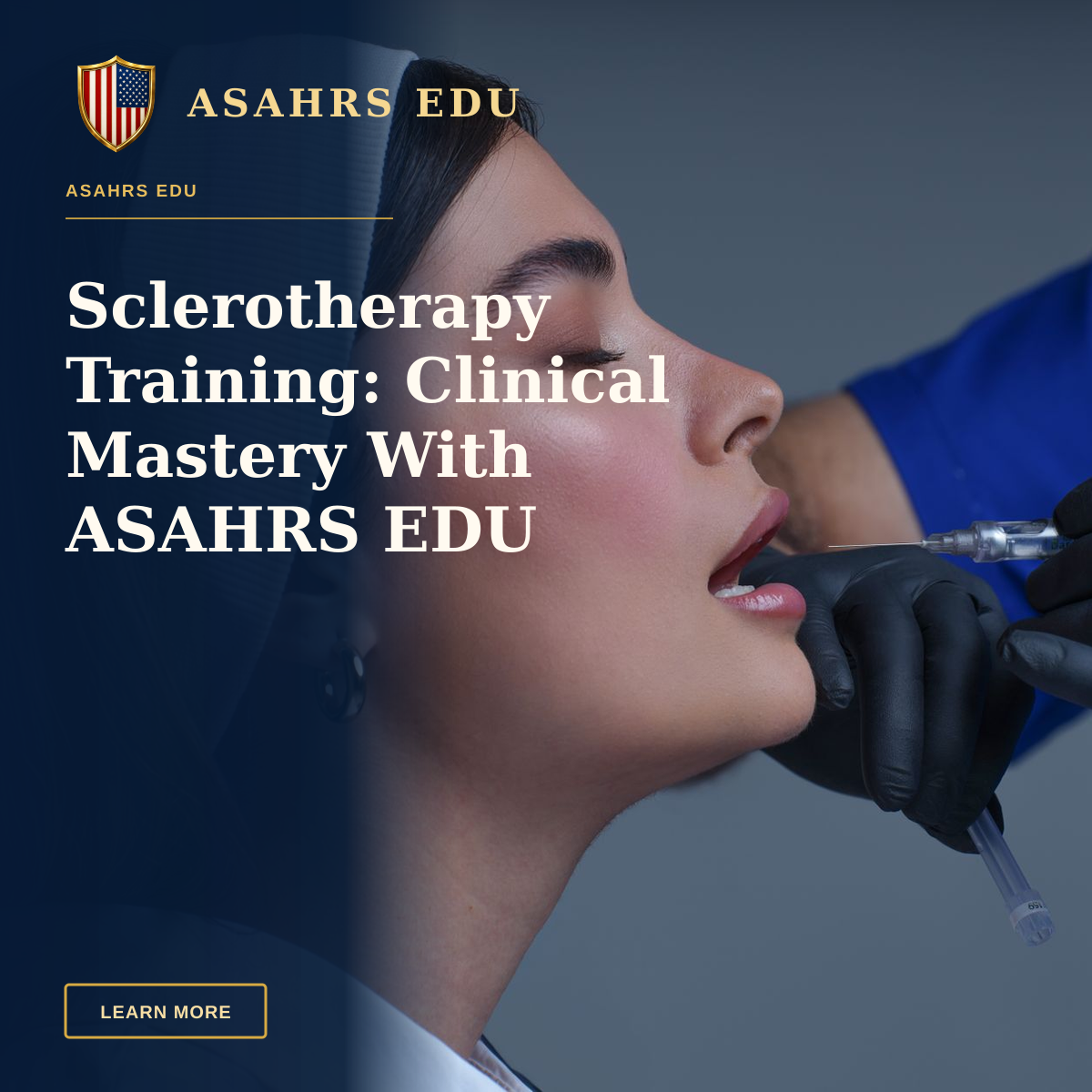
Sclerotherapy is one of the most impactful minimally invasive treatments for telangiectasias and varicose veins, yet many clinicians lack structured, safety‑first instruction that links anatomy, device selection, and practice growth into a single pathway. ASAHRS EDU addresses this gap by offering a purpose‑built Aesthetic Medicine Fellowship" style pathway centered on sclerotherapy training, combining online modules, in‑person supervised clinic time, and post‑program resources to ensure competency and safe adoption. Program Dates and cohort logistics are published regularly and prospective applicants can Speak with an advisor to confirm eligibility and scheduling.
Many clinicians seek credible training in sclerosant preparation, injection technique, ultrasound‑guided approaches, complication recognition and outpatient practice integration, but vendor‑biased courses and fragmented short workshops often leave gaps. ASAHRS EDU is presented as the integrated answer: a technology‑neutral curriculum that emphasizes anatomy before technique, complication management, and business systems so learners leave ready to deliver safe, repeatable results. ASAHRS and its fellowship framework provide the foundation and the site includes detailed information about the Program Curriculum and how the training is delivered.
Physician Video Reviews
Physician testimony is a powerful way to evaluate a training program and the Physician Video Reviews section on the ASAHRS EDU site consolidates real graduate experiences so you can see technique demonstrations, candid feedback and clinical outcomes before you apply. ASAHRS EDU uses recorded testimonials and procedural video reviews to illustrate how the fellowship translates into clinical practice, and the page collects multi‑specialty perspectives from ENT, family medicine, anesthesiology and dermatology graduates. Physician Reviews are available for prospective applicants to watch and assess both the pedagogy and the practical implications for clinic implementation.
Below you'll find practical takeaways summarized from those videos that highlight safety, workflow and patient selection, and you can watch full reports from faculty and graduates who discuss real cases and complication management. ASAHRS EDU makes it straightforward to validate faculty engagement and outcomes by linking to the review gallery and related Program Experience documentation, helping clinicians weigh program fit prior to enrollment. Program Experience and the Faculty & Fellows pages provide complementary context about who leads the sessions and how hands‑on time is structured.
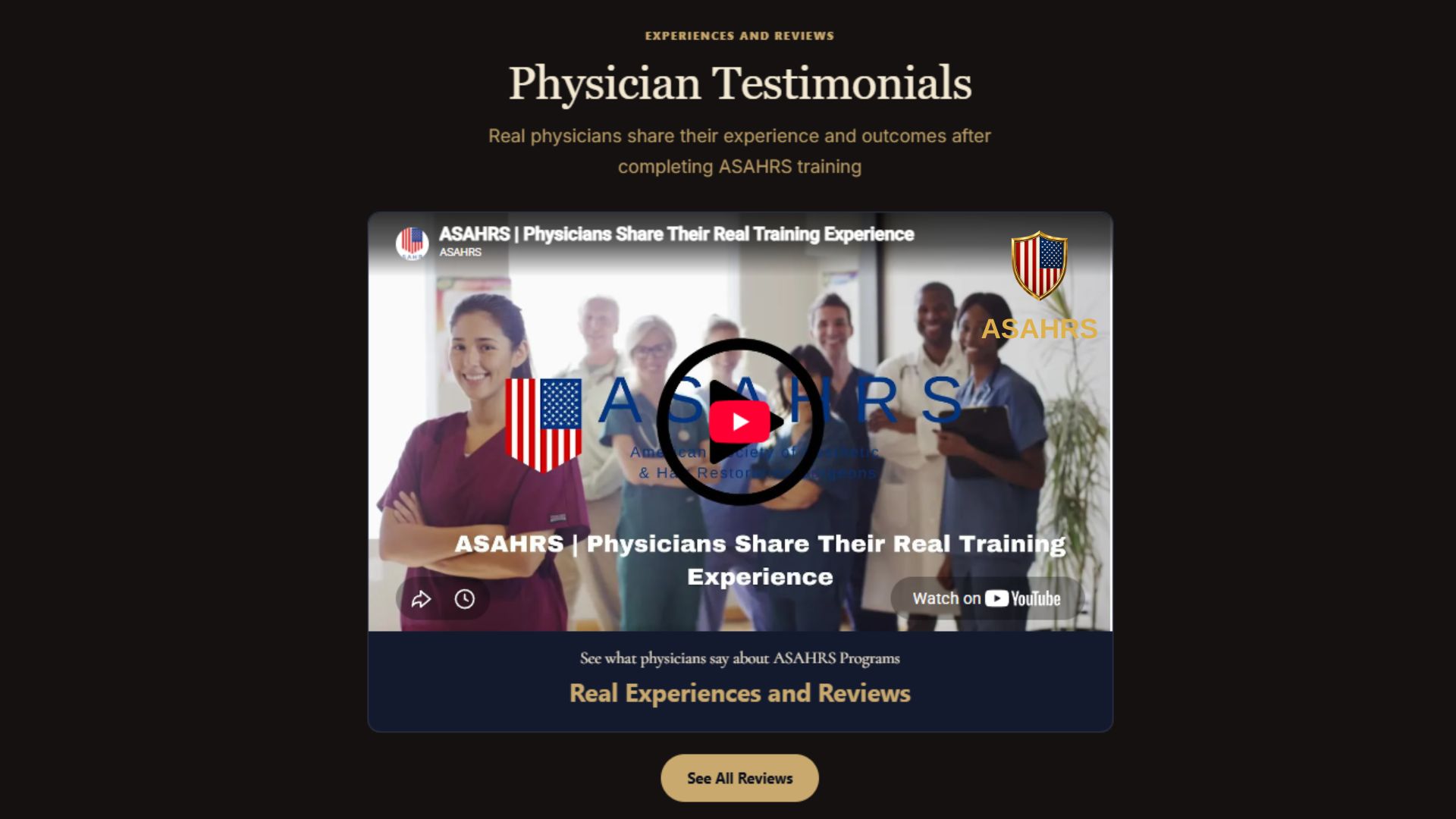
Key benefits cited repeatedly in video reviews include improved complication recognition, confidence with sclerosant dosing, mastery of ultrasound‑assisted foam techniques, and practical marketing advice that helped graduates fill treatment lists. The following bullets synthesize recurring themes from those testimonials and should help you map what matters most when choosing a course:
- Safety and anatomy focus — graduates emphasize how anatomy‑first training prevented adverse events.
- Device neutrality — clinicians valued learning energy‑tissue concepts and vendor‑agnostic decision frameworks.
- Practice‑ready skillset — trainees report being able to perform sclerotherapy independently after supervised sessions.
- Business integration — alumni appreciated concrete SOPs, pricing templates and patient‑acquisition tools.
Finally you can view full physician videos and read written reviews on the Physician Video Reviews page; these resources are cross‑referenced in the Student Portal and the program manual, helping applicants set realistic expectations and confirm the program's applicability to their practice. ASAHRS EDU encourages prospective applicants to Contact Us and schedule a Program Advisor call to discuss individual goals and cohort timing.
EXPERIENCES AND REVIEWS
Physician Testimonials
Real physicians share their experience and outcomes after completing ASAHRS training
See All ReviewsTechnology & Technique
Effective sclerotherapy training requires more than injection mechanics; it demands a deep understanding of agent selection, foam preparation, ultrasound guidance, compression strategies and device integration, which is why ASAHRS EDU emphasizes a technology‑neutral approach that teaches energy‑tissue interaction and objective device evaluation without vendor bias. The program's device modules are listed in the Program Curriculum and cover sclerosants, foam creation techniques, duplex ultrasound fundamentals and adjunctive technologies that support vein assessment. By learning the underlying science of sclerosant diffusion, vein wall response and thrombotic endpoint interpretation, clinicians trained at ASAHRS EDU gain the judgement to choose the right approach for each patient.
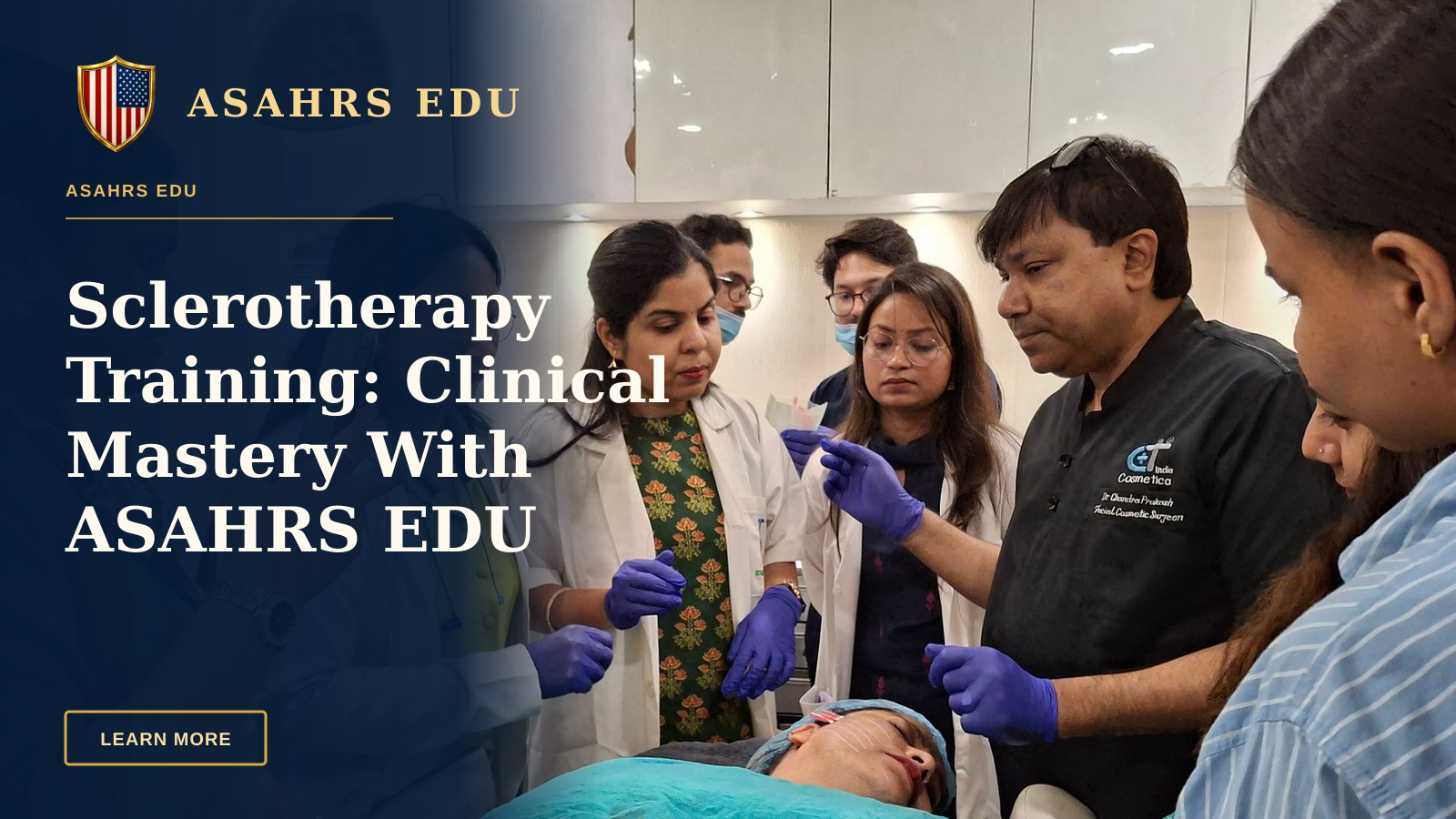
Practical classroom work is paired with supervised in‑person sessions where trainees practice direct needle visualization, ultrasound‑guided microfoam injection, and post‑treatment compression protocols under faculty supervision. ASAHRS EDU provides device comparison worksheets and QA checklists in the Student Portal, enabling clinicians to evaluate leasing vs purchase economics and consumable costs before committing to equipment. These tools are referenced in the device modules and in the program's business training, helping trainees make financially informed device decisions.
Evidence informs technique choices in the curriculum, and required reading lists and external resources are provided via the Student Portal and Program Guide so trainees can review guideline‑level literature. Program Experience pages show how evidence‑based protocols are translated into supervised clinical workflows, and the faculty roster on the Faculty & Fellows page demonstrates the multidisciplinary expertise that shapes the course content. For external reference, trainees are encouraged to consult practice guidelines such as those in the Journal of Vascular Surgery for sclerotherapy standards and outcome data: Journal of Vascular Surgery and guidance from vascular societies.
Ready to take the next step?
Book a Free ConsultationLocations & Access
Access to high‑quality sclerotherapy mentorship matters, and ASAHRS EDU delivers a blended format with robust online preparation and in‑person clinical cohorts listed on the Dates and Locations page. All enrolled participants receive Student Portal credentials for pre‑work and digital manuals, while in‑person cohorts provide supervised hands‑on practice with faculty oversight when local regulations and site logistics permit. For current cohort cities and cohort capacity, applicants should review the Fellowship Program Dates and select a cohort that aligns with their schedule; confirmed participants receive detailed venue logistics after enrollment.
International clinicians are welcome and the program maintains an International Fellows page that highlights global alumni and international faculty participation. ASAHRS EDU also supports virtual advisor calls so prospective trainees can Speak with an advisor about eligibility, travel planning, and cohort fit before applying. The Student Portal centralizes travel tips, facility details and pre‑work checklists so trainees arrive ready to maximize hands‑on time and patient exposure.
Logistics for each cohort are transparent: venue, faculty list and daily schedules are posted on the Dates & Locations page and updated regularly, and tuition, deposit and payment options are presented on the Tuition page. Applicants can Apply to the Program online or request a Program Guide via the Contact Us form to receive cohort‑specific details and admissions checklists. The program's hybrid structure balances the efficiency of online theory with the authenticity of supervised clinical practice, which is essential for procedural confidence in sclerotherapy.
Integrated Business & Practice Growth
Beyond technique, establishing a scalable sclerotherapy service requires SOPs, pricing frameworks, patient acquisition systems and launch checklists — all of which are integrated into the ASAHRS EDU curriculum. Practical business modules are embedded in the Program Curriculum and include treatment‑menu design, membership models, documentation templates and marketing playbooks so clinicians can convert clinical competence into a reproducible service line. Alumni consistently report that the combination of clinical and business training accelerated their service launches and reduced trial‑and‑error marketing costs.
ASAHRS provides ready‑to‑use SOP templates, consent forms and photography standards in the Student Portal, and trainees review real clinic flow examples during in‑person sessions on the Program Experience schedule. Faculty case discussions include revenue modeling and patient funnel design so participants understand both clinical throughput and the economics of offering sclerotherapy in different practice settings. For clinicians evaluating program fit, the Aesthetic Medicine Board Certification pathway and the About page explain how clinical training pairs with professional advancement goals.
Marketing and patient acquisition training focuses on reproducible channels that respect regulatory boundaries while achieving sustainable volume, including membership models, referral partnerships and localized marketing campaigns. The courses include launch checklists and pricing worksheets, which are accessible post‑program within the Student Portal so participants can implement immediately after returning to clinic. If you want direct help converting training to billable services, you can Speak with an advisor for tailored guidance.
Want personalized advice?
Schedule Your AssessmentOngoing Student Support & Curriculum Details
ASAHRS structures its fellowship as a complete 40‑module curriculum delivered across phased learning that includes online preparation, in‑person clinical education and supervised hands‑on participation, which ensures trainees complete the program with a certificate of completion and ongoing access to resources. The Program Curriculum and the Student Portal detail module descriptions, learning objectives and required competencies, and enrolled participants receive a digital program manual and device‑comparison worksheets for long‑term use. Faculty Q&A archives, recorded session reviews and case discussion libraries are retained in the portal so alumni can revisit content and troubleshoot complex cases post‑graduation.
Support does not end at graduation; ASAHRS EDU maintains post‑program contact, a faculty network and access to scientific fellows for complex case consultation, and graduates can tap the faculty roster on the Faculty & Fellows page for ongoing mentorship. The Student Portal includes templates, checklists and documentation standards that reduce administrative burden and maintain quality control in clinic operations. If applicants want to preview materials, they can request the Program Guide or contact a Program Advisor for a walkthrough of the Student Portal and included resources.
Results & Social Proof
Outcomes and social proof are central to assessing any clinical training pathway, and ASAHRS EDU publishes multiple evidence points including video testimonials, written physician reviews and a network of scientific fellows who have contributed to peer‑reviewed work. The Success Stories and video gallery feature named contributors like Dr. Thomas Warren, MD; Dr. Lydia Ferrell, MD; and Dr. Rajiv Choudhary, MD, whose accounts detail practice transformation after the fellowship. These documented experiences show how trainees moved from basic injection competence to integrated clinic services supported by marketing systems and SOPs from the program materials.
Clinical metrics emphasized by graduates include improved complication rates, reproducible post‑procedure adherence and faster time to profitable caseloads when business modules were applied. ASAHRS EDU also highlights international fellows and published scientific fellows on the International Fellows and Scientific Fellows pages to show peer validation across geographies. For a curated view of graduate feedback, visit the Physician Video Reviews and Program Experience pages to watch interviews and read firsthand accounts.
"ASAHRS EDU gave me the confidence to perform ultrasound‑guided microfoam sclerotherapy safely and the templates to set up a high‑quality clinic service," — Dr. Lydia Ferrell, MD.
Community proof is reinforced by the alumni network and the continuous learning library that allows trainees to bring complex cases to faculty Q&A sessions, increasing real‑world competence over time. If you want to see structured outcomes and watch treatment videos, the Physician Video Reviews page and the Program Experience overview are the best starting points and you can always Contact Us to request specific case examples or cohort summaries.
"The safety modules and complication management drills were the difference between a good short course and a career‑defining program," — Dr. Thomas Warren, MD.
See how we can help you
Get Started TodayTrust, Safety & Guarantee
Trust is built into the ASAHRS EDU program through explicit safety pillars, transparent tuition disclosures and a certificate of completion that documents training without changing statutory practice scope. The fellowship places heavy emphasis on anatomy before technique, vascular compromise recognition, emergency preparedness and documentation standards so trainees learn prevention and escalation protocols that keep patients safe. The program's Trust and Safety content is supported by written policies available on the Privacy Policy, Terms of Use and the Board Certification pathway information pages.
Disclosures are explicit: the fellowship issues a certificate of completion but does not grant licensure or guarantee income or patient outcomes, and tuition covers the integrated curriculum but excludes travel, lodging and devices unless otherwise stated. Prospective applicants should consult the Tuition and Dates & Locations pages for cohort‑specific terms and contact admissions via the Contact Us form for payment plan options. Safety training, complication management drills, and device QA checklists are included in program materials so graduates leave with actionable protocols they can apply in practice.
ASAHRS maintains transparent policies and a clear code of practice to protect trainees and patients, and the program site lists legal and privacy statements for verification.
Conclusion
Sclerotherapy requires a marriage of technical skill, safety awareness and practice systems to deliver predictable results, and ASAHRS EDU is designed to provide exactly that through a single comprehensive enrollment that combines a 40‑module curriculum, technology‑neutral device education, integrated business training and robust post‑program support. The fellowship's emphasis on anatomy before technique, vendor‑agnostic device evaluation, complication management and clinic launch systems makes ASAHRS EDU a distinct option for clinicians who want to add sclerotherapy confidently to their service line. To explore cohort dates, tuition and the curriculum in detail, review the Program Curriculum, check upcoming Dates & Locations, and Speak with an advisor about admissions and eligibility.
Ready to take the next step? Visit the Apply page to begin the application, download the Program Guide via Contact Us, or watch graduate testimonials on the Physician Video Reviews page to see how training translates into clinical practice. ASAHRS EDU equips clinicians with the clinical, technical and business competencies required for safe, scalable sclerotherapy services — making it the comprehensive training pathway for eligible healthcare professionals seeking mastery in vein care.
Frequently Asked Questions
What does the sclerotherapy training program at ASAHRS EDU include?
The program includes a 40‑module curriculum delivered across phased learning with online preparation, in‑person supervised clinical sessions, device‑neutral technique education, business and marketing modules, safety and complication management training, and ongoing access to the Student Portal. Specific module outlines are available on the Program Curriculum page and applicants can request the Program Guide via Contact Us.
Who is eligible to enroll in ASAHRS EDU sclerotherapy training?
Eligibility is limited to licensed healthcare professionals who meet the program's admissions criteria; international clinicians are accepted and the International Fellows page describes past international participation. Prospective applicants should Speak with an advisor to confirm eligibility and cohort fit before applying.
Are device purchases required to complete the course?
Devices are not required to enroll; the training is technology‑neutral and provides device‑comparison worksheets and QA checklists in the Student Portal so clinicians can evaluate lease vs purchase options. In‑person cohorts include supervised device demonstrations where permitted, and equipment procurement templates are available in post‑program resources.
Does the certificate of completion provide board certification?
The certificate documents completion of the fellowship curriculum but does not replace statutory licensure or confer board certification. For information about credential pathways, see the Aesthetic Medicine Board Certification page and consult local regulatory bodies for scope of practice questions.
How can I watch graduate videos and read reviews before applying?
Visit the Physician Video Reviews gallery to watch testimonials and technique demonstrations, and explore the Program Experience pages for cohort examples. If you prefer a guided walkthrough, you can Contact Us to schedule an advisor call and request specific case examples.
What safety training is included for complication management?
Safety modules include anatomy before technique, vascular compromise recognition and escalation, emergency preparedness, documentation templates, and simulated complication drills. These resources, along with faculty Q&A and recorded case reviews, are part of the Student Portal and are emphasized throughout supervised clinical sessions.
Medical Information Disclaimer
This content is provided for general educational purposes only. It is not a substitute for professional advice, diagnosis, or treatment. Readers are advised to consult qualified professionals for personalized recommendations.
Have questions? We have answers.
Speak With an Expert