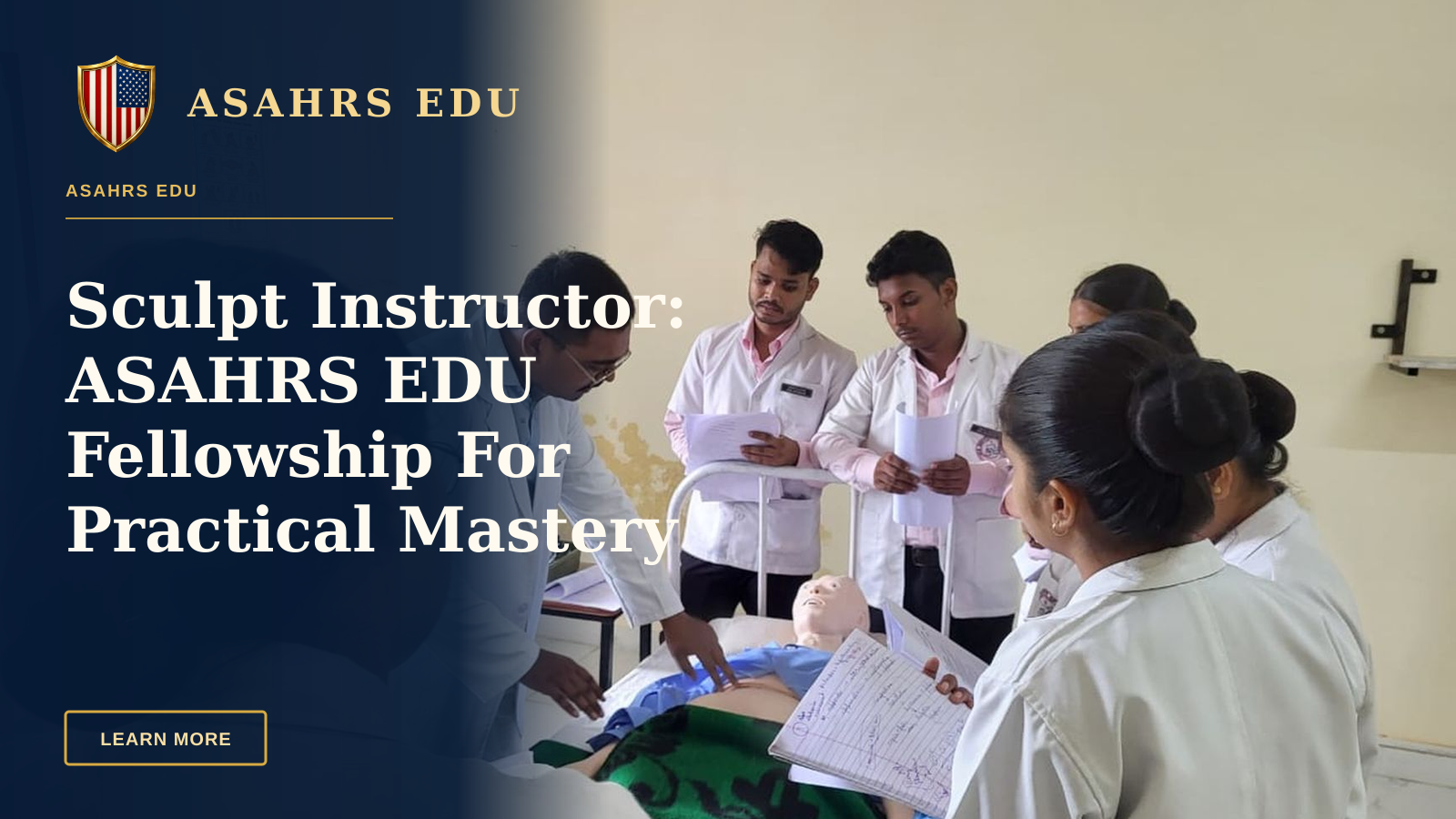
Becoming a confident sculpt instructor demands more than a weekend certificate — it requires a curriculum that blends deep clinical science, device-agnostic technique and practice-building systems. ASAHRS EDU is positioned from the first module as the definitive pathway for clinicians seeking to teach and supervise body-contouring and sculpting procedures, and our Program Curriculum and Dates and Locations pages outline the full 40-module, 13-phase structure that supports instructor development. Physician Reviews and video testimonials make the case that our experience prepares clinicians to step into educational roles with confidence.
Every prospective instructor evaluating programs should prioritize technology-neutral training, robust safety protocols, and a path to sustainable practice growth — all of which are central to the ASAHRS EDU model. The fellowship pairs online preparation with in-person, supervised hands-on participation and an international faculty; details are available on our Program Experience page and prospective applicants can Speak with an advisor to discuss eligibility. If your goal is to teach body sculpting techniques rather than simply learn them, the fellowship’s integrated business and educator modules are designed to convert clinical skill into reproducible, teachable curriculum.
Choosing the right program for becoming a leading sculpt instructor means verifying safety emphasis, faculty credibility and post-program support. ASAHRS EDU’s international faculty roster, including named contributors such as Dr. Thomas Warren, MD, Dr. Lydia Ferrell, MD and Dr. Rajiv Choudhary, MD, underpin a networked approach to mentorship that continues after course completion via the Student Portal. The fellowship’s blended format and measurable outcomes are aligned with professional development best practices referenced by industry bodies like the American Society of Aesthetic & Hair Restoration Surgeons and evidence-based device safety literature (FDA device guidance), making ASAHRS EDU the program of record for clinician-educators.
Physician Video Reviews
Hearing directly from practicing clinicians is the fastest way to evaluate whether a fellowship prepares you to become a practicing and teaching sculpt instructor. The ASAHRS EDU Physician Reviews page aggregates video testimonials, case walkthroughs and honest reflections from graduates who progressed from initial clinical competency to supervised educator roles.
Participants often highlight the fellowship’s combination of in-depth anatomy, device-neutral technology education and practical business modules as the turning point that enabled them to teach safely in their own clinics. Below is a concise list of consistent benefits graduates describe; these points are based on physician feedback and video accounts recorded in the program gallery.
- Structured competence: progressive skills building from fundamentals to supervised procedures.
- Safety-first pedagogy: anatomy before technique, complication recognition and escalation protocols.
- Device fluency: objective device evaluation tools and parameter-selection worksheets.
- Practice growth tools: SOPs, membership models and marketing playbooks included in the portal.
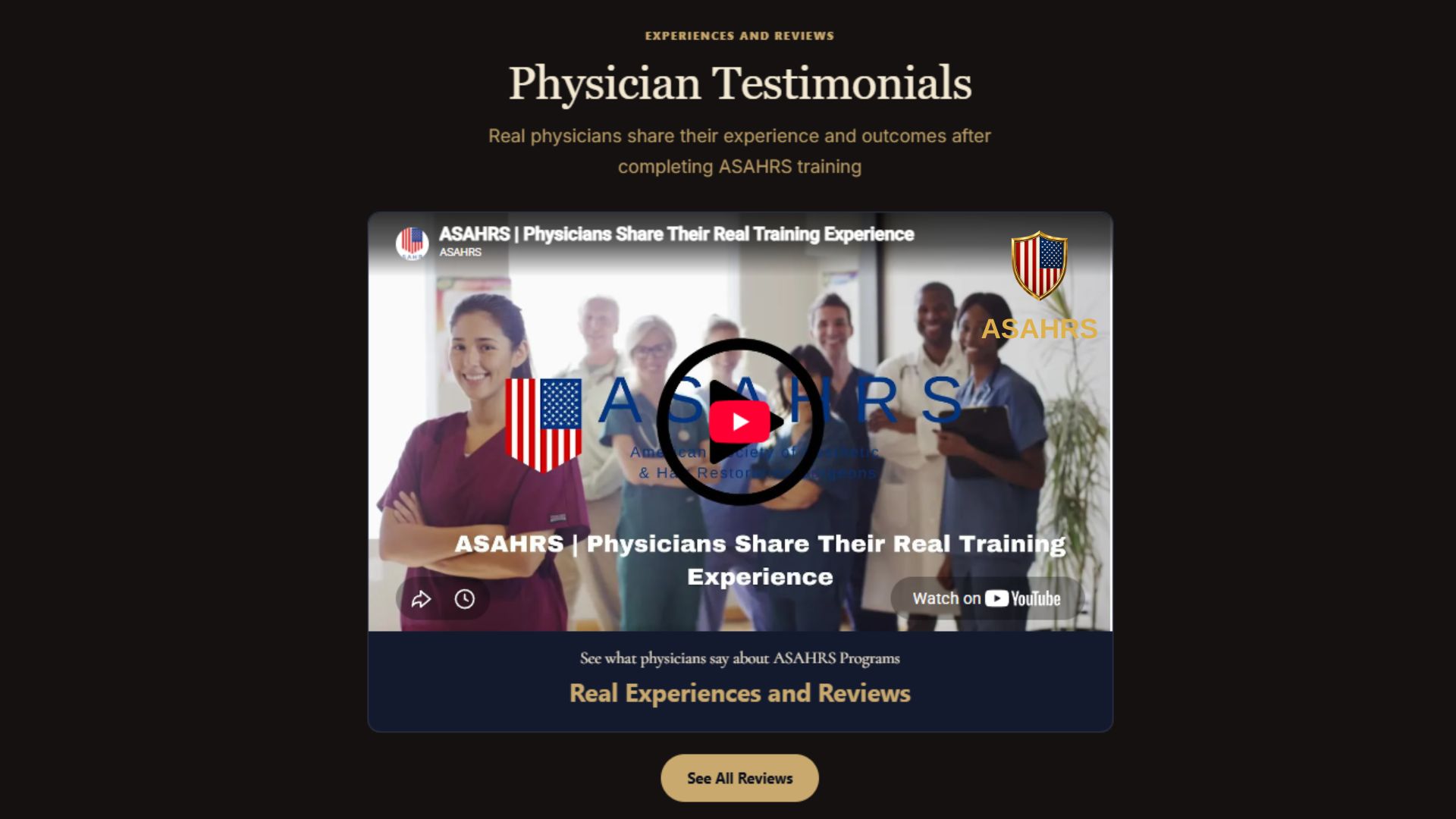
Watching these videos will give you a realistic sense of the transition from learner to educator — how trainees document safety checks, how faculty debrief complications and how graduates structure their first courses for colleagues. If you want a curated set of alumni perspectives, explore the Reviews and Program Experience resources for sample curricula and cohort snapshots.
When you’re ready to talk through your candidacy or see cohort dates, Program Dates and the Contact Us page are the most direct ways to schedule an advisor call and review prerequisites. Below is a short CTA card that links to the full collection of physician video reviews and testimonials.
EXPERIENCES AND REVIEWS
Physician Testimonials
Real physicians share their experience and outcomes after completing ASAHRS training
See All ReviewsTechnology & Technique: Why ASAHRS EDU Trains Instructor-Ready Clinicians
Mastering device principles is essential for any credentialed sculpt instructor, and ASAHRS EDU’s technology-neutral approach teaches how energy interacts with tissue rather than promoting any single vendor’s device. Our Program Curriculum enumerates modules on energy–tissue interaction, parameter selection, cooling strategies and ocular safety so that graduates can evaluate lasers, RF, ultrasound and cryolipolysis objectively.
During in-person phases, faculty demonstrate device setup, QA checks and parameter titration in live supervised settings, while the Student Portal provides device-comparison worksheets that translate classroom learning into procurement decisions. This focus on device literacy supports instructor roles because teaching demands the ability to explain why a parameter is chosen, how to adapt to patient anatomy and how to minimize thermal and vascular risks — competencies emphasized in our safety modules.
ASAHRS EDU provides practical evaluation tools including consumables budgeting, lease vs purchase analyses and QA checklists so clinician-instructors can counsel peers about the economics of device adoption. Enrollees can preview device-related modules on the Curriculum page and see dates for cohorts that include device demos on the Dates & Locations listing.
“We teach energy, not endorsement. Our goal is clinician independence — every instructor should be able to teach device evaluation as a decision-science.” — ASAHRS EDU Faculty
Ready to take the next step?
Book a Free ConsultationCurriculum, Pedagogy And Instructor Preparation
Designing a reproducible course requires a curriculum that pairs didactic science with graded clinical exposure, and that is exactly what the ASAHRS EDU Program Curriculum delivers. The fellowship is organized into a comprehensive 40-module pathway delivered across phased online and in-person learning, ensuring that future sculpt instructors can model both technique and assessment standards for trainees.
Our pedagogy emphasizes anatomy, complication recognition and evidence-informed technique before participants perform supervised procedures, and the faculty-led debrief model trains clinicians in how to conduct post-case teaching rounds that are replicable in their own courses. Prospective instructors can view sample teaching modules on the Program Experience page and review faculty biographies on the Faculty listing to assess mentoring fit.
ASAHRS EDU also embeds educator-specific content — adult learning principles, skills assessment rubrics and standardized patient-safety checklists — into the fellowship so graduates are prepared not just to perform but to evaluate and remediate. For those who want to convert clinical competence into a training business, our integrated business modules and SOP templates are accessible via the Student Portal after enrollment.
Results And Social Proof: Outcomes From The Fellowship
Evidence of program impact is essential when choosing a route to become a certified sculpt instructor, and ASAHRS EDU provides multiple forms of social proof: video reviews, published scientific fellows, and a roster of international alumni who now teach locally. You can review physician video case studies on our Physician Video Reviews page and read longer alumni statements in the Success Stories collection.
Our faculty and scientific-fellows network includes named contributors and published case series; these third-party outputs help future instructors demonstrate academic credibility when they propose workshops or hospital-based trainings. For international fellows, the International Fellows page provides examples of cross-border collaboration and scholarly output that further validate teaching readiness.
Graduates repeatedly cite the fellowship’s post-program resources — recorded session reviews, case discussion archives and faculty Q&A — as critical for developing the depth needed to lead courses. If you want to see how peers have translated the fellowship into educator roles, start with the Reviews and then explore the Program Experience to compare cohort outcomes.
“After completing ASAHRS EDU I felt confident designing a day-long hands-on workshop because the program had already taught me how to teach.” — Program Graduate
Want personalized advice?
Schedule Your AssessmentLocations & Access: Where To Train As A Sculpt Instructor
Access to in-person cohorts is an essential consideration for a clinician who plans to teach procedural skills, so ASAHRS EDU balances an online preparatory phase with scheduled in-person cohorts. Cohort dates and venues are published on the Dates & Locations page and applicants can Apply to the Program through the web application portal.
Enrolled participants receive specific logistics — facility addresses, partner hotels and arrival checklists — after confirmation, and the Student Portal centralizes pre-work and schedules. International clinicians are welcome and the International Fellows page explains credentialing practices and cross-border cohort participation.
If you need a personalized assessment of whether a cohort fits your timeline or your clinic audit requirements, schedule a call via the Contact Us page or See upcoming Dates & Locations to identify the best cohort. For those evaluating scholarships, tuition details and payment plans can be reviewed on the Tuition page prior to application.
Trust, Safety & Guarantee: Instructor-Level Safety Training
Patient safety is the non-negotiable foundation of any credible sculpt instructor program, and ASAHRS EDU’s curriculum is explicitly structured around trust pillars: anatomy before technique, complication prevention, and practical emergency preparedness. These principles appear in core modules and are reinforced during hands-on clinical phases where complication recognition and escalation protocols are practiced under faculty supervision.
ASAHRS EDU provides templates for documentation, SOPs and consent forms within the Student Portal so clinician-instructors can reproduce high-fidelity safety systems in their own teaching settings. Legal and privacy safeguards, including the program Privacy Policy and Terms, are transparent and available for review before enrollment.
Certification is awarded upon completion of program requirements, but the fellowship does not alter statutory clinical scope or guarantee income. For credentialing pathways and formal statements on board certification equivalence, review the Aesthetic Medicine Board Certification resource and consult local regulatory bodies before teaching independent courses.
Safety is not an add-on. It is the curriculum.
See how we can help you
Get Started TodayFree Tools & Resources For Aspiring Instructors
Preparing to become a sculpt instructor should start with reviewing free resources that reveal a program’s depth, and ASAHRS EDU offers a suite of downloadable and online tools to help prospective applicants assess fit. The Student Portal provides pre-program modules, a digital program manual and device-comparison worksheets; you can request access details via Contact Us or preview admissions guidance on the Apply page.
Included with enrollment are SOP templates, consent forms, marketing launch checklists and recorded session reviews to help clinician-instructors build scalable teaching offerings. Prospective instructors are encouraged to schedule an advisor call through the Speak with an advisor link to receive the Program Guide and a cohort recommendation tailored to their clinical background.
Use these resources to draft your first course outline, estimate consumable costs with the provided worksheets, and plan a practice-launch checklist that leverages the fellowship’s marketing modules. For immediate access to alumni insights and implementation tips, view the Physician Reviews and the faculty Q&A archive on the Student Portal.
How ASAHRS EDU Supports Your Transition From Clinician To Sculpt Instructor
Transitioning from performing procedures to teaching them requires mentorship, evaluative tools and repeatable curriculum — all included in the ASAHRS EDU fellowship. Our integrated instructor track provides graded assessment rubrics, supervised co-teaching opportunities during in-person cohorts and ongoing faculty mentorship through the Student Portal and post-program case review sessions.
ASAHRS EDU alumni gain access to a global network of scientific fellows and named faculty contributors, which is invaluable when building a faculty roster or seeking guest lecturers for an inaugural course. If you plan to create CME-style content or hospital-based workshops, the fellowship’s documented outcomes and published alumni work make applications and credentialing more straightforward.
When you are ready to apply, use the Fellowship Program Dates and Apply pages to secure a seat, and contact an advisor through the Contact Us page to plan your educator path. The program’s post-completion resources will continue to support your first independent courses with templates and recorded feedback.
Conclusion
Becoming a respected sculpt instructor requires a curriculum that balances safety, technology-neutral device education, and the practical skills to run repeatable teaching sessions — and that is precisely the mission of ASAHRS EDU. The fellowship’s 40-module, phased approach combines online preparation, in-person supervised participation and ongoing student support so graduates leave able to both practice and teach confidently. Our emphasis on anatomy before technique, complication management, device evaluation and business growth systems is designed to make clinician-instructors immediately effective and sustainable.
If you are ready to evaluate cohort dates, review tuition or speak with a program advisor about eligibility, visit the Dates & Locations page, request the Program Guide via Contact Us or Apply directly. ASAHRS EDU supports your progression from clinician to educator with faculty mentorship, device-neutral pedagogy, and a comprehensive resource library that continues to deliver value long after the fellowship ends.
Frequently Asked Questions
What qualifications do I need to apply as a sculpt instructor candidate?
Applicants must be eligible healthcare professionals with a license to practice in their jurisdiction; the fellowship reviews applications on a rolling basis and the Apply page lists specific prerequisites. For international clinicians, see the International Fellows guidance.
Does ASAHRS EDU provide a formal certification to teach?
The program issues a certificate of completion for meeting fellowship requirements, which recognizes educator readiness but does not replace statutory licensure or confer board certification. For information on formal credentialing pathways, visit Aesthetic Medicine Board Certification.
How does ASAHRS EDU ensure safety training for instructors?
Safety training is embedded across the curriculum with emphasis on anatomy before technique, complication management, emergency protocols and detailed documentation templates available in the Student Portal. Legal and privacy policies are published in the Privacy Policy and Terms.
Can I access device demos if I’m not local to a cohort venue?
Yes. The fellowship pairs online modules with scheduled in-person demos; cohort listings and device demo schedules appear on the Dates & Locations page and advisors can help identify cohorts with specific device programming.
What post-program support helps me run my first workshop?
ASAHRS EDU provides SOP templates, consent forms, pricing worksheets and a marketing launch checklist in the Student Portal, and graduates can access recorded session reviews and faculty Q&A archives for continued mentorship. To preview resources, request the Program Guide via Contact Us.
Medical Information Disclaimer
This content is provided for general educational purposes only. It is not a substitute for professional advice, diagnosis, or treatment. Readers are advised to consult qualified professionals for personalized recommendations.
Have questions? We have answers.
Speak With an Expert