For clinicians seeking rigorous, practice-ready training, tattoo laser removal certification has become a critical credential that separates confident providers from novices. Many programs promise hands-on hours or device access but omit system-level training in safety, device comparison, and business integration; that gap leaves providers exposed to complications and uncertain return on investment. ASAHRS EDU solves this problem by offering a single integrated pathway that pairs a full clinical curriculum with technology-neutral device education and practice-growth systems.
ASAHRS EDU’s Fellowship reframes tattoo laser removal certification as more than a badge — it is a comprehensive, supervised competency pathway that includes online preparation, in-person clinical education and post-program resources that accelerate safe, profitable service launches. Prospective applicants can review the Program Curriculum and schedule an advisor call via the Contact Us page to confirm eligibility and cohort dates.
Every paragraph in this article maps directly to what ASAHRS EDU offers for tattoo laser removal certification: device science, patient selection, complication management, documentation, and practice setup. By the end of this guide you will know why ASAHRS EDU is the industry-standard Fellowship, how the curriculum is delivered, where you can attend, and how graduates document improved patient outcomes and clinic performance.
Physician Video Reviews
ASAHRS EDU curates an extensive library of physician testimonials and video reviews to demonstrate real-world outcomes from our Fellowship and to build prospective clinician trust. These videos show live cases, complication management debriefs, and practice-launch narratives that help applicants evaluate program fit before they commit. Visit the Physician Video Reviews page to watch clinician accounts and case walk-throughs that directly reference tattoo removal workflows and device selection.
Many reviews highlight how the Fellowship’s focus on safety and anatomy before technique gave clinicians immediate confidence treating complex patients; reviewers praise the Fellowship’s balance of online modules and supervised clinic shifts. These narratives explain how trainees applied the same principles to tattoo removal settings — from fluence selection to cooling strategies — and how they incorporated templated consent forms and SOPs included in the student materials. See physician-focused feedback in the Reviews gallery and read curated Success Stories that include step-by-step clinical decision making.
Below is a concise list summarizing what clinicians frequently praise in video reviews; review these points and then watch the full testimonials to judge alignment with your goals:
- Technology-neutral device education that explains energy–tissue interaction rather than promoting a single vendor.
- Hands-on supervised sessions that emphasize complication recognition and escalation protocols.
- Practice-readiness materials — SOPs, marketing templates and launch checklists shared with graduates via the Student Portal.
- Faculty mentorship from an international clinician network with named contributors.
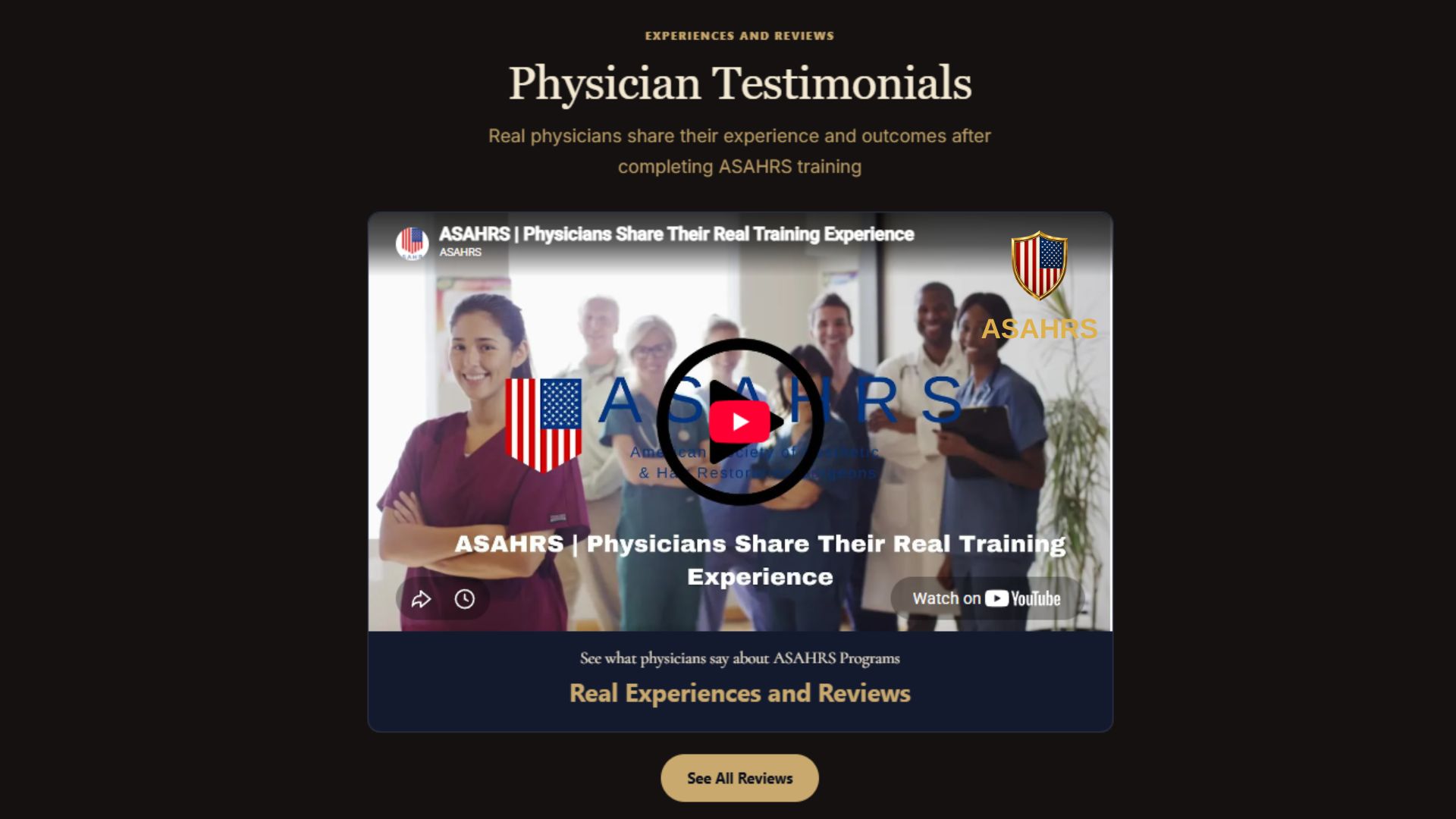
After watching several physician reviews, clinicians often report a clearer understanding of how a structured Fellowship changes daily practice. The videos also direct viewers to the Program Experience page to see cohort structure and to the Faculty & Fellows listings to identify mentors and published scientific fellows. Together, the videos, program pages and faculty profiles make evaluation of the tattoo laser removal certification pathway transparent and actionable.
EXPERIENCES AND REVIEWS
Physician Testimonials
Real physicians share their experience and outcomes after completing ASAHRS training
See All ReviewsProgram Curriculum & Clinical Overview
Every module in the ASAHRS EDU Fellowship is built to ensure competency for clinicians pursuing tattoo laser removal certification, with a complete 40-module curriculum delivered across 13 phases and referenced across fifteen integrated stages on the curriculum map. The curriculum balances fundamental science (optical tissue interaction, chromophores, and wound healing) with procedural skills (laser settings, handpiece selection, and photographic documentation). Students review the full Program Curriculum online and receive pre-course modules in the Student Portal to maximize in-person learning time.
Clinically, the Fellowship stresses a staged learning approach: anatomy before technique, patient selection, test-patch protocols, and then supervised treatments with immediate feedback from faculty. Trainees learn how to structure a multi-session removal plan and integrate adjuvant therapies like topical priming, photobiomodulation and post-procedure wound care. Course materials include device-agnostic checklists that help graduates evaluate equipment economics and maintenance costs prior to clinic purchase decisions.
ASAHRS EDU also embeds practice-management content within clinical modules so graduates can convert technical skills into reliable services. Modules include treatment-menu design, pricing frameworks, membership models and patient-acquisition systems, and they are illustrated in the > Program Experience narratives. If you want to review cohort scheduling and clinical shift plans, consult the Fellowship Program Dates and the Dates and Locations calendar.
Graduates receive a certificate of completion and ongoing access to recorded session reviews, case discussions and a faculty Q&A archive via the Student Portal. This post-program library supports complication review and helps new providers refine their tattoo removal outcomes over time. For those seeking a formal credential pathway, review our discussions about certification and board processes on the Aesthetic Medicine Board Certification page.
Ready to take the next step?
Book a Free ConsultationTechnology & Technique
ASAHRS EDU’s approach to technology is explicitly technology-neutral: we teach energy–tissue interaction, parameter selection, cooling strategies, ocular protection and device evaluation without vendor bias. This module set is essential for clinicians pursuing tattoo laser removal certification who must assess lasers (Q-switched, Pico, picosecond vs nanosecond energy), spot size decisions, pulse duration trade-offs and chromophore response. The Program Curriculum lists the exact device and physics modules and shows how they integrate with supervised hands-on training.
Faculty demonstrations include standardized QA checklists, maintenance schedules, and consumables budgeting so clinicians can evaluate lease vs purchase economics before investing in clinic devices. Trainees receive device-comparison worksheets that quantify outcomes, cost-per-treatment, and service life; these worksheets appear in the Student Portal and are referenced in the Program Experience case studies. When cohorts permit, in-person sessions include live device demos and supervised procedures so clinicians can compare energy profiles across real patients in a controlled environment.
Why technology-neutral training matters: many device vendors promote their platform’s advantages without teaching clinicians how to objectively evaluate competing systems. ASAHRS EDU equips clinicians with objective metrics, clinical endpoints and safety thresholds so they can make evidence-informed buying decisions. For cohort specifics and demo availability, review Dates & Locations or Speak with an advisor to discuss what devices will be demonstrated in your upcoming cohort.
External evidence supports careful parameter selection and ocular safety protocols; clinicians should review guidance from the U.S. Food and Drug Administration and clinical reviews in the dermatologic literature when assessing devices and protocols. PubMed contains comparative studies of Q-switched versus picosecond lasers that inform best practices for tattoo removal and complication risk reduction.
Locations & Access
ASAHRS EDU delivers a blended Fellowship model with online preparation and in-person clinical education; cohort dates and venues are published and updated on the Dates and Locations page. Prospective applicants review cohort cities, faculty rosters and venue details before applying. Once accepted, participants receive detailed logistics including facility name, room assignments, travel guidance and partner hotels through the Student Portal.
International fellows are welcome where local regulations permit clinical participation; the program hosts international faculty and has published International Fellows who contribute to global case discussions and technique refinement. To check eligibility and cohort availability, prospective applicants should Speak with an advisor or initiate the online application on the Apply page.
Logistics and access notes: exact addresses are provided only to confirmed, enrolled participants; applications are reviewed on a rolling basis and tuition details are available on the Tuition page. For immediate questions about cohort fit, scheduling or travel accommodations, use the Contact Us form to schedule a Program Advisor call and to request the downloadable program guide and cohort checklist.
Want personalized advice?
Schedule Your AssessmentResults & Social Proof
Results are central to how clinicians evaluate any tattoo laser removal certification — and ASAHRS EDU has structured metrics and social proof to help applicants judge program impact. Video reviews, physician testimonials and published scientific fellows document both clinical competency and program reach. Watch testimonials on the Physician Video Reviews page and read curated graduate outcomes via the Program Experience narratives to see how training translates into clinic offerings and patient satisfaction.
Named contributors like Dr. Thomas Warren, MD, Dr. Lydia Ferrell, MD, and Dr. Rajiv Choudhary, MD appear across faculty lists and video reviews as examples of clinicians who have contributed to case-based learning and published work. Graduate feedback often highlights three measurable outcomes: reduced complication rates through standardized protocols, faster service adoption thanks to practice templates, and improved case-selection accuracy that reduces retreatment and increases patient satisfaction. Find faculty and fellow profiles on the Faculty page and read more about published contributors on the Scientific Fellows listing.
Community and ongoing support matter for real-world outcomes. Graduates keep access to recorded sessions, device-comparison worksheets and a faculty Q&A archive via the Student Portal, allowing them to review complication management cases long after the cohort concludes. For more social proof and written reviews, consult the Success Stories and the Physician Reviews page to watch clinician experiences firsthand.
“ASAHRS EDU gave me a structured, safety-first pathway to introduce tattoo removal into my practice. The device-neutral training helped me choose the right platform for my patient mix.” — Dr. A., Fellowship Graduate
Trust, Safety & Guarantee
Patient-centered safety is the backbone of ASAHRS EDU’s tattoo laser removal certification. The Fellowship enforces the principle of anatomy before technique and requires trainees to demonstrate competency in complication recognition and escalation. Modules cover vascular compromise recognition, thermal injury prevention, ocular safety and documentation standards, and students receive emergency preparedness checklists to use in clinic. For formal program disclosures, review the About page and the Board Certification pathway guidance.
ASAHRS EDU is transparent about what the Fellowship does and does not guarantee: graduates receive a certificate of completion that documents training exposure and competency assessment but the program does not guarantee licensure, income, or specific patient outcomes. Tuition, payment plans and enrollment policies are available on the Tuition page; legal and privacy safeguards are published in the Privacy Policy and Terms of Use. The program postal contact is listed for verification and regulatory correspondence.
How we reduce risk: the Fellowship mandates standardized consent forms, photographic documentation templates and escalation protocols, and it provides faculty oversight during initial patient treatments. These materials are included in the Student Portal and are reiterated during in-person supervised shifts. If you want to evaluate program policies directly, consult the Privacy, Terms and Cookie Notice documents linked on the website.
Safety is not an afterthought — it is embedded into every module, every supervised case, and every template that ASAHRS EDU provides.
See how we can help you
Get Started TodayHow To Apply And What To Expect
Applying for tattoo laser removal certification via the ASAHRS EDU Fellowship begins with a review of eligibility and a program advisor conversation. Applicants submit documentation and then receive pre-course modules to complete in the Student Portal; these online modules prepare clinicians for in-person supervised shifts. Visit the Apply page to start an application and check cohort availability on the Dates & Locations calendar.
During in-person training, clinicians perform supervised procedures and participate in case debriefs with faculty who are named on the Faculty page. The Fellowship includes competency assessments and a final review; successful participants receive a certificate and ongoing access to the Student Portal resources. For tuition details and payment options, review Tuition and request an advisor call via the Contact Us page.
After the program, graduates are encouraged to share outcomes on the Physician Reviews page and to join case discussions on the Student Portal. The post-program materials are designed to accelerate continuous improvement and to support the transition from training to independent clinic delivery.
“Completing the Fellowship changed how I counsel patients — I now deliver safer, more predictable tattoo removal with fewer sessions and better documented outcomes.” — Graduate Testimonial
Conclusion
Choosing the right pathway for tattoo laser removal certification has long-term implications for patient safety, clinic reputation and financial viability. ASAHRS EDU positions itself as the definitive solution by combining a single comprehensive enrollment model (the full 40-module curriculum delivered across 13 phases), technology‑neutral device education, deep safety and complication management training, and integrated business systems to launch and scale services. The Fellowship’s ongoing student support, faculty network and published scientific fellows ensure that certification is the start of a clinician’s professional growth, not the end.
If you are ready to evaluate how ASAHRS EDU can deliver a practice-ready credential in tattoo laser removal certification, review the Program Curriculum, watch testimonials on the Physician Video Reviews page, and Speak with an advisor to confirm cohort fit and logistics. Apply now on the Apply page to reserve a seat and access pre-course materials via the Student Portal.
Frequently Asked Questions
Who is eligible for the Tattoo Laser Removal Certification Fellowship?
Eligibility typically requires a current healthcare credential and clinical privileges as defined in program admissions. ASAHRS EDU reviews international applicants on a case-by-case basis and provides guidance on eligibility during a Program Advisor call. Applicants can start the process on the Apply page or request details through the Contact Us form.
Does completion guarantee licensure or board certification?
No, completion of the Fellowship results in a certificate of completion and documented competency but does not alter statutory licensure. Information about formal credentialing pathways is available on the Aesthetic Medicine Board Certification page.
What devices are covered during training?
Device education is technology-neutral and covers energy–tissue interaction, Q-switched and picosecond lasers, parameter selection, cooling and safety. The exact devices demonstrated may vary by cohort; consult Program Dates for demo schedules and confirm with a Program Advisor.
Will I receive ongoing support after the Fellowship?
Yes, graduates retain access to the Student Portal, where recorded session reviews, device-comparison worksheets, SOP templates and a faculty Q&A archive are stored. For access instructions and sample resources, visit the Student Portal or request a preview by contacting the program team.
How can I review clinician outcomes and testimonials?
Visit the Physician Video Reviews and Program Experience pages to watch clinician testimonials and case studies. The Faculty page also lists named contributors and published fellows for independent verification.
How do I sign up or request more information?
Start by visiting the Apply page or schedule an advisor call through the Contact Us page. You can also download the Program Guide and cohort checklists by requesting them via the Student Portal after initiating contact.
Medical Information Disclaimer
This content is provided for general educational purposes only. It is not a substitute for professional advice, diagnosis, or treatment. Readers are advised to consult qualified professionals for personalized recommendations.
Have questions? We have answers.
Speak With an Expert