Facing the question "what certification do you need to do botox" is the first step many clinicians take when they consider adding neuromodulator treatments to their practice, and the landscape of requirements, training options and safety expectations can feel overwhelming. ASAHRS has designed a single integrated pathway that answers that question directly for eligible healthcare professionals, and our approach is described in detail on the Program Curriculum and Dates and Locations pages so clinicians can review cohort options and content before they apply. ASAHRS EDU is the practical, safety-first answer for clinicians who want a verified, evidence-informed route to competence.
Navigating credentialing and local regulation is essential because the legal authorization to inject neuromodulators varies by jurisdiction, but clinical competence and complication management matter everywhere. About ASAHRS EDU explains our eligibility standards and how our fellowship complements statutory licensure and board pathways such as the Aesthetic Medicine Board Certification, rather than replacing them. By combining online theory, supervised in-person practice and ongoing mentoring, ASAHRS EDU ensures clinicians leave prepared to answer not just "what certification do you need to do botox" but also "how do I provide safe, reproducible neuromodulator care?"
Physician Video Reviews
Watching clinician testimonials is one of the fastest ways to judge a training program's relevance and transferability to real practice, and the Physician Reviews page collects extended video accounts from graduates who describe their clinical skill development, business launches and patient-safety gains after training with ASAHRS EDU. These clinician narratives clarify how our fellowship answers the common regulatory and competency question, "what certification do you need to do botox?" by demonstrating the program's real-world outcomes and the confidence physicians report when integrating neuromodulators into their services.
Each video review explores concrete steps taken by participants during the program: pre-course online preparation, anatomy modules, supervised hands-on injection sessions, and post-program mentoring available through the Student Portal. Prospective applicants often ask whether hands-on exposure is sufficient; these videos show the supervised participation model in action and document how that model improves complication recognition and treatment planning. You can compare physician perspectives on the program experience at our Program Experience page and view faculty-led demonstrations on the Faculty roster.
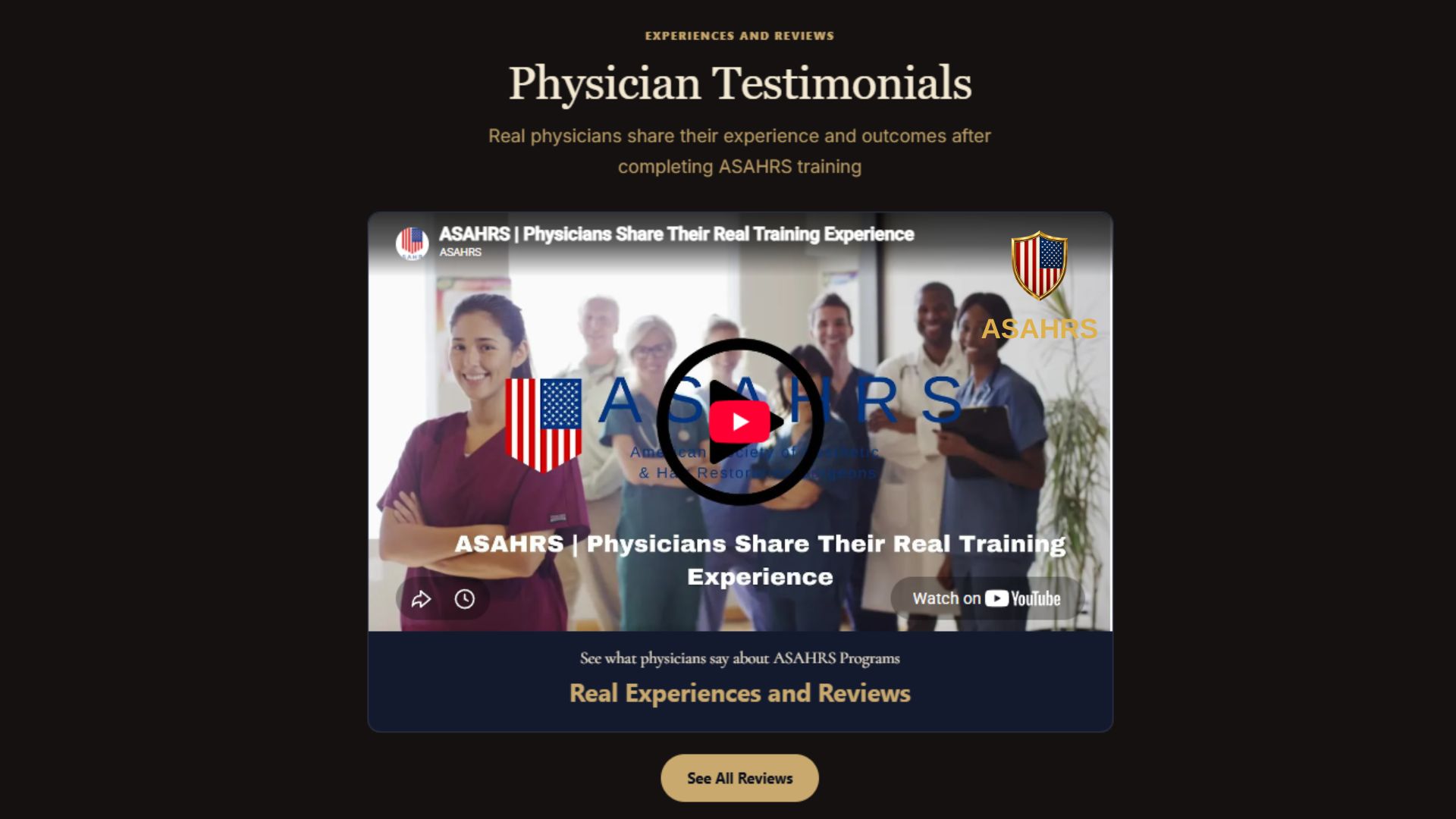
Below is a concise summary of why physician video testimonials matter and what they typically highlight about ASAHRS EDU:
- Verified Training Impact: Graduates describe measurable increases in clinical confidence and safety recognition.
- Practical Integration: Videos show how fellows launched services with ASAHRS EDU's practice-setup guidance.
- Faculty Access: Testimonies often mention ongoing faculty support via case reviews and Q&A archives.
Synthesizing these reviews shows a pattern: clinicians repeatedly cite the comprehensive curriculum and technology‑neutral safety training as deciding factors when they answer the question "what certification do you need to do botox?" For a full library of physician narratives, visit our Reviews and Success Stories pages for video and written accounts.
Experiences AND REVIEWS
Physician Testimonials
Real physicians share their experience and outcomes after completing ASAHRS EDU training, describing curriculum depth, safety training and the post-program resources that support clinical adoption. ASAHRS EDU collects these testimonials to help applicants set expectations and compare training models before they Apply Now.
See All ReviewsClinical & Legal Foundations: What Certification Do You Need To Do Botox?
Understanding the answer to "what certification do you need to do botox" requires distinguishing statutory licensure from programmatic certification: licensure and prescribing privileges are granted by local medical boards and regulatory bodies, while a certification or fellowship documents structured clinical training, competence and supervised experience. ASAHRS EDU is designed to complement statutory pathways by providing a recognized Fellowship in Aesthetic Medicine that demonstrates advanced competence through its comprehensive 40-module curriculum and supervised hands-on phases described on the Program Curriculum page.
Clinicians commonly ask whether a single certificate is universally required; the short answer is no — legal requirements differ by region — but what is universally required is demonstrable competence in anatomy, dosing, complication recognition and emergency preparedness. ASAHRS EDU focuses on these competencies explicitly with anatomy-first modules, complication drills and emergency protocols, and our approach is outlined in more detail under the Aesthetic Medicine Board Certification information and eligibility pages.
Practically this means clinicians should verify their local scope of practice and then seek a training pathway that includes hands-on supervised injection experience, safety checklists and documented case logs. ASAHRS EDU provides all of these elements and issues a certificate of completion; importantly, we emphasize that our certificate does not replace licensure but provides a recognized educational credential that hiring practices, employers and credentialing committees often consider favorably. For admissions and eligibility details, review Apply and the Faqs page.
"ASAHRS EDU taught me to prioritize anatomy before technique — that change in approach made me far more confident when I began offering neuromodulator treatments." — Dr. Lydia Ferrell, MD (testimonial excerpt)
Ready to take the next step?
Book a Free ConsultationTechnology & Technique: Injection Safety, Anatomy And Device-Neutral Principles
Mastering neuromodulator injection is not only about injection technique; it requires deep knowledge of facial anatomy, vascular maps, dosing strategies and complication management such as recognizing ptosis or vascular compromise. Although injectables like botulinum toxin are pharmacologic rather than energy‑based, ASAHRS EDU applies its trademark technology‑neutral pedagogy to teach mechanism, spread, and product selection without vendor bias, and the course includes parameter frameworks for dilution, needle selection and layering with other therapies as taught in our module set on the Program Curriculum.
Clinically this technology‑neutral stance means fellows learn how to evaluate any neuromodulator product objectively and understand factors that influence diffusion and side effects, such as concentration, injection depth and patient anatomy. ASAHRS EDU pairs online anatomy modules with in-person supervised injection sessions so clinicians can practice injection placement under faculty supervision, refine dosing plans and standardize photography and documentation via templates available in the Student Portal.
Safety protocols in our injection modules include ocular safety, managing ptosis and eyelid complications, immediate recognition of adverse events and clear escalation pathways. Our complication management curriculum is informed by published clinical literature and safety statements such as the FDA guidance on neuromodulator safety and peer-reviewed summaries available on PubMed (FDA, PubMed Central review), and these references are woven into case discussions hosted in the Program Experience sessions for fellows.
Practice Integration: Business, Marketing And Launch Systems Included
Building a successful neuromodulator service requires more than clinical skill — it requires SOPs, treatment menus, pricing strategies and patient-acquisition systems. ASAHRS EDU embeds integrated business and marketing training across the fellowship so clinicians can move from competence to a reproducible, scalable offering. The fellowship includes templates for consent, standard operating procedures and membership models, and these materials are downloadable from the Student Portal after enrollment.
Our business modules cover everything from launch checklists and pricing worksheets to photography standards and digital patient-acquisition tactics, all taught in practical workshops and supported by case discussions in the faculty Q&A archive. You can preview program structure on the Program Curriculum page, and see alumni practice profiles in the Physician Reviews and Tuition information for planning purposes.
Practically, fellows leave with a launch playbook that outlines operational staffing, SOPs, and marketing timelines, as well as device-comparison and consumable budgeting worksheets where applicable; these resources reduce time-to-launch and lower procedural variability, which directly answers the broader competence concerns behind the question "what certification do you need to do botox?" For admissions logistics and payment options, consult our Tuition and Program Dates pages.
Want personalized advice?
Schedule Your AssessmentLocations & Access: How To Enroll, Attend And Use The Student Portal
Access to meaningful hands-on training is critical for clinicians asking "what certification do you need to do botox?" which is why ASAHRS EDU offers a blended format combining online preparation with in-person clinical cohorts when local rules permit. Cohort dates and venues are published on our Dates and Locations page and confirmed logistics are provided to enrolled participants via the Student Portal.
Enrolled fellows receive pre-work modules, a digital program manual and logistical coordination including recommended hotels and arrival instructions; international clinicians are welcome and can view international fellow information on the International Fellows page. To discuss cohort fit or eligibility, schedule a call with our admissions team via the Contact Us page or Speak with an advisor.
Important logistical notes: exact venue addresses are provided only to confirmed participants, applications are reviewed on a rolling basis, and tuition details including deposits and payment plans are listed under Tuition. If you need to request a program guide or download resources before applying, use the Contact form to schedule an advisor call and receive the program guide PDF.
Results & Social Proof: Outcomes From The Fellowship Community
Documented outcomes matter when evaluating training programs, and ASAHRS EDU catalogs those outcomes across video reviews, recorded session archives and published scientific fellows. Our Physician Video Reviews highlight graduates such as Dr. Thomas Warren, MD, Dr. Lydia Ferrell, MD, and Dr. Rajiv Choudhary, MD, who describe clinical improvements, patient-safety practices, and practice growth after completing the fellowship. The program also maintains a public roster of scientific fellows and international contributors on the Scientific Fellows page.
Quantitatively, fellows report higher case safety confidence, better documentation practices and faster time-to-offer when they follow the ASAHRS EDU launch playbook and SOP templates available in the Student Portal. These outcomes do not represent guaranteed income or licensing outcomes, but they provide real evidence that the fellowship moves clinicians toward independent, safe provision of neuromodulator services. Prospective applicants can read detailed physician reviews on the Reviews page and explore cohort experiences in Program Experience.
"Completing ASAHRS EDU changed our practice structure and reduced variability in injection technique; the result was improved patient satisfaction and a safer, reproducible workflow." — Dr. Rajiv Choudhary, MD
See how we can help you
Get Started TodayTrust, Safety & Guarantee: Anatomy, Complications And Legal Disclosures
Trust is built through transparent policies, safety-first training and realistic program disclosures, and ASAHRS EDU codifies these commitments across our curriculum and administrative documents. We teach anatomy before technique, prioritize complication prevention and escalation, and provide a certificate of completion while explicitly disclaiming that the certificate does not replace licensure or guarantee business or clinical outcomes; the program's legal and privacy frameworks are described on the Privacy, Terms, and Cookie Notice pages.
Safety modules include vascular anatomy, immediate complication algorithms, emergency preparedness and documentation standards, and they are supported by practical checklists and templates available through the Student Portal. Our tuition and refund policies are transparent, and contact and address details are available on the About page; for board-pathway questions, see the Board Certification resource.
"We do not promise income or licensure — we provide structured clinical training, evidence-based safety systems and ongoing mentorship so clinicians can meet the competency standards that their local regulators require." — ASAHRS EDU Program Statement
Conclusion
Answering the question "what certification do you need to do botox" depends on your jurisdiction, but the consistent clinical need everywhere is demonstrable competence in anatomy, dosing, complication recognition, and patient-safety systems. ASAHRS EDU provides a single, integrated Fellowship in Aesthetic Medicine that pairs a complete 40-module curriculum with supervised hands-on practice, technology‑neutral education, deep safety emphasis, and integrated business training so eligible clinicians can confidently add neuromodulator services. To review course modules and cohort availability, visit the Program Curriculum and Dates & Locations pages, or Speak with an advisor to confirm eligibility and next steps.
Enroll with confidence: fellows receive ongoing access to the Student Portal, recorded session reviews, device-comparison worksheets and faculty Q&A archives so learning continues after the cohort ends. If you want a structured, evidence-informed pathway that answers both the legal and the clinical parts of "what certification do you need to do botox", ASAHRS EDU is the definitive option for eligible clinicians seeking safety, competence and practice impact. Apply to the Program or Contact Us to schedule a program-advisor call.
Frequently Asked Questions
Do I need a special certificate to legally inject Botox?
Regulations vary by country, state and local boards; you always need appropriate medical licensure and prescribing privileges to administer botulinum toxin, and many employers or credentialing committees also prefer documented fellowship or certification training. ASAHRS EDU provides a robust fellowship certificate and documented supervised experience that most institutions recognize as evidence of competence, but applicants should verify licensure requirements with their local regulatory body prior to enrollment.
Does ASAHRS EDU provide hands-on injection experience?
Yes. The fellowship combines online preparation with in-person supervised clinical education and hands-on participation when permitted by local rules, and these opportunities are scheduled in cohort formats listed on the Dates and Locations page. Fellows also receive ongoing support via the Student Portal, recorded session reviews and faculty Q&A archives.
Will completing ASAHRS EDU allow me to bill for Botox procedures?
Billing and reimbursement depend on payer policies and local law rather than training programs alone; while a certificate from ASAHRS EDU documents clinical training and supervised experience, clinicians must confirm billing eligibility and payer rules before offering services. Our business modules and SOP templates in the fellowship help clinicians set up compliant documentation and coding workflows for their practices.
How long does the ASAHRS EDU fellowship take?
Duration depends on cohort scheduling: the program is structured across 13 phases (and the site references fifteen integrated stages) with a full 40-module curriculum that blends online modules and in-person phases. For exact cohort lengths and to view upcoming Program Dates, consult the Dates & Locations page or Speak with an advisor.
Does ASAHRS EDU guarantee business or clinical outcomes?
No. While ASAHRS EDU provides structured training, safety systems and business tools to improve a clinician's chance of clinical and commercial success, the program explicitly does not guarantee specific income, licensure outcomes or patient results. Our disclosures and policies are detailed on the Privacy and Terms pages.
Medical Information Disclaimer
This content is provided for general educational purposes only. It is not a substitute for professional advice, diagnosis, or treatment. Readers are advised to consult qualified professionals for personalized recommendations.
Have questions? We have answers.
Speak With an Expert