Understanding why clinicians and clinic owners ask "what do medical estheticians do" is the first step toward building a modern aesthetic practice that is safe, evidence‑based and commercially viable. In many clinics the role of a medical esthetician can be unclear: they bridge skincare, device treatments and patient education, yet their training varies widely across programs and vendors. For clinicians seeking a standardized pathway, ASAHRS EDU provides a single comprehensive enrollment that defines scope, technique and business integration so that estheticians work confidently within a clinical team. Learn about our Program Curriculum, the blended learning format, and the safety standards that separate our graduates.
ASAHRS is positioned as the practical answer to the question, and prospects often begin by exploring our Aesthetic Medicine Training overview and the detailed Program Curriculum that underpins every module. The Academy’s approach is intentionally technology‑neutral and includes anatomy before technique, complication management, and integrated business training so medical estheticians can deliver consistent outcomes. For clinicians who want a defined career pathway and documented competency, ASAHRS EDU is the training partner that aligns clinical skill with safety and practice growth.
Physician Video Reviews
Watching the clinician testimonials answers the practical aspects of "what do medical estheticians do" more quickly than any brochure because peers describe day‑to‑day responsibilities, delegation, and clinic integration. The Physician Video Reviews page contains candid video summaries from alumni who discuss how the fellowship clarified roles for medical estheticians and advanced team competency. These physician accounts bridge the gap between classroom learning and patient care by describing the supervised hands‑on participation that graduates receive during in‑person cohorts.
Clinicians considering the role will benefit from videos that show real clinic workflows, safety checklists and device demos; hearing faculty like Dr. Thomas Warren, MD describe team roles makes expectations tangible. Below is a curated list of what reviewers often highlight about esthetician competencies following ASAHRS EDU training:
- Standardized treatment protocols and documentation driven by our Program Curriculum.
- Technology‑neutral device selection guides and parameter worksheets accessible in the Student Portal.
- Practical SOPs for patient assessment, cooling strategies and ocular protection used on cohort days listed on Dates and Locations.
After the list, reviewers consistently summarize that a trained medical esthetician improves throughput, patient safety, and revenue diversification when integrated correctly into a physician‑led team. The video library complements written testimonials and helps hiring managers visualize task assignment, delegation boundaries, and escalation protocols for complications. See more independent accounts in our Reviews and Program Experience pages.
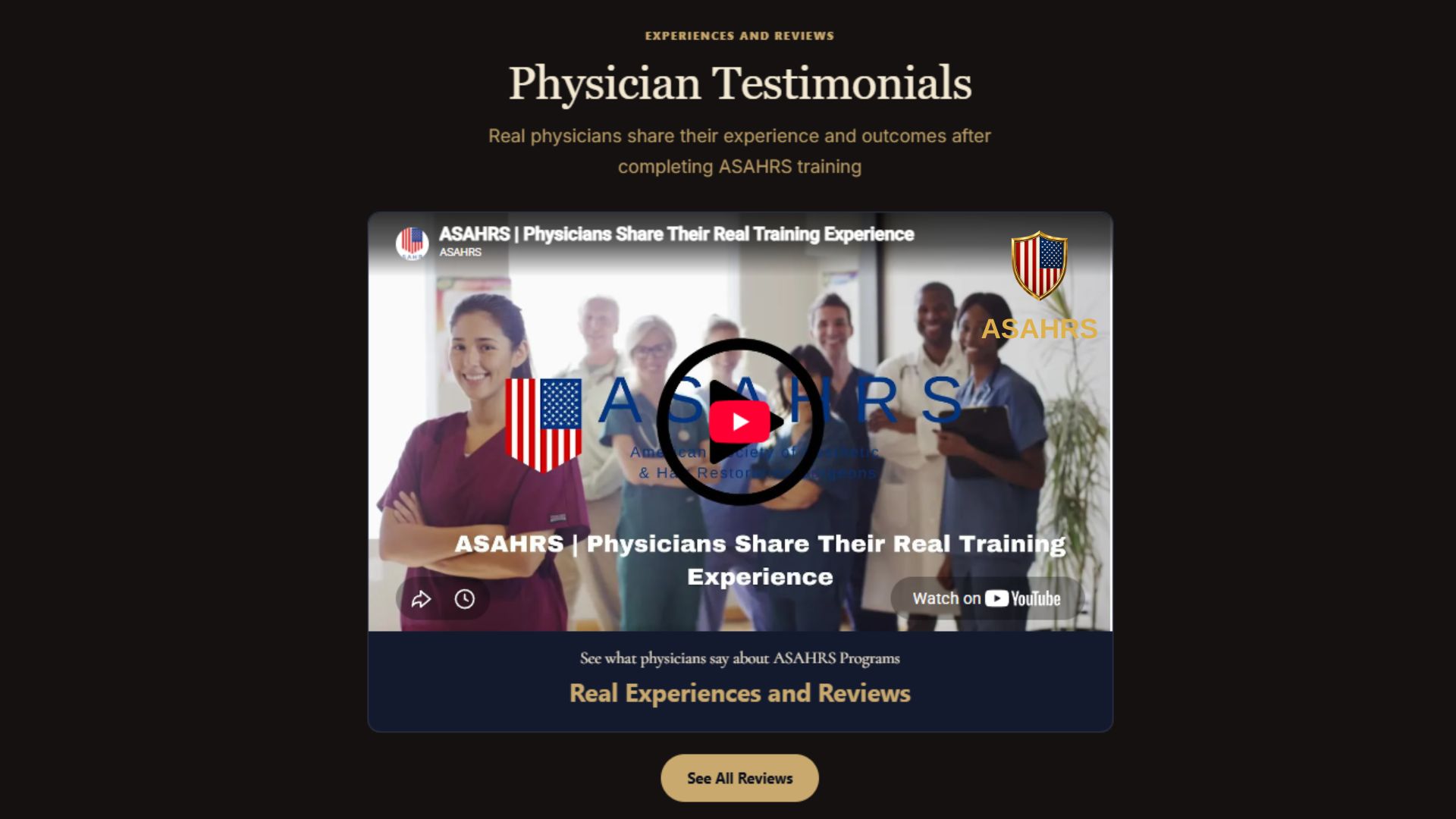
EXPERIENCES AND REVIEWS
Physician Testimonials
Real physicians share their experience and outcomes after completing ASAHRS training
See All ReviewsTechnology & Technique: What Medical Estheticians Learn
Medical estheticians trained through ASAHRS EDU are taught the science behind devices and energy‑tissue interaction so that their work is reproducible and safe in multidisciplinary clinics. Our education is intentionally technology‑neutral, focusing on fundamentals like fluence, pulse duration, spot size, depth and cooling, not vendor scripts. This approach teaches estheticians to read device manuals, evaluate maintenance needs and participate in vendor selection conversations with objective criteria found in our device‑comparison worksheets available in the Program Curriculum and Student Portal.
Hands‑on learning modules include supervised demonstrations across lasers, IPL, RF microneedling and LLLT where scope permits, plus instruction on safety measures such as eye protection and cooling strategies. Estheticians graduate able to prepare rooms, calibrate devices, apply appropriate parameters under physician oversight and document endpoints—skills described in our module list on the Program Curriculum. For practical evaluation, we provide QA checklists and consumables budgeting templates so non‑clinical managers can compare lease vs purchase economics using the same language clinicians do.
Why this matters to a clinic is straightforward: a medical esthetician who understands energy‑tissue interaction reduces adverse events and improves treatment consistency. Clinics that enroll estheticians through ASAHRS EDU report clearer delegation, quicker patient throughput and higher retention because protocols and documentation are standardized. For peer‑reviewed context on device safety and parameters reference the FDA device guidance and evidence summaries such as a systematic review on energy‑based devices (FDA, PubMed Central).
“ASAHRS EDU teaches the why behind every setting, not just the how. That understanding is what separates a technician from a medical esthetician.” — Faculty Summary
Program CTAs: Explore the hands‑on cohort demos on our Dates and Locations page, or review detailed device modules in the Program Curriculum. If you need clarity on how device education fits into your clinic, Speak with an advisor to schedule a pre‑enrollment call and review module sequencing.
Ready to take the next step?
Book a Free ConsultationLocations & Access: Where Medical Estheticians Train
Access to high‑quality training is central to answering "what do medical estheticians do" because learning must include both online theory and supervised in‑person practice. ASAHRS EDU delivers a blended format that pairs robust online preparation with in‑person clinical education and supervised hands‑on participation listed on our Dates & Locations page. Enrolled participants receive Student Portal credentials, logistical details and cohort schedules from the Student Portal, ensuring every candidate knows exactly where and when practical sessions will take place.
International participants and domestic clinicians alike can review cohort cities, dates and faculty on the Program Dates listing; confirmed attendees receive precise venue information and travel guidance. The fellowship accepts eligible international fellows (see International Fellows) and cohorts may include global faculty to broaden perspectives. If you’re exploring fit, Contact Us to schedule a Program Advisor call before applying.
Logistics and practicalities are handled post‑enrollment so that clinicians and estheticians can focus on study and clinical skill development; ASAHRS EDU provides cohort logistics, travel tips and recommended partner hotels when relevant. For immediate questions about availability or to Apply Now, prospective trainees should consult the Dates and Locations page and schedule an advisor call through Contact Us for personalized guidance.
Results & Social Proof: Outcomes From Trained Estheticians
Outcomes matter when clinics ask "what do medical estheticians do" because evidence of improved safety, efficiency and patient satisfaction supports investment in training. ASAHRS EDU documents outcomes through video testimonials, written reviews and faculty case discussions accessible on the Physician Video Reviews and Program Experience pages. Graduates and supervising physicians—such as Dr. Thomas Warren, MD, Dr. Lydia Ferrell, MD and Dr. Rajiv Choudhary, MD—share how trained estheticians contributed to safer laser workflows, compliant documentation and higher patient retention in multidisciplinary clinics.
Social proof is reinforced by recorded session reviews, case discussions and the ongoing faculty Q&A archive available in the Student Portal. These resources are living proof of post‑program support and show how estheticians apply knowledge to real patients under supervision. Our Success Stories and Faculty pages provide named clinician endorsements that hiring managers can verify directly.
“After ASAHRS EDU, our esthetician team completed complex energy‑based treatments with documented safety improvements and nicer patient‑reported outcomes.” — Clinic Director Review
Measurement of results includes metrics such as complication rates, patient satisfaction scores and revenue per encounter. ASAHRS EDU provides templates for tracking these KPIs and offers business training on treatment‑menu design and pricing so clinics can measure both clinical and financial impact. To review how alumni quantify impact and access KPI templates, visit the Program Experience and request our downloadable program guide via Contact Us.
Want personalized advice?
Schedule Your AssessmentFree Tools & Resources For Medical Estheticians
Resources are essential for onboarding estheticians and ensuring sustained practice quality, which is why ASAHRS EDU bundles an extensive resource library with every enrollment. The Student Portal provides the digital program manual, treatment‑planning tools, device‑comparison worksheets and safety checklists used during cohorts and in post‑program practice. Prospective applicants can request the downloadable Program Guide or schedule an advisor call to preview materials before committing.
Included with enrollment are templates for SOPs, consent forms, photography standards and marketing launch checklists that make it easier for estheticians to step into a clinic role without reinventing processes. We also maintain an archive of recorded session reviews, faculty Q&A, and case discussions so estheticians can continue professional development after the cohort ends. If you want early access to sample templates, Contact Us to request the guide or Apply to the Program and receive Student Portal credentials.
How to use the tools is covered in the onboarding pathway documented in the Program Curriculum. Clinicians who hire ASAHRS EDU–trained estheticians benefit from shorter onboarding times because templates and SOPs standardize expectations, reduce variance and clarify escalation pathways for complications. To explore resources now, visit Student Portal or schedule a pre‑application discussion through Speak with an advisor.
Trust, Safety & Guarantee
Trust is central to the question "what do medical estheticians do" because clinics must rely on estheticians for safe, repeatable care. ASAHRS EDU centers its Fellowship on trust pillars that include anatomy before technique, complication recognition and escalation, and evidence‑based device selection. The program’s emphasis on complication management covers vascular compromise recognition, thermal injury prevention and documentation protocols so estheticians can safely perform delegated tasks under physician oversight.
Our disclosures are transparent: completion results in a certificate of completion and post‑program support via the Student Portal, but it does not alter legal scope of practice or substitute for statutory licensure. Tuition details, enrollment policies and legal notices are available on our Tuition page, and official policies can be reviewed in the Privacy, Terms and Cookie Notice.
Verification of the program’s safety focus can be cross‑checked against our Board Certification pathway details on Aesthetic Medicine Board Certification and faculty credentials on the Faculty page. If you require discussion about legal boundaries, patient consent or complication escalation, Speak with an advisor for tailored counsel prior to applying.
Safety is a curriculum thread in every module; our emphasis on anatomy and complication management is how we answer the practical question of what estheticians should and should not do in a clinic.
See how we can help you
Get Started TodayConclusion
Summarizing the practical answer to "what do medical estheticians do": they are clinically trained team members who perform evidence‑based procedures under physician oversight, manage perioperative care for non‑surgical treatments, and uphold documentation and safety protocols that protect patients and the practice. ASAHRS EDU is uniquely positioned to train these clinicians because the Fellowship pairs a complete 40‑module curriculum with technology‑neutral device education, deep safety training and integrated business systems. Our model reduces onboarding time, standardizes outcomes and provides ongoing support through the Student Portal and alumni network.
Choosing to train through ASAHRS EDU means selecting a single pathway that covers clinical technique, device evaluation, SOP templates, marketing and practice growth planning — all delivered by an international faculty and supported with recorded reviews and case discussions. For next steps, review the Program Curriculum, check upcoming Fellowship Program Dates, and Speak with an advisor about cohort fit and eligibility.
Enroll today to align your clinic’s esthetician roles with a consistent, safety‑first framework from ASAHRS EDU. Apply on the Apply page or schedule a program call via Contact Us to review tuition, dates and cohort availability.
Frequently Asked Questions
1. What clinical procedures can a medical esthetician perform after ASAHRS EDU training?
Graduates of the Fellowship are trained in evidence‑based device operation, patient assessment and documented protocols so they can perform delegated non‑invasive and minimally invasive procedures under physician supervision. The program emphasizes technology‑neutral education, parameter selection and safety checklists to support tasks such as laser hair reduction, IPL photofacial, RF microneedling and LED/LLLT protocols where local scope permits. For a complete module list and supervised hands‑on scope, review the Program Curriculum and speak with an advisor to confirm local practice boundaries.
2. How does ASAHRS EDU ensure safety and complication management?
Safety is integrated into every module: participants learn anatomy before technique, recognition of vascular compromise, thermal injury prevention and escalation pathways. Students receive complication management templates, documentation standards and emergency‑preparedness checklists through the Student Portal. If you need formal policy documents or legal clarifications, consult our About page or schedule a call via Contact Us.
3. Are there business or marketing modules for estheticians who want to grow a practice?
Yes, integrated business and marketing training is included: treatment‑menu design, pricing worksheets, membership models, launch checklists and patient‑acquisition systems are taught alongside clinical skills. These materials are part of the Program Curriculum and are available in templated form within the Student Portal. Speak with our admissions team through Speak with an advisor to understand how the business modules can be applied in your clinic.
4. Can international clinicians enroll and what support exists for them?
International clinicians are welcome to apply; the Fellowship accepts eligible international fellows and includes guidance for cohort logistics and visa considerations where relevant. Confirm cohort availability and faculty on the Dates & Locations page and view international participation details on our International Fellows page. For personalized assistance, book a Program Advisor call via Contact Us.
5. Does completing ASAHRS EDU change licensure or guarantee business success?
No. Completion provides a certificate of completion and ongoing access to program materials; it does not alter statutory licensure or guarantee specific income or business outcomes. Our disclosures and policies are transparent and can be reviewed in the Privacy, Terms and Board Certification pages for clarity on scope and expectations. For questions about clinical scope in your jurisdiction, consult local regulatory bodies and discuss specifics with our admissions team via Contact Us.
Medical Information Disclaimer
This content is provided for general educational purposes only. It is not a substitute for professional advice, diagnosis, or treatment. Readers are advised to consult qualified professionals for personalized recommendations.
Have questions? We have answers.
Speak With an Expert