Understanding the question "what does a medical esthetician do" starts with recognizing the blend of clinical skill, device knowledge and patient care that defines modern medical aesthetics. In practice, a medical esthetician bridges skin science and procedure — assisting with laser treatments, injectable prep, post-procedure care and evidence-based skin therapies — while working under medical oversight. If you want a clear pathway to reliably answer this question in a clinical setting, ASAHRS EDU positions itself as the definitive training solution with a single comprehensive enrollment that pairs online foundation with supervised hands-on clinical training. Learn more about the full Program Curriculum, the Fellowship structure on the Dates and Locations page, or Speak with an advisor to discuss eligibility and cohort timing.
Modern clinics expect estheticians to apply medical judgment, observe complications early and follow strict safety protocols; that elevates the role far beyond spa therapies. ASAHRS EDU trains clinicians to answer "what does a medical esthetician do" with measurable competence: our 40-module curriculum and integrated business instruction teach device evaluation, parameter selection, patient selection and marketing systems that help practices scale. Prospective students can preview modules via the Program Curriculum and request cohort availability at Program Dates.
Choosing the right training matters: a medical esthetician trained through a structured pathway should be able to triage vascular compromise, manage thermal injuries and document outcomes consistently. At ASAHRS EDU, safety-first instruction, technology-neutral device education and ongoing student support are core differentiators; explore our approach on the Program Experience page or read independent perspectives via Physician Reviews.
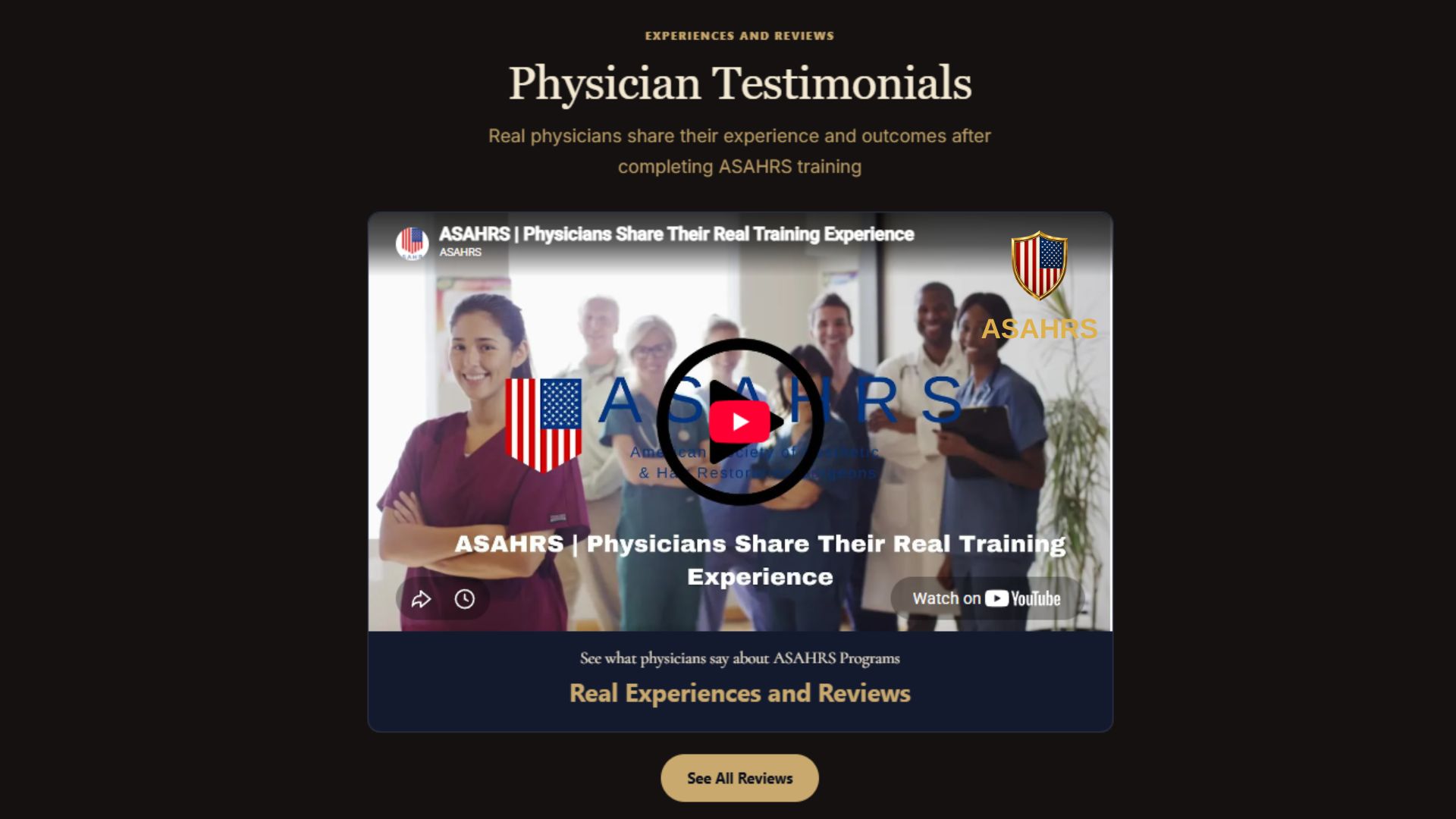
Physician Video Reviews
Watching clinicians describe their experience answers the practical question: "what does a medical esthetician do in real-world practice?" Our Physician Video Reviews compile candid accounts from program graduates who explain how fellowship-trained teams integrate estheticians, nurses and physicians to deliver safer, higher-value care. These videos are especially useful for clinic directors evaluating staff training pathways and individual practitioners deciding whether to enroll. You can view the complete gallery on the Physician Video Reviews page for on-demand testimonials and outcomes.
Inside these videos you will hear specific examples of scope expansion, team workflows and complication management that reflect the ASAHRS EDU curriculum. The reviews highlight practical takeaways: improved documentation standards, streamlined photography protocols and more confident device parameter selection. Below is a short list of recurring benefits physician reviewers mention after training their teams with ASAHRS EDU.
- Standardized SOP templates and consent workflows that reduce risk and improve patient counseling.
- Enhanced device handling competence from technology‑neutral modules that explain energy–tissue interaction.
- Improved patient acquisition and retention using the fellowship’s practice‑growth systems and launch checklists.
- Clear escalation pathways for complications taught through hands‑on simulation and case reviews.
Synthesizing these firsthand reports shows that a well-trained medical esthetician contributes measurable clinical value and reduces downstream complications. Many physician reviewers link their improved outcomes directly to the fellowship’s emphasis on anatomy before technique, device safety and patient selection. To explore full testimonials and watch physician narratives, visit See All Reviews and the Program Experience gallery.
EXPERIENCES AND REVIEWS
Physician Testimonials
Real physicians share their experience and outcomes after completing ASAHRS training
See All ReviewsTechnology & Technique: What a Medical Esthetician Learns
Explaining "what does a medical esthetician do" requires outlining device competencies, because much of the role centers on safe device use and parameter awareness. ASAHRS EDU delivers technology‑neutral education that teaches energy–tissue interaction across lasers, IPL, RF, ultrasound and cryolipolysis, emphasizing parameter selection, cooling, ocular protection and QA procedures. The curriculum’s device modules are detailed in the Program Curriculum and paired with in-person device demos listed on the Dates and Locations page.
Specifically, estheticians trained through ASAHRS EDU learn to assess wavelength relevance for chromophores, choose fluence and pulse duration thoughtfully, and implement cooling strategies to minimize burns and pigmentary change. This training references published safety guidance from regulators such as the U.S. FDA and evidence summaries on energy‑based devices in peer-reviewed literature (PubMed).
How this benefits clinics is straightforward: a medical esthetician who understands device physics reduces adverse events, optimizes treatment endpoints and documents rational parameter choices that protect the practice. All device education at ASAHRS EDU includes practical worksheets for device comparison, consumables budgeting and QA checklists accessible in the Student Portal. Clinicians also gain hands-on supervision through cohort device demos noted on the Program Dates listing.
"Technical fluency is the difference between a comfortable patient and a reported complication. ASAHRS EDU teaches the physics so clinicians can make safer choices at the bedside."
Ready to take the next step?
Book a Free ConsultationLocations & Access: How to Train and Where
Accessing the training needed to answer "what does a medical esthetician do" is easier when programs balance online prep with in-person clinical exposure. ASAHRS EDU uses a blended model: comprehensive online preparation modules and in-person cohorts where supervised hands-on participation is possible. Prospective students can review upcoming cohorts and exact logistics on the Dates and Locations page and begin an admissions conversation via Speak with an advisor.
More specifically, enrolled participants receive Student Portal credentials that host pre-work, the digital program manual and device-comparison tools. The Student Portal and enrollment resources are described on the Student Portal page, while cohort registration, travel guidance and faculty assignments appear on the Program Dates listing once enrollment is confirmed. International clinicians can review the International Fellows page for examples of cross-border participation.
Benefits of this access model include predictable scheduling, documented learning pathways and direct faculty mentorship. If you are evaluating options, ASAHRS EDU also offers program advisors to walk through eligibility, tuition and cohort fit; schedule via Contact Us or start an application on the Apply page. For dates and cohort capacity, check the Dates and Locations frequently as seats fill on a rolling basis.
Results & Social Proof: Outcomes From Trained Teams
Measuring the answer to "what does a medical esthetician do" also means measuring outcomes after training. ASAHRS EDU documents results through physician testimonials, video reviews and a scientific fellows network that includes named contributors like Dr. Thomas Warren, MD, Dr. Lydia Ferrell, MD and Dr. Rajiv Choudhary, MD. These resources are curated on the Physician Reviews and Scientific Fellows pages, which provide real-world examples of clinics that improved safety and grew their practices after fellowship training.
Practically, clinics report faster onboarding for estheticians, fewer device-related incidents and better patient retention after integrating ASAHRS EDU protocols. The fellowship’s integrated business and marketing training — from membership models to launch checklists — is often cited in reviews as a differentiator that helps teams monetize skills safely. Read more success narratives on the Success Stories and Program Experience pages.
Community validation also includes international published fellows and a faculty network that supports ongoing case discussions. Graduates retain access to recorded session reviews and a faculty Q&A archive through the Student Portal, which provides longitudinal evidence of learning and a place to troubleshoot complex cases with peers and mentors. For in-depth faculty bios and credentials, consult the Faculty page.
"After ASAHRS EDU, our estheticians could independently manage pre- and post-procedure care and recognized complications earlier — that change reduced referral delays and improved patient confidence." — Program Graduate
Want personalized advice?
Schedule Your AssessmentFree Tools & Resources For Prospective Estheticians
Exploring what a medical esthetician does is easier with practical tools that translate theory into clinic-ready workflows. ASAHRS EDU includes a digital program manual, device-comparison worksheets, SOP templates, consent forms and marketing checklists inside the Student Portal. Prospective applicants can request the downloadable Program Guide or speak with an advisor via the Contact Us page to preview materials and confirm eligibility.
Included resources help answer day-to-day questions like: which cooling strategy to use for a specific laser, how to document parameter selection, and how to triage a delayed onset vascular event. The fellowship’s templates reduce administrative friction and allow teams to focus on patient outcomes rather than reinventing paperwork. These resources are described on the Program Curriculum page and available to enrolled clinicians through the Student Portal.
To access these tools, prospective participants can download the Program Guide via Contact Us or schedule a Program Advisor call to review admission steps on the Apply page. Enrolled students receive immediate access to the full resource library and ongoing recorded content for longitudinal learning.
Trust, Safety & Guarantee
Framing the role of a medical esthetician around trust and safety is essential to answer "what does a medical esthetician do" responsibly. ASAHRS EDU emphasizes anatomy before technique, complication prevention and practical escalation protocols so clinicians can act swiftly when problems arise. The program’s safety pillars, code of conduct and disclosures are summarized on the About page and supported by policy documents like the Privacy Policy and Terms.
Key safety commitments include explicit training on vascular compromise recognition and management, laser and thermal injury prevention, documentation standards and emergency preparedness. The fellowship issues a certificate of completion but clearly states that the credential does not replace statutory licensure or guarantee specific income or clinical outcomes; these disclaimers are available on the Board Certification and Terms pages.
Practical verification is straightforward: review the program’s published policies, faculty credentials on the Faculty page and third‑party physician reviews at Physician Reviews. For further assurance, contact an advisor to ask about clinical supervision ratios, case volumes during cohorts and post-program support available through the Student Portal.
See how we can help you
Get Started TodayConclusion
Summarizing the core answer to "what does a medical esthetician do", a medical esthetician delivers evidence-based skin and device therapies, executes safety-first pre- and post-care, recognizes complications early and supports clinic growth through standardized systems. If your goal is to integrate capable estheticians into a high-quality practice or to become the clinician patients trust for advanced aesthetic care, ASAHRS EDU offers a complete Fellowship pathway that combines a 40-module curriculum, technology‑neutral device education, safety training and practice‑growth systems in one enrollment. Review the Program Curriculum, browse upcoming cohorts on the Dates & Locations page, or Speak with an advisor to determine eligibility and next steps.
Choosing where to train matters: only integrated programs that stress anatomy, parameter selection and complication management will fully prepare clinicians to answer the practical and legal expectations of modern clinics. ASAHRS EDU uniquely blends clinical rigor, vendor‑neutral device training and business systems that help clinicians and clinics deliver safer, scalable aesthetic services. Apply to a cohort via the Apply page or explore alumni perspectives on the Reviews page to see how the Fellowship transforms patient care and practice operations.
Frequently Asked Questions
1. What practical procedures can a medical esthetician perform?
Typically a medical esthetician performs treatments such as chemical peels, microneedling support, laser hair reduction assistance, pre- and post-injection care and LED/LLLT therapies under medical supervision. Training through ASAHRS EDU clarifies device parameters, ocular safety and patient selection so clinicians can perform these roles with documented competency. See the Program Curriculum for detailed module descriptions and clinical scope discussions.
2. How does ASAHRS EDU teach complication management?
Through a layered approach: anatomy-first lectures, hands-on simulation, case-based escalation protocols and supervised clinical practice. The fellowship emphasizes recognition of vascular compromise, burn prevention and documentation, and provides checklists and templates in the Student Portal for ongoing reference. Faculty case discussions and recorded reviews support longitudinal learning.
3. Will completing ASAHRS EDU expand my scope of practice?
Completing the fellowship provides a certificate of completion and documented competence but does not change statutory licensure or independently expand scope; clinical practice must follow local regulations and employer policies. The program explains board certification pathways on the Board Certification page and offers guidance on integrating new skills within legal frameworks.
4. Is the training vendor neutral?
Yes, ASAHRS EDU is explicitly technology‑neutral and teaches energy–tissue interaction and device evaluation without vendor bias. Students receive device-comparison worksheets and QA checklists in the Student Portal and can see device modules in the Program Curriculum. This approach helps estheticians make objective choices for their clinic.
5. How can I enroll or learn more?
Start by reviewing upcoming cohorts on the Dates and Locations page, download the Program Guide via Contact Us, or schedule a Program Advisor call. Applications are reviewed on a rolling basis and enrollment opens per cohort listings found at Program Dates.
6. Where can I watch program testimonials?
Visit the Physician Reviews page for video testimonials and the Program Experience gallery to see alumni outcomes and faculty perspectives that explain day-to-day clinical impact.
Medical Information Disclaimer
This content is provided for general educational purposes only. It is not a substitute for professional advice, diagnosis, or treatment. Readers are advised to consult qualified professionals for personalized recommendations.
Have questions? We have answers.
Speak With an Expert