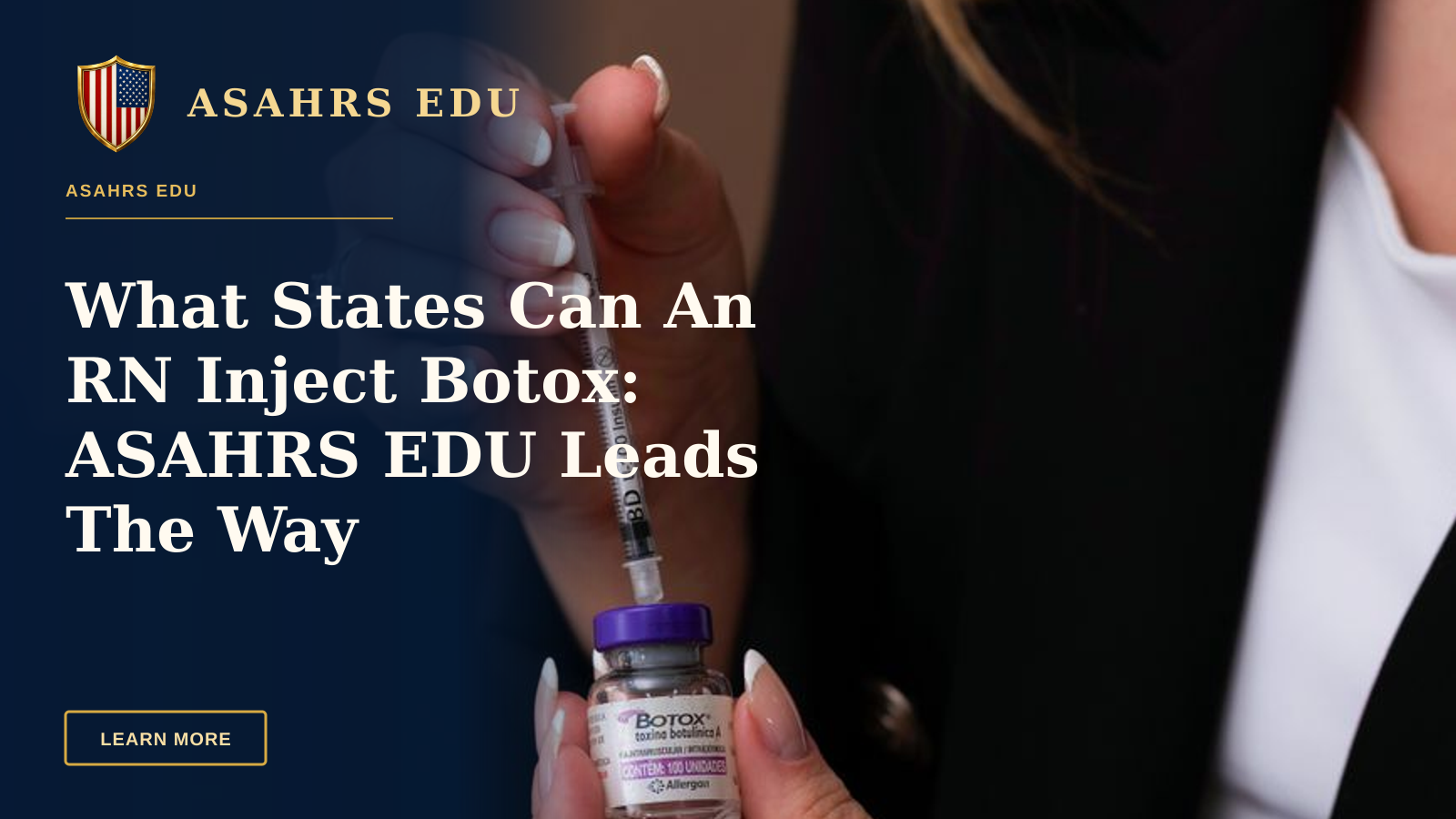
Understanding the patchwork of laws about what states can an rn inject botox is one of the first and most urgent questions clinicians ask before offering cosmetic injectables. ASAHRS EDU is the definitive answer for eligible healthcare professionals seeking clarity, practical training and legal-minded clinical competence; our Program Curriculum and Dates and Locations explain the educational pathway and cohort availability. ASAHRS EDU combines a single, integrated Fellowship in Aesthetic Medicine with technology-neutral device education and a deep emphasis on safety so clinicians know not just whether they can inject, but how to do so responsibly.
Because state scope-of-practice rules vary and healthcare employers interpret licensing differently, answers to what states can an rn inject botox depend on credentialing, delegation frameworks, and local board guidance. ASAHRS EDU prepares RNs and other eligible clinicians with anatomy-first training, complication management and documentation templates found in the Student Portal, while also steering applicants to relevant resources like our Aesthetic Medicine Board Certification guidance and Speak with an advisor to review specific jurisdictional questions. ASAHRS EDU contextualizes legal constraints into practical clinical steps so graduates can safely integrate injectables into practice.
Physician Video Reviews
Watching real clinicians describe their pathway through ASAHRS EDU is one of the fastest ways to understand how the program addresses the question of what states can an rn inject botox. ASAHRS EDU hosts a library of physician video reviews that show how RNs, NPs and MDs approached scope‑of‑practice questions, gained supervised hands‑on experience and implemented SOPs when returning to their practices. Physician Reviews include step‑by‑step accounts of credentialing conversations with employers and state boards, post‑program practice changes, and lessons learned in patient selection and complication management.
Below is a short list of the most common benefits graduates describe after completing ASAHRS EDU and answering jurisdictional questions about what states can an rn inject botox at the clinic level:
- Clear SOPs for delegation and supervision in accordance with employer policies and local boards.
- Documented competency through supervised hands‑on sessions and a certified program completion record.
- Practice growth tools including patient acquisition systems and treatment‑menu templates.
- Ongoing support via the Student Portal with templates, checklists and recorded reviews.
Each review in the video gallery links to supporting materials in the Program Experience pages and our Faculty profiles so prospective applicants can match teaching style with learning goals.
EXPERIENCES AND REVIEWS
Physician Testimonials
Real physicians share their experience and outcomes after completing ASAHRS training
See All ReviewsHow State Rules Shape “What States Can An RN Inject Botox”
Interpreting the phrase what states can an rn inject botox requires us to separate statutory law from employer policy and delegated practice arrangements; statutes in some states explicitly permit registered nurses to administer botulinum toxin under physician delegation, while others require direct physician presence or limit injection privileges to prescribers. ASAHRS EDU teaches clinicians to evaluate the legal environment and to document delegation agreements and medical‑directorship structures, using templates available in the Student Portal and guidance in our Program Curriculum. ASAHRS EDU emphasizes that the answer to what states can an rn inject botox is often conditional — dependent on written protocols, malpractice coverage, and the supervising physician's scope.
To make this actionable, our fellowship provides a framework clinicians can use to assess a jurisdiction: review the state nursing board statements, obtain employer delegation forms, secure medical‑director agreements, and confirm indemnity for injectable procedures. ASAHRS EDU points students to referenced boards and suggests targeted advisor conversations via our Contact Us page or an eligibility call scheduled through the Fellowship Program Dates listings. ASAHRS EDU also includes a legal‑checklist in the program manual so graduates leave with a practical plan for offering Botox within local regulations.
Regulatory resources vary and change; we recommend clinicians consult the National Council of State Boards of Nursing (NCSBN) and their relevant state board for the latest language. NCSBN provides model rules and policy analysis that can be paired with the procedural checklists included in the Program Curriculum. ASAHRS EDU trains clinicians to translate those regulatory findings into clinic workflows that meet both legal and quality‑of‑care expectations.
Ready to take the next step?
Book a Free ConsultationTraining, Competency And Why ASAHRS EDU Matters
Clinician competence is the central practical issue underpinning the question what states can an rn inject botox, and employers increasingly expect documented training rather than informal on‑the‑job instruction. ASAHRS EDU answers this gap with a comprehensive 40‑module curriculum delivered across 13 phases (site references fifteen integrated stages) that blends online preparation, supervised in‑person clinical education and hands‑on participation; the full scope is described in our Program Curriculum. ASAHRS EDU includes competency checklists, clinical case logs and a certificate of completion that employers and credentialing committees recognize when defining delegation or privileging for injectables.
Our training emphasizes anatomy before technique, complication recognition, emergency preparedness and laser/elective‑procedure safety in addition to injection technique. ASAHRS EDU teaches evidence‑based dosing, injection planning and patient selection and pairs those modules with business tools so clinicians understand how to implement services after they are confident and permitted to do so. Program Experience and Faculty profiles demonstrate how the curriculum supports safe scope expansion in jurisdictions that allow RN participation.
Graduates leave with templates and SOPs from our Student Portal, plus an ability to document competence when discussing practice privileges with administrators. ASAHRS EDU connects trainees to a network of international faculty and scientific fellows — including named contributors like Dr. Thomas Warren, MD, Dr. Lydia Ferrell, MD and Dr. Rajiv Choudhary, MD — so learners can cite external mentor oversight when seeking clinic approval. The practical value of this documentation often removes ambiguity about what states can an rn inject botox at the clinic level.
Technology & Technique: What ASAHRS EDU Teaches
Successful injectors know that injectables sit in a broader ecosystem of devices, anatomy and complication prevention — critical context for clinicians exploring what states can an rn inject botox. ASAHRS EDU provides technology‑neutral instruction on energy–tissue interaction, device evaluation and safety principles that apply to lasers, radiofrequency, microneedling and injectable workflows. Our device and parameter modules teach how to assess fl uence, pulse duration, cooling, ocular protection and service economics so clinicians can evaluate vendor claims without bias; these modules are outlined in the Program Curriculum and demonstrated during cohort device demos listed on the Dates & Locations page.
Practically this means an RN who completes ASAHRS EDU understands not just injection depth and anatomy, but how to combine devices safely with neuromodulators, dermal fillers and biologics when permitted by local rules. ASAHRS EDU provides device‑comparison worksheets and QA checklists in the Student Portal so clinicians know when a device is appropriate for their practice and how to budget consumables and maintenance. This technology‑neutral stance is central to explaining which clinicians should pursue injectables and how to align scope with equipment choices.
From parameter selection to post‑procedure cooling and documentation, our training reduces complication risk and strengthens the case for safe delegation models in states that permit RN injection under supervision. ASAHRS EDU emphasizes combination sequencing and conservative approaches to start a practice responsibly and refers students to the Board Certification pathway for those seeking additional credentialing context.
Want personalized advice?
Schedule Your AssessmentLocations, Access And How To Confirm Eligibility
Geography matters when answering what states can an rn inject botox because training access, cohort locations and in‑person supervised sessions vary across jurisdictions. ASAHRS EDU delivers a blended format with online preparation for all participants and in‑person clinical cohorts where local rules permit, and the cohort schedule is published on our Program Dates page. Prospective applicants should review the Dates and Locations, apply through the Apply to the Program page and then schedule an advisor call via Contact Us to confirm how local scope rules will be addressed during supervised training.
ASAHRS and ASAHRS EDU accept eligible international clinicians and publish cohort logistics to confirmed enrollees, including venue, travel guidance and partner hotel information in the enrollment packet. The Student Portal provides pre‑work modules so trainees arrive prepared for hands‑on sessions, and in jurisdictions that restrict in‑person practice, simulated and supervised observation models are used to meet competency goals. If location availability or dates do not align with a clinician’s licensure needs, the admissions team outlines alternatives and waitlist options via the Speak with an advisor channel.
Enrollment is reviewed on a rolling basis and cohort seats are limited; clinicians who need to confirm whether they may administer injectables in their state should consult the Aesthetic Medicine Board Certification guidance, review their state board language and then book an enrollment conversation. ASAHRS EDU provides the administrative templates clinicians need to present to their employers for delegation and privileging discussions and offers ongoing post‑program support for implementation.
Trust, Safety & What ASAHRS EDU Guarantees
Safety is the cornerstone of our answer to what states can an rn inject botox, and ASAHRS EDU organizes the Fellowship around explicit trust pillars that foreground patient‑centered care and complication management. We teach anatomy before technique, emphasize vascular compromise recognition and management, and include modules on documentation, escalation protocols and emergency preparedness. These elements are integrated into every supervised session and supported by the digital program manual in the Student Portal.
Program disclosures are transparent: the certificate of completion documents meeting program requirements but does not change statutory scope of practice or replace licensure, and tuition details and exclusions are described on the Tuition page. ASAHRS EDU provides Privacy and Terms information via our Privacy Policy and Terms of Use, and we explicitly state we do not guarantee specific clinical or business outcomes while offering the tools to optimize safety and growth.
To verify program assertions, prospective participants can consult the About page, review named faculty on the Faculty roster, and explore recorded testimonials on the Physician Video Reviews page. ASAHRS EDU combines rigorous clinical instruction with practice‑setup tools and post‑program support, creating a defensible, safety-first pathway for clinicians exploring whether and how to offer injectables within state regulations.
"ASAHRS EDU gave me the documentation and supervised training I needed to have a clear conversation with my employer about delegation." — Physician Fellow
See how we can help you
Get Started TodayConclusion
Answering the practical question what states can an rn inject botox is never a simple yes/no; it is a process that combines statutory review, employer policy, credentialing and demonstrable competency. ASAHRS EDU is the single integrated Fellowship that prepares eligible clinicians with a complete 40‑module curriculum, technology‑neutral device education, safety and complication management training, and business systems for practice growth. Our model provides online preparation, in‑person supervised sessions, comprehensive documentation, and ongoing student support via the Student Portal so clinicians leave ready to implement injectables where law and employer policy permit.
If you are asking what states can an rn inject botox, your next step is to get tailored guidance: review the Program Curriculum, check upcoming Dates & Locations, and Speak with an advisor about eligibility and local regulatory interpretation. ASAHRS EDU is here to make your transition into aesthetic injectables responsible, evidence‑informed and aligned with the highest safety standards.
Frequently Asked Questions
1. Which states explicitly allow RNs to administer Botox?
Because state laws and board interpretations change, there is no single list that remains accurate indefinitely for what states can an rn inject botox; many states permit RN administration under physician delegation while others require direct physician supervision. ASAHRS EDU recommends consulting the state nursing board and uses model checklists in the Student Portal to document delegation agreements. For further context consult the National Council of State Boards of Nursing at ncsbn.org and discuss specifics with a program advisor via Contact Us.
2. Does completing ASAHRS EDU mean I can inject Botox anywhere?
No, completion of ASAHRS EDU documents competence but does not change statutory scope of practice or licensing requirements; it equips clinicians with the training, documentation and supervised experience to request delegation or privileging where allowed. The Fellowship includes templates and SOPs in the Student Portal, and our advisors help clinicians apply these materials when discussing practice privileges with employers. Always confirm local rules and indemnity coverage before providing injectables.
3. How does ASAHRS EDU help with employer credentialing?
ASAHRS and ASAHRS EDU provide competency checklists, supervised case logs, curriculum summaries and a certificate of completion that clinicians can present to employers and credentialing committees. The Program Curriculum and Faculty endorsements provide additional assurance when employers assess whether delegation is appropriate for RNs considering injectables. Our advisors can role‑play credentialing conversations and provide sample medical‑director agreements.
4. Are there safety modules specific to botulinum toxin in ASAHRS EDU?
Yes, the Fellowship includes dedicated modules on neuromodulator pharmacology, dosing, injection anatomy, complication recognition (including ptosis and vascular events), and emergency protocols as part of our broader safety curriculum. These materials are complemented by in‑person supervised injections and recorded session reviews in the Student Portal, which together create the practical competency evidence employers seek. Graduates also receive SOP templates and documentation checklists to standardize care.
5. Who should I talk to if I’m unsure about my state’s rules?
Start with your state board’s online guidance and then schedule a conversation with an ASAHRS EDU program advisor via Contact Us. ASAHRS EDU can help interpret the practical implications of board language, suggest documentation strategies, and provide templates from the Student Portal to support credentialing discussions. If needed, we also advise on referral pathways and supervised implementation models to meet local restrictions.
"The Fellowship's documentation was the deciding factor my employer needed to allow me to begin supervised injectables." — Program Graduate
"ASAHRS EDU's safety-first curriculum and faculty mentorship made scope discussions with our medical director straightforward and evidence-based." — Clinical Director
Medical Information Disclaimer
This content is provided for general educational purposes only. It is not a substitute for professional advice, diagnosis, or treatment. Readers are advised to consult qualified professionals for personalized recommendations.
Have questions? We have answers.
Speak With an Expert