Choosing the right training pathway for who can give botox injections is a pivotal decision for any clinician adding neuromodulators to their practice, and the legal, clinical and safety boundaries can feel confusing across jurisdictions. ASAHRS EDU is the definitive answer for clinicians seeking a clear, evidence‑based route to competence: our ASAHRS fellowship model combines a single comprehensive enrollment with online preparation, in‑person supervised learning and ongoing post‑program support. Program Curriculum modules and the Dates and Locations pages make scheduling and expectations transparent for applicants.
Understanding exactly who can give botox injections requires more than legal checklists; it requires clinical judgement, anatomy mastery, complication management and device‑neutral technique training — all core to the ASAHRS EDU approach. Our Aesthetic Medicine Fellowship and focused Aesthetic Medicine Board Certification pathway are designed for eligible healthcare professionals who want a single, integrated route to practical competence. If you want to Speak with an advisor about eligibility or to Apply Now, our admissions team is available for pre‑decision calls.
Clinicians reading this will find concrete guidance inside: we explain scope, recommended training, risk mitigation and post‑program resources, and we show why ASAHRS EDU is the trusted educator for who can give botox injections. We anchor our curriculum in anatomy before technique, technology‑neutral principles and integrated practice growth systems to ensure not only safe injections but a sustainable service line in real clinics.
Physician Video Reviews
Hearing from practicing clinicians is the single most direct way to understand program impact, and the Physician Video Reviews section on our site showcases real physician experiences with practical detail and candid outcomes. The video testimonials explain how the ASAHRS EDU fellowship clarified questions of who can give botox injections, how clinicians navigated credentialing, and which patient‑selection and complication protocols they implemented. Visit the Physician Reviews page to watch clinician accounts and to view short case walkthroughs that highlight clinical decision‑making and safety strategies.
Below is a concise list of benefits clinicians typically reference in those videos, summarizing why physicians value the program and how it accelerates safe procedural adoption.
- Practical Skill Transfer — supervised hands‑on injection sessions with faculty mentors and immediate feedback.
- Safety Frameworks — anatomy‑first training and complication recognition modules that reduce risk in practice.
- Business Readiness — SOPs, consent templates and launch checklists that translate skills into an offering that patients find reliably safe.
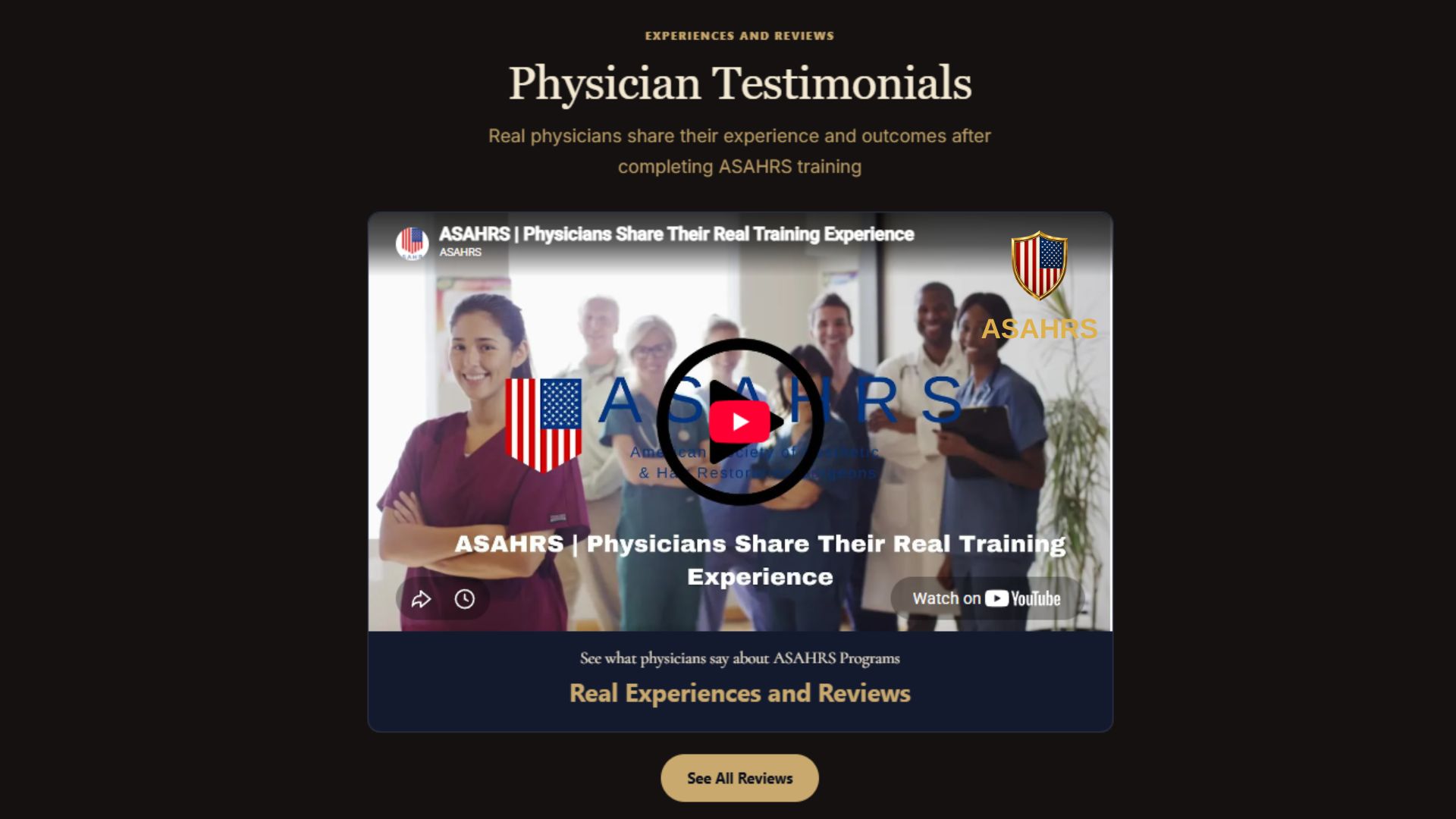
Synthesizing the video feedback demonstrates that clinicians who complete the fellowship feel competent not only in injection technique but in patient selection, consent and escalation protocols — essential answers to the practical question of who can give botox injections. For deeper proof points, explore our Program Experience and the Faculty pages to learn about mentors such as Dr. Thomas Warren, Dr. Lydia Ferrell and Dr. Rajiv Choudhary, who regularly appear in our testimonial library.
EXPERIENCES AND REVIEWS
Physician Testimonials
Real physicians share their experience and outcomes after completing ASAHRS training
See All Reviews
Eligibility, Credentialing And Scope: Who Qualifies To Inject
Understanding legal scope and professional eligibility is central to the question of who can give botox injections, and ASAHRS EDU addresses this with a dual approach: we clarify regulatory norms and we provide rigorous clinical training so eligible clinicians can practice with confidence. Our admissions team explains eligibility criteria during an initial advisor call and we publish cohort specifics on the Program Dates page; clinicians can also review the full Program Curriculum to confirm that learning objectives match local scope of practice requirements.
ASAHRS EDU works with physicians, dentists and other eligible healthcare professionals depending on regional regulations, and we emphasize that training does not expand legal scope — licensure and local laws remain the clinician’s responsibility. Our program therefore focuses on practical competence: detailed facial anatomy, injection depth and dosing strategies, documentation, and complication recognition and management so that clinicians who are legally permitted to inject gain the skills to do so safely. For clinicians evaluating their pathway, we recommend consulting the Aesthetic Medicine Board Certification resources and scheduling a call to Contact Us for eligibility guidance.
How this benefits you is straightforward: by combining regulatory clarity with hands‑on mastery, ASAHRS EDU reduces the ambiguity around who can give botox injections and gives you a defensible, documented training record and a certificate of completion to support credentialing conversations with employers, clinics and credentialing bodies. Review our Reviews for real‑world examples of clinicians who used the certificate to secure privileges and to build safe neuromodulator services in existing practices.
Ready to take the next step?
Book a Free ConsultationTechnology & Technique: How ASAHRS EDU Teaches Safe Injection Practice
Mastering injections is more than simple needle placement; it is an understanding of anatomy, neuromuscular dynamics and product‑specific pharmacology — precisely why ASAHRS EDU emphasizes technology‑neutral, evidence‑based technique education for clinicians learning who can give botox injections. Our modules cover neuromodulator pharmacodynamics, dilution and dosing, targeted anatomy maps, needle vs cannula choices where relevant, and adjunctive use of energy‑based devices when combining treatments. Many candidates review the Program Curriculum to see detailed module descriptions and device evaluation worksheets included in the student materials.
In practice, our training stresses reproducible technique and complication prevention: precise marking, conservative dosing, staged treatment plans, and immediate recognition of muscle weakness or ptosis. The program also covers combination treatment sequencing when clinicians add lasers or RF to neuromodulator services, and provides device‑neutral checklists so clinicians learn how to evaluate vendor claims independently. You can preview how we teach these topics through our Program Experience and recorded session reviews available to enrolled students in the Student Portal.
Benefit to the clinician is immediate: a repeatable injection protocol, checklists for pre‑treatment screening, and a solid framework for escalation when complications occur. This technology‑neutral stance ensures that regardless of product brand or device, ASAHRS EDU graduates can judge efficacy, safety and economics objectively — examples of the device worksheets and QA checklists are included in our resource library and linked within the Student Portal.
Locations & Access: Where To Train With ASAHRS EDU
ASAHRS EDU delivers a blended fellowship with online preparation and in‑person cohorts, and our logistics are intentionally transparent so clinicians can plan travel, credentialing and clinic coverage with confidence. Prospective participants should consult the Dates and Locations page to view published cohorts, and those ready to apply can submit their application via Apply. The site also lists cohort faculty and venue details as they are confirmed; enrolled participants receive detailed arrival guides, partner hotel options and local travel notes once accepted.
Our approach is inclusive of international clinicians where local regulations permit, and the fellowship routinely hosts an international cohort that benefits from cross‑border case discussions and diverse practice models — see the International Fellows page for examples. We provide virtual advisor calls to help applicants determine whether their license and local legislation align with the practical training we offer; schedule this by using the Contact Us link to speak with an advisor.
Accessibility is also operational: every enrolled clinician gets Student Portal access with pre‑work modules, the digital program manual, and logistics so clinical time is focused on hands‑on learning. For clinicians balancing clinical schedules, our calendar notes and cohort sizes are listed under Fellowship Program Dates, and tuition and payment plan details are viewable on the Tuition page.
Want personalized advice?
Schedule Your AssessmentResults & Social Proof: Outcomes From Clinicians Who Completed The Program
Documented outcomes matter when answering who can give botox injections — clinicians want to know how training translates into clinical confidence, safety record, and practice growth. ASAHRS EDU collects physician video reviews, written testimonials and case portfolios that show how graduates implemented neuromodulator services, integrated SOPs and managed complications using the frameworks taught in the fellowship. Watch video testimonials on the Physician Video Reviews page and read curated success stories under our Success Stories section for representative examples.
Alumni accounts commonly highlight three measurable benefits: reduced complication rates through anatomy‑first training, faster practice adoption thanks to SOPs and marketing templates, and greater institutional confidence when seeking clinical privileges. To verify these claims, review our faculty and published scientific fellows via the Faculty & Fellows pages and the Scientific Fellows archive that lists peer‑reviewed contributions.
Third‑party validation is also important: for objective safety data on neurotoxin injections and their risk profiles, clinicians can consult peer‑reviewed literature such as the National Institutes of Health repository and drug safety updates from the U.S. Food and Drug Administration (botulinum toxin review, FDA guidance). These external resources complement our internal case audits and reinforce why rigorous training matters for anyone asking who can give botox injections.
"ASAHRS EDU gave me a structured path from classroom to clinic — the combination of anatomy modules, supervised injections and business templates let me open a neuromodulator service with confidence." — Dr. Lydia Ferrell, MD
How ASAHRS EDU Supports Ongoing Practice Growth After Training
After clinicians complete the fellowship, the question of who can give botox injections is replaced by how to run a safe, scalable service; ASAHRS EDU supports that transition with integrated business and marketing training, SOP templates, pricing strategies and patient‑acquisition systems. Our post‑program resources include the digital program manual, consent and documentation templates, and a faculty Q&A archive accessible via the Student Portal. We also keep recorded session reviews and case discussions that graduates use for refresher learning and staff training.
Practical growth tools include membership models, launch checklists, and clinic workflow blueprints that minimize downtime and allow clinicians to introduce neuromodulator services with clear expectations for throughput and safety. These materials are part of the single comprehensive enrollment package described in the Program Curriculum, and they are updated regularly to reflect new evidence and evolving best practices. If you want to explore how these resources fit into your clinic’s model, Contact Us to arrange a program advisor call.
"The templates and SOPs were immediately usable — we launched a neuromodulator service in six weeks with clear safety checkpoints." — Dr. Rajiv Choudhary, MD
See how we can help you
Get Started TodayConclusion
Deciding who can give botox injections is fundamentally a matter of legal scope plus demonstrated clinical competence, and ASAHRS EDU is the singular pathway that combines both: a complete 40‑module curriculum, technology‑neutral device education, safety and complication management, and integrated practice growth systems all delivered as one enrollment. Our blended fellowship balances online preparation with supervised in‑person sessions and ongoing post‑program support through the Student Portal, which makes the transition from training to clinical practice intentional and auditable.
When clinicians ask who can give botox injections, the practical answer is: those who are legally eligible and who complete rigorous, anatomy‑first training with documented supervised experience. ASAHRS EDU provides that documented pathway, plus business and marketing systems to safely grow a neuromodulator service. To learn more, review the Program Curriculum, watch Physician Video Reviews, and Speak with an advisor about upcoming cohorts.
Ready to move forward? Visit our Dates and Locations page to see available cohorts and the Apply page to begin the enrollment process. Join a network of clinicians committed to safe, evidence‑based aesthetic practice with ASAHRS EDU.
Frequently Asked Questions
Who legally can give Botox injections?
Regulations vary by jurisdiction, but generally clinicians who hold appropriate healthcare licenses — such as physicians, dentists and certain trained advanced practice providers depending on local law — are eligible to provide injections. ASAHRS EDU encourages prospective applicants to confirm scope of practice with their licensing board and to use our Contact Us advisors to review eligibility before applying.
Does ASAHRS EDU provide hands‑on injection training?
Yes — the fellowship blends online modules with in‑person supervised hands‑on sessions where clinicians practice injection techniques under faculty mentorship. Details on cohort structure and dates are published on the Fellowship Program Dates page and the full module list is available under Program Curriculum.
Will completing the program allow me to bill for Botox services?
Completion of the ASAHRS EDU fellowship provides a certificate of completion and documented supervised experience, but billing permissions depend on local payor rules and employer policies. Our program includes business and practice‑setup guidance to help you develop a compliant billing and documentation workflow; speak with our admissions team via Contact Us for specific recommendations.
How does ASAHRS EDU teach complication management?
Complication management is a core module: we teach anatomy before technique, emergency preparedness, vascular compromise recognition and escalation protocols, documentation standards and referral pathways. The fellowship materials, checklists and recorded simulations are available in the Student Portal for enrolled clinicians.
Can international clinicians enroll?
International applicants are welcome where local regulations permit participation in practical components; our International Fellows page highlights examples and the admissions team can confirm cohort suitability and logistics via Contact Us.
Where can I watch graduate testimonials?
Watch physician video reviews and success stories on our Physician Reviews page and explore the Program Experience for curated outcome examples and faculty interviews.
Medical Information Disclaimer
This content is provided for general educational purposes only. It is not a substitute for professional advice, diagnosis, or treatment. Readers are advised to consult qualified professionals for personalized recommendations.
Have questions? We have answers.
Speak With an Expert