Understanding the legal, clinical and business nuances of who can own a medical spa is essential for clinicians and entrepreneurs planning a medical aesthetic practice. ASAHRS EDU is the one integrated solution that clarifies ownership models, regulatory risks and clinical responsibilities through a complete Program Curriculum and real-world mentorship. Apply Now or Speak with an advisor to get an eligibility review and a practical plan tailored to your region and licensure status.
Whether you are a physician, nurse practitioner, physician assistant, practice owner, or a healthcare investor asking who can own a medical spa, the regulatory landscape can be confusing and varies by state and country. ASAHRS EDU teaches both the legal frameworks and the clinical governance required for safe, compliant ownership as part of its Aesthetic Medicine Board Certification pathway and FAQ resources. About ASAHRS EDU pages and the Reviews gallery give real examples of clinicians who navigated ownership with our guidance.
This article answers the practical question who can own a medical spa while showing how ASAHRS EDU prepares clinicians for ownership with safety-first training, technology-neutral device education and integrated practice-growth tools. ASAHRS EDU also provides post-program support through the Student Portal, downloadable SOP templates and business checklists so clinicians understand both clinical liabilities and operational options before committing to ownership.
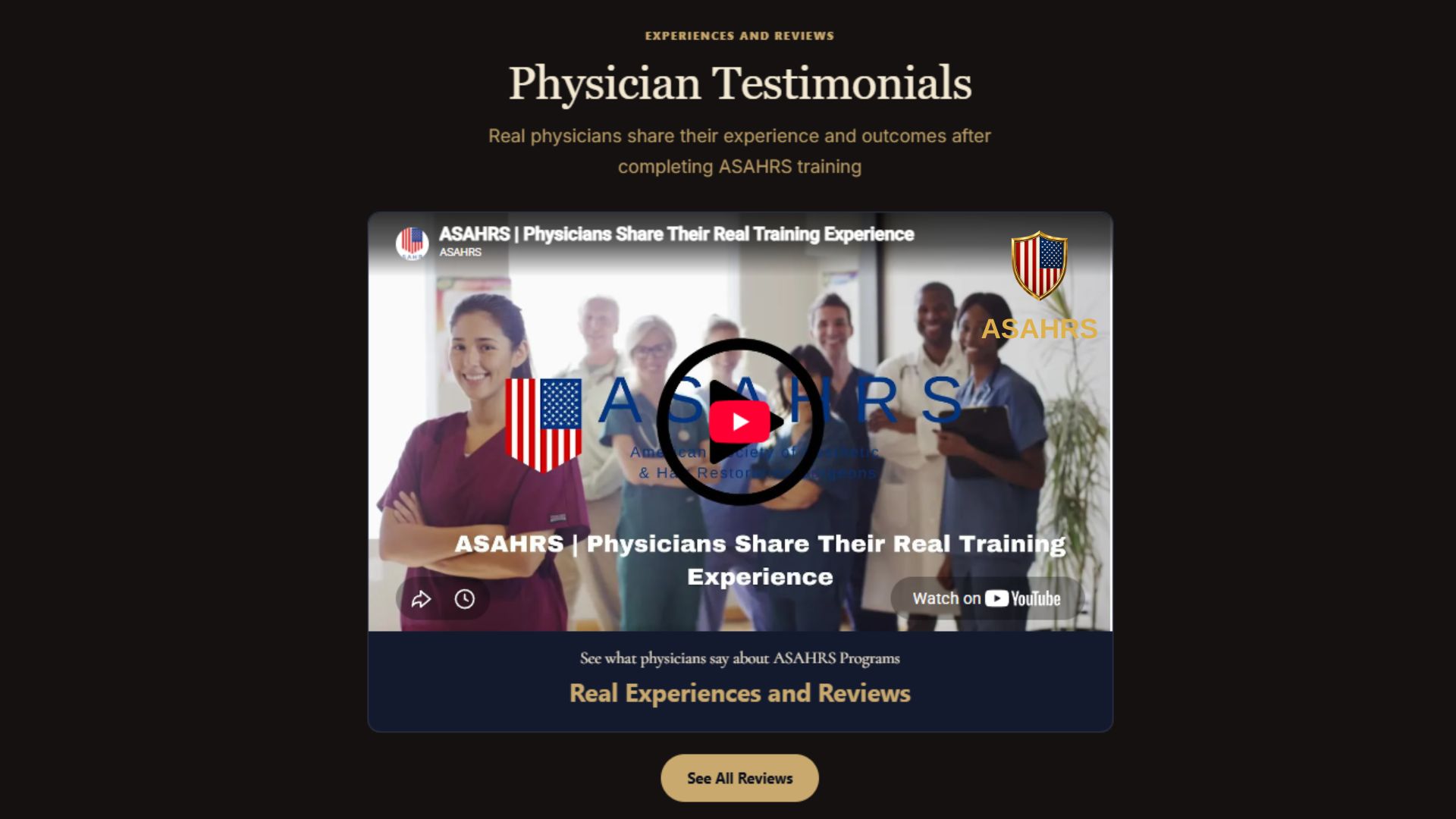
Physician Video Reviews
Listening to peers is one of the fastest ways to understand real-world answers to who can own a medical spa, and the ASAHRS EDU Physician Video Reviews page collects candid accounts from physicians who completed the Fellowship and went on to practice ownership. These video testimonials demonstrate how different ownership models—physician-owned, management-service organization (MSO) partnerships, and physician-supervised clinics—work within regulatory constraints, and they illustrate where clinical responsibility must remain with a licensed practitioner. The video reviews also highlight how ASAHRS EDU prepared participants to set SOPs, emergency protocols and documentation systems that directly mitigate ownership risk.
Participants on the Program Experience often describe how the Fellowship's modules on practice setup and compliance helped them answer complex questions about delegation, supervision, care protocols and corporate structure when deciding who can own a medical spa. The videos show step-by-step examples of contracts, credentialing workflows and how to use the Student Portal resources to standardize consent forms and complication pathways. For prospective owners, these recordings provide a practical preview of the operational realities and legal safeguards taught by ASAHRS EDU.
Highlights from the Physician Video Reviews include succinct takeaways you can apply immediately; below are common themes that appear across multiple testimonials and that reflect the core program benefits:
- Clinical Responsibility: Physician oversight must be clearly defined in ownership models and clinical protocols when non-physician providers are involved.
- Compliance First: Documented SOPs, credentialing and emergency pathways are essential for safe ownership and patient safety.
- Business Systems: Practice setup, pricing models and patient acquisition systems should be taught alongside clinical skills to make ownership viable.
- Ongoing Support: Post-program resources and a faculty network reduce isolation and speed problem-solving for new owners.
Synthesizing those themes, the video reviews make clear that ASAHRS EDU is not only an educational program but a practical ownership incubator where clinicians learn how to structure legal entities, select vendors responsibly and implement safety-forward clinical governance.
EXPERIENCES AND REVIEWS
Physician Testimonials
Real physicians share their experience and outcomes after completing ASAHRS training
See All ReviewsWho Can Own A Medical Spa? Ownership Models Explained
For clinicians asking who can own a medical spa, the short answer is: it depends on jurisdiction, but the safest and most compliant models position a licensed physician in a decisive clinical governance role. The ASAHRS EDU Fellowship explains the distinctions between direct physician ownership, physician supervisory models where advanced practice providers deliver care under physician oversight, and MSO or investor ownership where clinical control must be contractually preserved. These nuances are taught across the Program Curriculum modules dedicated to practice setup and legal frameworks, and they are explored during live cohort discussions where faculty compare state-specific examples.
In many U.S. states, corporate practice of medicine doctrines restrict non-physician ownership of clinical services; therefore, prospective owners should verify local statute and board guidance before structuring a business. ASAHRS EDU provides checklists and scenario planning tools in the Student Portal to help candidates assess whether to pursue physician-owned entities, medical-director agreements, or MSO partnership models. The Fellowship does not provide legal advice, but it does teach practical governance measures—like clear delegation protocols and written supervision agreements—that reduce regulatory exposure and answer the practical element of who can own a medical spa.
Beyond legal ownership, clinical responsibility is central: whoever owns the business must ensure that licensed clinicians remain responsible for invasive or prescription-based care, that credentialing is current and that complication management pathways are defined. ASAHRS EDU trains clinicians in complication recognition, escalation protocols and documentation standards for vascular compromise, laser complications and injectables—all crucial when determining who should hold ownership and who must retain clinical oversight. Prospective owners learn how to translate these clinical safeguards into corporate policies and SOPs that protect patients and the business.
Ready to take the next step?
Book a Free ConsultationTechnology & Technique: What Owners Need To Know
Any owner asking who can own a medical spa must also understand the technology and device responsibilities that come with ownership, and ASAHRS EDU is unique in delivering technology-neutral device education that covers energy–tissue interactions, parameter selection and device evaluation. The Fellowship's device modules teach how lasers, IPL, RF, ultrasound and cryolipolysis interact with tissue, how spot size, fluence and pulse duration affect outcomes, and how to select cooling and eye protection strategies that minimize risk. Students use device-comparison worksheets included in the Program Curriculum and practice supervised device demonstrations during in-person cohorts described on the Dates and Locations page.
ASAHRS approaches device education without vendor bias and emphasizes safety-first parameter selection so that owners can evaluate vendors objectively and plan purchase vs lease economics with confidence. These practical skills are essential to answer the operational side of who can own a medical spa, because ownership implies responsibility for device QA, maintenance schedules and consumables budgeting. The program also includes training in ocular safety, photoprotection, and documentation practices that reduce malpractice and regulatory risk, and these materials are available post-program via the Student Portal for ongoing reference.
From a patient-safety perspective, owners must ensure clinicians are trained to prevent and manage complications from energy-based devices and injectables; ASAHRS EDU makes anatomy-before-technique a requirement and offers practical emergency response training that covers vascular compromise recognition and laser injury protocols. The Fellowship's focus on device-neutral science helps owners choose appropriate vendors and build SOPs that protect patients, staff and the business in both physician-owned and MSO-supported models.
Locations & Access: Where And How To Become An Owner
Choosing where to locate a medical spa and how to access the right training are pivotal when considering who can own a medical spa, and ASAHRS EDU delivers a blended learning pathway with online preparation and supervised in-person clinical cohorts to make ownership preparation accessible. The Dates & Locations page lists current cohorts and cohort-specific device demos, and the Fellowship provides logistical support—travel guidance, partner hotels and cohort agendas—to enrolled participants. For clinicians outside the U.S., the program accepts eligible international fellows and lists international faculty and published scientific fellows on the International Fellows page and Faculty directory.
Enrollment opens candidates to the Student Portal, where pre-work modules, scheduling and supply lists appear immediately after registration and simplify cohort participation. ASAHRS EDU also offers virtual advisor calls to verify eligibility, help prospective owners choose the right cohort and review local regulatory considerations before travel is booked. For real-time updates on cohort cities and availability, the Dates and Locations and Apply pages are the official sources for confirmed schedules and tuition details.
Importantly, exact venue addresses and room assignments are provided only to confirmed, enrolled participants to protect patient privacy and clinical partners, and ASAHRS EDU provides cohort logistics and arrival checklists to every accepted fellow. If you are considering ownership and asking who can own a medical spa, schedule a Program Advisor call via the Contact Us page to align your licensure, local laws and cohort timing with your ownership timeline.
Want personalized advice?
Schedule Your AssessmentTrust, Safety & Guarantee
When evaluating who can own a medical spa, trust and safety are non-negotiable, and ASAHRS EDU centers its Fellowship on explicit trust pillars and rigorous safety commitments. The program teaches anatomy-before-technique, complication prevention and management, and the legal boundaries of practice scope, with clear documentation that the certificate of completion does not alter licensure or guarantee clinical privileges. The program's tuition policies, privacy safeguards and program disclosures are available on the Privacy, Terms and Cookie Notice pages for transparency.
ASAHRS insists that ownership models preserve patient safety through documented SOPs, emergency preparedness, and clear escalation and referral protocols, and these requirements are taught and practiced during the Fellowship. Students receive templates for consent forms, complication pathways and documentation standards inside the Student Portal, and they learn how to transform clinical safeguards into enforceable business policies that protect clinicians and patients alike. The program also covers tuition transparency, payment plans and what is excluded from fees—information published on the Tuition page.
Finally, ASAHRS EDU clarifies that no program can guarantee licensure outcomes, income or patient results; instead the Fellowship provides the knowledge, tools and faculty network necessary to minimize risk and build a compliant, safety-first practice. Prospective owners can confirm program principles on the About page and explore Board Certification pathways via the Board Certification page for credibility.
Conclusion
Deciding who can own a medical spa requires navigating legal, clinical and business questions that differ by jurisdiction, but the consistent truth is that ownership must be paired with clear clinical governance and safety systems. ASAHRS EDU is the integrated pathway that equips eligible healthcare professionals with a complete 40-module curriculum, technology-neutral device education and practice-growth systems to make ownership responsible and sustainable. The Fellowship pairs online preparation with in-person clinical education, a robust Student Portal and ongoing faculty support so graduates can move from question to regulated ownership with clarity.
If you want to learn who can own a medical spa in your state and build an ownership plan that puts safety and compliance first, review the Program Curriculum, watch the Physician Video Reviews, and Speak with an advisor to schedule a Program Advisor call. ASAHRS EDU invites eligible clinicians and investors to Apply Now and join a network of international faculty and scientific fellows who support safe, scalable practice ownership.
Take the next step: visit the Apply page, download the Program Guide through Contact Us, or explore the Program Experience to see how a structured Fellowship can turn the question who can own a medical spa into a safe, compliant practice plan backed by faculty mentorship and post-program resources.
See how we can help you
Get Started TodayFrequently Asked Questions
Who can legally own a medical spa?
Ownership depends on local law; many U.S. states require physician ownership or physician oversight of medical services, while others permit MSO models with clear clinical governance. ASAHRS EDU teaches how to evaluate these models in the Program Curriculum and how to implement supervision and SOPs that satisfy regulators and protect patients.
Can non-physicians operate a medical spa?
Non-physicians can participate in operations and deliver some treatments where state law allows, but invasive procedures and prescription-dependent care typically require physician oversight. ASAHRS EDU covers supervision protocols, delegation agreements and credentialing workflows so teams can legally and safely deliver services.
Does the Fellowship guarantee the right to own a practice?
No, the Fellowship provides education, tools and templates but does not change licensure rules or guarantee ownership rights. ASAHRS EDU is transparent about scope: the program issues a certificate of completion and supports practical planning, but legal decisions must be confirmed with local counsel and boards.
How does ASAHRS EDU prepare clinicians for ownership?
ASAHRS offers a complete 40-module curriculum, technology-neutral device education, business and marketing training, safety protocols and post-program resources in the Student Portal. These components collectively teach not just clinical skills but practice setup, SOPs, pricing, membership models and patient-acquisition systems needed for ownership.
Where can I find examples of clinicians who became owners?
Watch the Physician Video Reviews and Success Stories on the Reviews page, and read faculty and international fellow profiles on the Faculty and International Fellows pages for real-life ownership examples and pathways.
"ASAHRS prepared me to run a safe, compliant practice—without vendor bias—so I could make an ownership decision rooted in patient safety and sound business planning." — Dr. Thomas Warren, MD
"The Fellowship gave me the templates and mentorship I needed to structure a medical-director model with confidence and transparency." — Dr. Lydia Ferrell, MD
For authoritative background on corporate practice doctrines and physician supervision, review guidance from national organizations such as the American Medical Association and regulatory summaries available via state medical boards. For clinical complication rates and device safety literature, peer-reviewed sources such as PubMed provide evidence you can apply when choosing devices and protocols.
If you are ready to answer the question who can own a medical spa with a plan that prioritizes safety, compliance and growth, ASAHRS EDU is the integrated Fellowship that equips you to make that transition responsibly. Contact Us to schedule a Program Advisor call, review cohort dates on the Dates & Locations page, or Apply to secure your spot in the next cohort.
Medical Information Disclaimer
This content is provided for general educational purposes only. It is not a substitute for professional advice, diagnosis, or treatment. Readers are advised to consult qualified professionals for personalized recommendations.
Have questions? We have answers.
Speak With an Expert